
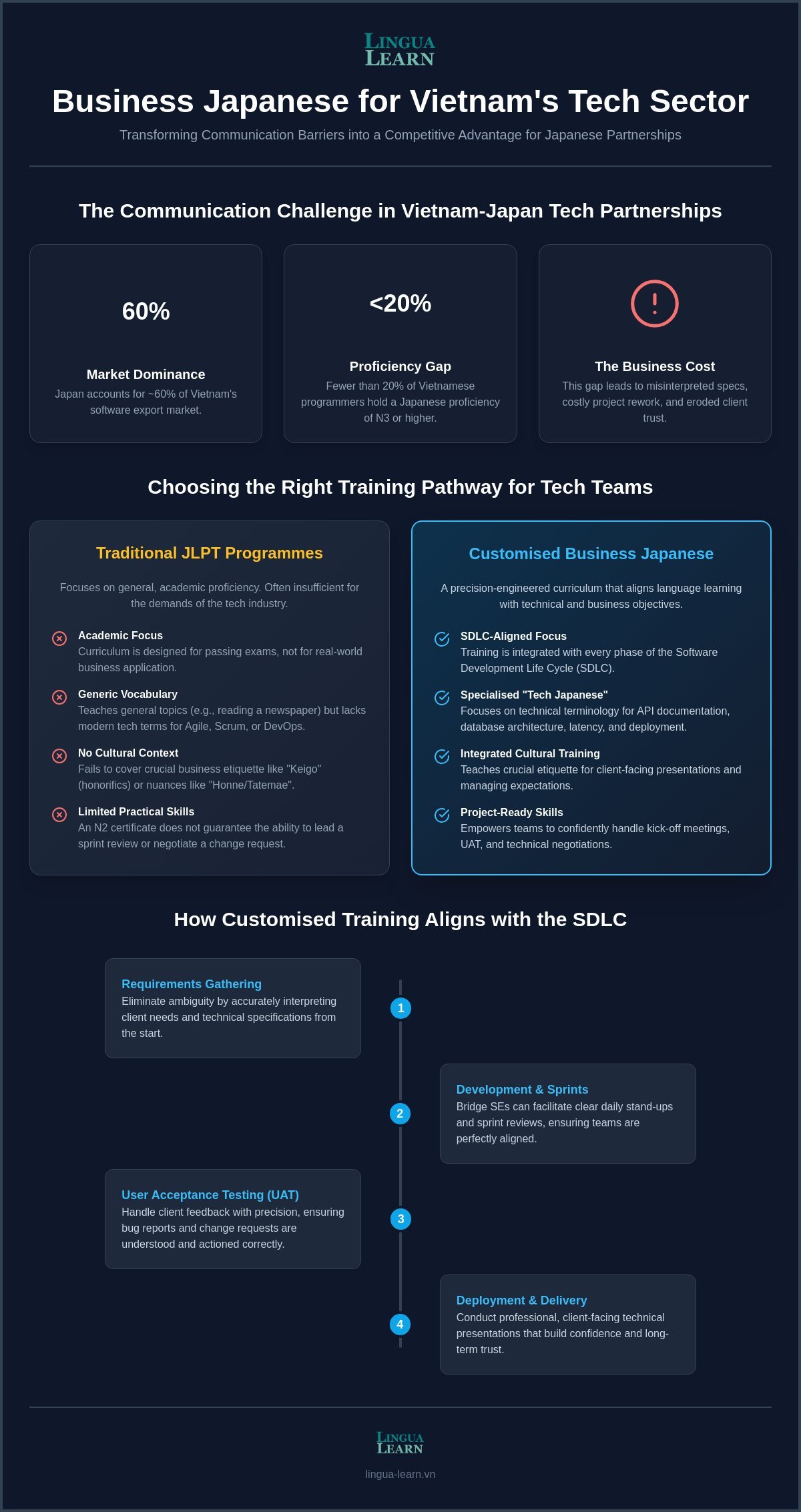
Business Japanese for tech companies in Vietnam has become an essential skill for organisations working with Japanese clients, suppliers and development partners. Did you know that whilst Japan accounts for approximately 60% of Vietnam’s software export market, only around 20% of Vietnamese programmers possess a Japanese proficiency of N3 or higher? This significant gap often leads to misinterpreted technical specifications and costly project rework that drains your resources. It’s a common challenge for firms where even Bridge SEs with JLPT N2 certifications may struggle to negotiate or manage high-stakes client meetings effectively. This 2026 case study reveals how specialised business Japanese for tech companies in Vietnam can transform these communication barriers into a strategic competitive advantage.
We understand the frustration of seeing talented developers feel overwhelmed by language barriers, which often leads to high staff turnover. In this article, you’ll discover how tailored Japanese language programmes bridge the communication gap between Vietnamese tech talent and Japanese stakeholders to drive project success. We’ll explore a scalable way to upskill your technical teams online, ensuring faster project delivery and higher client satisfaction scores through clearer, more professional communication that respects the nuances of the Japanese workplace.
Vietnam has firmly established itself as the primary hub for Japanese offshore development in 2026. This growth is underpinned by a comprehensive strategic partnership that has turned the country into a digital powerhouse for Japanese stakeholders. However, this rapid expansion has exposed a significant operational weakness. The Bridge Software Engineer (BrSE) role, intended to be the vital link between technical teams in Ho Chi Minh City and project managers in Tokyo, is often the most vulnerable point in the chain. It’s a role that requires more than just a passing grade in a language exam; it demands a deep understanding of how Japanese business culture interacts with modern software engineering.
Many partnerships struggle because general fluency doesn’t always translate to technical precision. Misunderstandings often stem from the cultural nuance of “Honne” (true feelings) versus “Tatemae” (public facade). In a professional setting, this can lead to ambiguous requirements being accepted without necessary clarification to avoid conflict. When these social subtleties collide with complex technical specifications, the result is inevitably rework. This is why forward-thinking firms are moving away from generic tutoring. They’re now investing in business Japanese for tech companies in Vietnam to ensure their teams can navigate both the code and the culture with total confidence.
Relying solely on JLPT levels is a common mistake for hiring managers. Whilst an N2 certificate proves a developer can read a newspaper or understand a lecture, it doesn’t guarantee they can lead a high-pressure sprint review or negotiate a complex change request. Academic Japanese often lacks the modern, specialised vocabulary required for Agile, Scrum, and DevOps environments. A developer might know the kanji for “efficiency” but fail to explain why a specific microservices architecture will cause latency during a live deployment. True proficiency in this sector requires a curriculum that mirrors the real-world Software Development Life Cycle (SDLC).
The financial consequences of a “lost in translation” moment are steep. When a technical specification is misinterpreted, the cost of rework isn’t just measured in developer hours. It’s measured in delayed market entry and eroded client trust. In a competitive market, a single failed delivery can end a multi-year contract. Strategic corporate staff language development acts as a vital risk-mitigation strategy. By upskilling teams in business Japanese for tech companies in Vietnam, organisations protect their margins and build the long-term credibility needed to move from simple outsourcing to high-value co-creation.
Customised training isn’t just about learning to say “hello” in a boardroom. It’s a precision-engineered curriculum that blends high-level technical terminology with the nuanced etiquette required in Japanese corporate culture. Given the soaring demand for Japanese-speaking manpower in the region, tech firms are realising that generic language apps simply can’t bridge the gap. Instead, effective business Japanese for tech companies in Vietnam focuses on the entire Software Development Life Cycle (SDLC). This ensures that every phase, from the initial kick-off meeting and requirements gathering through to User Acceptance Testing (UAT), is handled with linguistic accuracy.
This approach ensures that developers don’t just speak Japanese; they speak “Tech Japanese.” It involves mastering “Keigo” (honorifics) specifically for client-facing technical presentations where professional distance and respect are paramount. It also prioritises cross-cultural training to help Vietnamese teams manage Japanese client expectations. These expectations often revolve around meticulous documentation and proactive communication, which can differ significantly from domestic standards. By understanding these cultural pillars, your team can avoid the friction that often plagues international collaborations.
It’s time to move beyond basic greetings. A tailored programme enables developers to discuss API documentation, database architecture, and complex system requirements with precision. Training should involve real-world scenarios like conducting code reviews, reporting critical bugs, and negotiating deadlines under pressure. For firms working in specialised sectors, such as FinTech, AI, or Automotive software, the vocabulary can be further refined. This includes industry-specific jargon that builds immediate credibility with stakeholders. When a developer can explain a “memory leak” or “concurrency issue” in natural-sounding Japanese, it instantly elevates the client’s trust in the technical team’s ability.
Technical skill alone won’t secure a long-term partnership. Understanding “Hou-Ren-So” (Report, Inform, Consult) is vital, especially in a remote or hybrid development environment where visibility is key to building trust. Mastering the “Aisatsu” (greetings) in virtual meetings sets a professional tone from the first second. Perhaps most importantly, teams learn the delicate art of saying “no” or flagging a potential delay without damaging the relationship. It’s about providing solutions and alternatives whilst maintaining the harmony expected by Japanese partners. This level of cultural fluency is what separates a vendor from a true strategic partner. If your team needs to improve their communication flow, you can speak with our consultants about a organised training plan.
For years, the Japanese Language Proficiency Test (JLPT) has been the gold standard for measuring fluency. However, tech leaders in Vietnam are increasingly finding that a certificate on a CV doesn’t always translate to success in a code review or a client negotiation. While the JLPT provides a solid academic foundation, it’s essentially a passive assessment of grammar and vocabulary. In contrast, results-oriented corporate training focuses on active production and professional application. This shift is why many tech companies are moving away from generic language schools in favour of business Japanese for tech companies in Vietnam that prioritises immediate workplace utility.
Customised programmes utilise CEFR-aligned assessments to provide a more accurate picture of what a developer can actually do. Instead of a broad “N2” ranking, these assessments measure specific competencies, such as the ability to explain a technical roadblock or present a project timeline. This granular data allows HR managers to make informed decisions about project staffing. Furthermore, tailored training significantly accelerates the onboarding of junior developers. By focusing only on the language they’ll use daily, new hires can contribute to Japanese projects weeks earlier than those enrolled in traditional, broad-spectrum courses.
True proficiency is found in the gaps that standardised tests ignore. We recommend using technical pre-assessments to identify exactly where a developer’s speaking skills might falter during a sprint. Interestingly, the same business English training for HR models that have proven successful in the global tech sector are now being applied to Japanese. This approach replaces one-off annual exams with continuous feedback loops. By monitoring progress in real-time, companies can adjust the training focus as project requirements evolve, ensuring the team’s skills remain sharp and relevant.
The 24/7 nature of modern tech operations makes traditional classroom settings impractical. Virtual classrooms have become the preferred choice for agile teams because they offer the flexibility needed to balance learning with deployment schedules. Online delivery allows developers to join sessions from anywhere, eliminating travel time and maximising productive coding hours. Recorded sessions are particularly valuable for teams working across different time zones or those who need to revisit complex technical explanations. This digital-first approach ensures that high-quality training is accessible without disrupting the momentum of your development cycles.
Implementing a programme for business Japanese for tech companies in Vietnam requires a structured approach to ensure it doesn’t just end up as a box-ticking exercise. To see real results, the training must be deeply integrated into the team’s daily workflows. We recommend a five-step framework designed specifically for the high-pressure environment of software development.
The biggest hurdle for any technical lead is finding time for training without delaying a release. The solution lies in scheduling short, high-impact sessions that fit naturally into a developer’s day. By focusing on “Micro-learning,” teams can consume accessible digital materials in bite-sized chunks during breaks or between tasks. This method is far more effective than traditional marathon sessions that lead to cognitive fatigue. Using cross-cultural training for remote teams also plays a vital role in streamlining collaboration. It helps developers understand the “why” behind Japanese communication styles, which ultimately saves time during project negotiations.
To justify the investment, you must be able to demonstrate a clear return. Modern HR dashboards allow managers to monitor attendance and engagement in real-time, providing a data-driven view of the programme’s health. You should correlate language progress directly with project delivery milestones. For example, as a team’s proficiency in technical Japanese improves, you should notice a corresponding decrease in the time spent on requirement clarification phases. Final reports that highlight these correlations are essential for securing long-term stakeholder buy-in and establishing the programme as a core part of your company’s growth strategy.
Lingua Learn Vietnam has refined a UK-standard approach to delivering business Japanese for tech companies in Vietnam. Our system is managed from the UK, ensuring that technology and quality standards meet global expectations for excellence. We utilise a structured 8-Step Learning Pathway that begins with a comprehensive pre-assessment and concludes with a personalised Student Action Plan. This plan is a vital tool for developers, as it helps them apply their new skills immediately in stand-up meetings or client presentations, ensuring that no time is wasted in the learning process.
Our native-speaking instructors aren’t just language experts; they’re trained in professional tech terminology. They understand the nuances of the Software Development Life Cycle, which allows for more relevant and practical practice sessions. For corporate clients, data security is a priority. Our virtual classrooms require no downloads, providing a secure environment that protects your company’s internal data whilst remaining easy for busy developers to access from any location. This combination of technical expertise and secure delivery makes our programme the preferred choice for firms handling sensitive Japanese projects.
We’ve built a reputation for designing customised business language training for IT firms looking to scale their Japanese operations. In a recent project, we worked with a large outsourcing firm to improve the communication effectiveness of their Bridge SEs. By shifting the focus to high-stakes negotiation and technical reporting, the team improved their delivery speed and client satisfaction scores. Our integrated HR dashboard provides the transparency managers need, offering real-time data on attendance and engagement to ensure the training investment is delivering measurable results.
We understand that developers have tight schedules and need low-friction solutions. Our single-click invitation system allows professionals to join their virtual classrooms without any technical hurdles or software installations. These online Japanese courses prioritise workplace fluency over academic theory, ensuring your team is ready for the demands of the 2026 market. If you’re ready to empower your technical talent and improve your partnerships with Japanese stakeholders, get in touch today. We’d be delighted to conduct a bespoke corporate needs analysis for your team to identify your specific communication gaps. To discover how we can support your growth, enquire about courses with Lingua Learn Vietnam.
The evolution of Vietnam’s tech sector as a strategic partner for Japan requires a shift from passive language learning to active, technical communication. By aligning your team’s training with the Software Development Life Cycle, you ensure that every sprint review and client meeting is conducted with professional precision. Moving beyond the academic constraints of the JLPT allows your developers to master the specific vocabulary and business etiquette necessary for long-term project success and deep client trust.
Implementing a programme for business Japanese for tech companies in Vietnam is an investment in your company’s operational resilience and global credibility. With our UK-managed technology standards and a CEFR-aligned curriculum, your team receives training that meets the highest international benchmarks. You can maintain full visibility of their progress through a dedicated HR dashboard for real-time reporting, ensuring that every training session translates into tangible workplace results. This structured approach empowers your developers to navigate complex technical negotiations with confidence whilst maintaining cultural harmony.
We look forward to helping your organisation unlock its full potential and secure its future as a leader in the Japanese tech market.
Most developers begin applying specific technical vocabulary and business etiquette within the first few weeks of training. Because the curriculum focuses on immediate workplace application, such as daily stand-ups or bug reporting, the impact is visible long before the full course concludes. Our structured 8-step pathway ensures that every session contributes directly to improved project communication, allowing your team to build confidence during real-world interactions with Japanese stakeholders.
Online training is often more effective for tech teams because it mirrors the digital environment where developers already collaborate. Virtual classrooms allow for recorded sessions, which developers can revisit to clarify technical explanations. This flexibility is essential for business Japanese for tech companies in Vietnam, as it allows learning to occur without disrupting tight deployment cycles or requiring travel to a physical centre. It provides a modern, interactive experience that fits the professional lifestyle.
We can fully customise our training modules to include industry-specific terminology for sectors like Fintech, AI, or Automotive software. This tailored approach is a core part of effective business Japanese for tech companies in Vietnam, as it ensures your developers use the right jargon for their niche. Our native-speaking instructors integrate your specific project requirements into the lessons, allowing for immediate workplace application and enhanced credibility with your Japanese partners.
We use a dedicated HR dashboard that provides real-time data on employee attendance, engagement, and assessment scores. Progress is measured against CEFR-aligned benchmarks through regular assessments conducted throughout the programme. At the end of the training, each student receives a Student Action Plan that highlights their achievements and provides a roadmap for continued linguistic growth. This data-driven approach ensures that HR teams have full transparency regarding their training investment.
The primary difference is that the JLPT N2 assesses general academic knowledge, whilst our course focuses on active professional production within a technical context. Many N2 certificate holders can read complex texts but struggle to lead a sprint review or negotiate a project deadline. Our training bridges this gap by prioritising the specific communication skills needed throughout the Software Development Life Cycle, focusing on output and professional etiquette rather than just passive comprehension.
Yes, we offer cross-cultural communication training designed to help Japanese managers collaborate more effectively with their Vietnamese counterparts. These sessions focus on understanding local work cultures and communication styles, which are vital for long-term project success. This dual approach ensures that both sides of the partnership have the tools to build trust and maintain a productive working relationship without the friction caused by cultural misunderstandings.
Our virtual classroom is a secure, no-download platform that requires only a standard web browser and a stable internet connection. This setup prioritises corporate data security and ease of access for your employees. Developers can join their sessions with a single-click invitation, making it a low-friction solution that integrates seamlessly into a busy professional schedule without needing to install external software or navigate complex technical hurdles.

Article by
Rob Holloway
Rob Holloway is the CEO of Lingua Learn Elevate Ltd (UK), the company that operates Lingua Learn Vietnam. He works with businesses and organisations across Asia to provide high-quality online language training, corporate communication programmes, and preparation for internationally recognised language certification. Working with organisations across industries including engineering, finance, technology, manufacturing, and professional services, Rob helps identify language training needs and connects clients with tailored learning solutions delivered by Lingua Learn’s experienced academic team. His professional focus includes corporate language training, business communication, cross-cultural communication, international education partnerships, and helping organisations build the language skills needed to succeed in global business environments. Through Lingua Learn Vietnam, Rob is committed to providing UK-managed online language training delivered by qualified instructors, helping professionals and organisations communicate with confidence in today’s international workplace.
 Vietnamese
  English (UK)