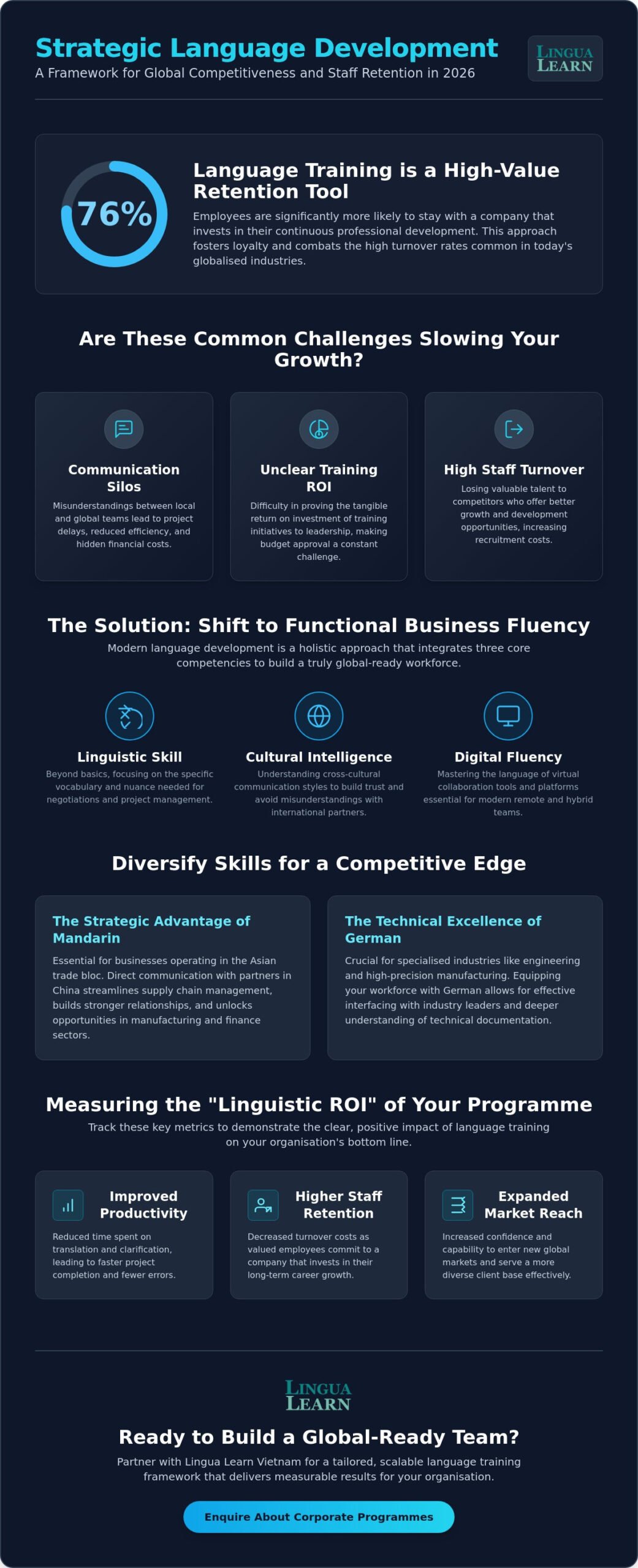
Did you know that 76% of employees are more likely to stay with a company that offers continuous training? In an increasingly mobile job market, your approach to corporate staff language development is no longer a secondary concern; it is a vital pillar of your retention strategy. At Lingua Learn Vietnam, we’ve observed that the most resilient organisations are those that treat communication as a core competency rather than an optional extra.
You probably recognise the specific frustration of communication silos between local teams and global headquarters, or the difficulty of proving the tangible ROI of your training initiatives. It’s exhausting to manage high staff turnover in sectors where talent is always looking for the next growth opportunity. This guide explores how to transform your workforce through strategic language training that drives both global competitiveness and employee loyalty. We’ll outline a clear framework for professional development that improves cross-border collaboration and provides the measurable outcomes your leadership team demands for 2026.
Effective corporate staff language development has moved far beyond the traditional confines of vocabulary drills and grammar worksheets. In the 2026 market, it is defined as a holistic approach to professional communication that integrates linguistic skill with cultural intelligence and digital fluency. This shift reflects a move from basic literacy to functional business fluency. Companies no longer require staff who can simply “get by” in a second language; they need professionals who can lead negotiations, manage complex projects, and represent the brand with confidence on a global stage.
For many organisations, establishing a clear Corporate language policy is the first step toward removing the “glass ceiling” that often restricts local talent. In Vietnam, highly skilled managers frequently find their career progression stalled, not because of a lack of technical expertise, but because they lack the linguistic nuance required for senior global leadership roles. By investing in đào tạo ngôn ngữ, businesses empower their best people to step into international positions, fostering a truly inclusive culture where ideas are valued regardless of an employee’s native tongue.
Language gaps are often the hidden culprits behind project delays and evaporated margins. When a technical specification is misunderstood or a subtle cue in a negotiation is missed, the financial repercussions can be staggering. Beyond the balance sheet, these barriers have a profound psychological impact. Employees who struggle to express themselves often retreat into silence, leading to a “translation-reliant” workflow that is slow and prone to error. Transitioning to a “direct-communication” model allows for real-time problem solving and boosts workplace confidence, ensuring that your team’s best insights aren’t lost in translation.
Modern professionals in Vietnam’s competitive sectors prioritise personal growth as much as salary. Providing bespoke professional development pathways makes an employee feel seen and valued. From a management perspective, the cost-benefit analysis is clear. Training existing staff who already understand your company’s internal culture is significantly more efficient than the expensive, time-consuming process of recruiting new bilingual talent. At Lingua Learn Vietnam, we’ve seen how these programmes create a deep sense of loyalty. When an organisation invests in a staff member’s long-term capability, that individual is far more likely to commit their future to the firm, directly combatting the high turnover rates seen in globalised industries.
While English remains a foundational requirement, relying solely on a single language creates a strategic bottleneck. A forward-thinking approach to corporate staff language development involves identifying the specific linguistic keys that unlock high-growth markets. By diversifying the skills of your workforce, your company gains the agility to pivot into new territories with minimal friction, turning communication into a competitive advantage rather than a hurdle. This diversification isn’t just about expansion; it’s about building a resilient team capable of navigating the complexities of the 2026 trade landscape.
Mandarin is no longer just an “extra” skill; it’s becoming essential for any business operating within the Asian trade bloc. For companies in manufacturing or finance, the ability to communicate directly with partners in mainland China or Taiwan streamlines supply chain management and builds trust. Many professionals are intimidated by the perceived difficulty of the language, yet structured, live tutor support can demystify the process. At Lingua Learn Vietnam, we provide online Mandarin courses tailored to professional contexts, ensuring your team learns the vocabulary they actually need on the factory floor or in the boardroom.
In specialised industries like engineering, German remains the language of technical excellence. Equipping your national workforce with German skills allows them to interface more effectively with high-precision equipment and European technical standards. Similarly, French training acts as a gateway to both European markets and emerging economies in West Africa. In these technical fields, general language courses often fall short. Success requires a focus on specialised terminology that reflects the daily realities of the industry. If you are unsure which language will best serve your 2026 expansion goals, you can speak with our consultants to design a custom curriculum.
Offering diverse language options like Tiếng Đức or Spanish also enhances your recruitment efforts. Modern staff value flexible benefits that contribute to their long-term career capital. By providing a choice of languages, you demonstrate a commitment to individual growth that resonates far more than a one-size-fits-all training programme. This variety ensures that your corporate staff language development strategy remains inclusive and adaptable to the evolving needs of your employees and the global market.
Justifying a learning and development budget requires more than just positive feedback from participants. HR leaders need a framework that translates linguistic progress into financial impact. This is where the concept of “Linguistic ROI” becomes essential. It focuses on three core pillars: productivity, retention, and market reach. By viewing corporate staff language development through this lens, organisations can move away from vague metrics and towards data-driven business outcomes. One immediate benefit is the reduction in reliance on external agencies. When your internal teams possess the fluency to handle negotiations or technical documentation, the need for expensive third-party translation and interpretation services diminishes.
Tracking this progress is most effective when linked to real-world application. Certified assessments provide a baseline, but the true measure of success lies in how staff use their new skills in daily operations. Linking language milestones to career progression reduces the churn rate significantly. Employees are less likely to leave when they see a clear path from their current role to a more senior position, supported by the company’s investment in their communication skills. This structured approach ensures that training is never seen as a one-off event but as a continuous journey of growth. For HR professionals looking to align these efforts with broader talent strategy, exploring the latest business English training for HR strategic trends for 2026 can provide a valuable framework for building a data-driven case to leadership.
Efficiency often increases as language barriers fall. Meetings that once took two hours due to translation delays or misunderstandings can be completed in half the time when participants speak the same professional language. You can measure time saved in email correspondence and the reduction in error rates within technical documentation. Using pre- and post-training assessments allows you to demonstrate tangible skill growth to stakeholders. At Lingua Learn Vietnam, we recommend using certified frameworks to ensure these metrics are both accurate and globally recognised.
Investing in your current workforce reduces the need for costly executive searches. By empowering local staff to take on regional leadership roles through advanced coaching, you retain institutional knowledge that would otherwise be lost. The “Retention Bonus” is the measurable increase in employee loyalty and tenure that occurs when a company provides consistent, high-value professional development opportunities. Providing these professional pathways ensures that your most talented individuals stay within the organisation rather than seeking growth elsewhere, proving that a robust corporate staff language development strategy is a powerful asset for any modern firm.
Moving from a strategic vision to a functional programme requires a methodical approach. For corporate staff language development to succeed, implementation shouldn’t be haphazard. A logical, five-step roadmap provides the necessary structure: Assessment, Customisation, Implementation, Monitoring, and Evaluation. This cycle ensures that every learner starts at the correct proficiency level and finishes with skills that are directly applicable to their specific job function. By prioritising professional terminology over general conversation, you ensure that your team can handle a technical briefing or a client pitch from day one; to see how these principles are applied in a corporate setting, you can explore Business English Course options at Learning Explorer.
Many organisations initially lean towards self-paced apps due to their perceived low cost. However, in a corporate environment, these platforms often suffer from low engagement and high abandonment rates. Live, virtual classrooms are superior because they provide the discipline of scheduled lessons and the immediate feedback of a certified tutor. This human-centric approach allows for the practice of complex skills like negotiation and leadership, which AI-only platforms cannot yet replicate. Balancing flexibility for busy professionals with the rigour of a fixed schedule is the key to maintaining momentum. Managers overseeing distributed workforces should also consider pairing language development with cross-cultural training for remote teams to address the full spectrum of communication challenges that arise in borderless work environments.
When evaluating a provider, look beyond the price tag. A professional institute is a safer investment than unaccredited freelance tutors because they offer platform stability and a consistent pedagogical standard. National coverage is equally vital. An online-only delivery model ensures that an employee in a remote manufacturing hub receives the same high-quality instruction as a manager at the city headquarters. You need a partner that can scale with your organisation whilst maintaining a bespoke feel for each department.
Generic language courses rarely provide the specific vocabulary needed for technical industries. Effective training involves integrating company-specific jargon and real-world scenarios into every lesson plan. You might develop role-specific tracks where the sales team focuses on persuasive communication whilst the engineering team masters technical reporting. You can explore various Đào Tạo Ngôn Ngữ Doanh Nghiệp models to see how these bespoke curricula are structured. If you’re ready to build a programme that reflects your brand’s unique needs, you can request a tailored proposal from our team today.
Lingua Learn Vietnam serves as a dedicated partner for organisations seeking to master corporate staff language development in a rapidly evolving global market. We’ve established ourselves as a credible authority within the Vietnamese landscape by combining international educational standards with a deep understanding of local business culture. Our approach ensures that your workforce doesn’t just learn a language; they gain the confidence to use it as a strategic tool for growth. Whether your objectives involve expanding into European markets with Tiếng Đức or Tiếng Pháp, or strengthening regional ties through Tiếng Quan Thoại, our certified tutors provide the expertise required for professional excellence. We pride ourselves on being a knowledgeable guide that stays invested in the long-term success of your team.
Our training packages are never generic. We build each programme around your specific corporate goals and key performance indicators, ensuring that every lesson is relevant to your industry. This results-oriented focus ensures that every hour spent in our virtual classroom contributes directly to your bottom line. The flexibility of our online-only delivery model is a significant advantage for modern, hybrid teams. It allows for a truly national reach, ensuring that staff in remote manufacturing sites or regional offices receive the same high-quality instruction as those in the Ho Chi Minh City or Hanoi headquarters. Our virtual platform is designed for stability and high engagement, providing a seamless learning experience that fits into the busy schedules of your professionals without the logistical burden of travel.
Moving from a strategy to a live programme is a low-friction process. We invite HR leaders to begin with a diagnostic assessment to benchmark your team’s current proficiency levels against the globally recognised CEFR framework. This data-driven starting point allows us to customise the curriculum from day one, ensuring that the training is neither too easy nor too challenging. Once the programme is live, we provide ongoing support and detailed reporting for HR managers. You’ll have access to clear metrics to track attendance, progress, and engagement, making it simple to demonstrate the success of the initiative to senior leadership. We act as a dedicated mentor throughout the process, ensuring your investment in corporate staff language development yields the highest possible return.
The journey towards global competitiveness starts with a single conversation. Our team is ready to help you design a roadmap that empowers your staff and secures your organisation’s future. Contact us today to discuss your bespoke corporate training package and discover how we can transform your workforce for 2026 and beyond.
Looking toward the complexities of international trade in 2026, the necessity of a robust strategy for corporate staff language development has never been clearer. By moving beyond basic literacy and embracing functional business fluency in languages like Mandarin, German, and French, your organisation can dismantle communication silos and unlock new market opportunities. You’ve seen how these programmes don’t just bridge gaps; they act as high-value retention tools that empower your local talent to step into leadership roles with confidence.
Lingua Learn Vietnam is dedicated to supporting this transformation with our team of certified professional tutors and bespoke curricula tailored to your industry’s unique jargon. Our fully virtual platform ensures national accessibility, allowing your teams across Vietnam to grow together regardless of their physical location. It’s time to turn communication into your strongest asset and ensure your business remains agile in a competitive landscape.
Book a Consultation for Your Bespoke Corporate Training Package and take the first step toward a more connected, competitive, and loyal workforce. We look forward to helping you unlock the full potential of your team.
Corporate staff language development focuses on functional business outcomes rather than just general literacy. Whilst general classes cover broad social topics, corporate training prioritises professional communication, negotiation, and industry-specific vocabulary. It’s designed to have an immediate impact on workplace performance. This approach ensures that employees can lead meetings or draft technical reports with confidence, rather than just knowing how to order a coffee or talk about hobbies.
Success is measured through a combination of quantitative metrics and qualitative feedback. You should track proficiency growth using certified assessments aligned with the CEFR framework. Additionally, monitoring participation rates and course completion provides insight into engagement levels. The ultimate measure lies in real-world application, such as reduced project delays, improved client satisfaction scores, or the ability of local teams to communicate directly with global headquarters without translation support.
Online training is often more effective than traditional classrooms for corporate environments because it offers greater flexibility and consistency. When using live, virtual classrooms with certified tutors, learners receive the same immediate feedback and interactive practice found in person. This model allows for national accessibility, ensuring that every employee receives the same high standard of instruction regardless of their location. It also integrates more seamlessly into a busy professional’s working day.
Most organisations begin to notice a return on investment within three to six months of starting a structured corporate staff language development programme. Initial gains usually manifest as improved internal communication and increased staff confidence. Over a longer period, typically twelve months, you can observe broader financial impacts. These include higher employee retention rates, reduced costs for external translation services, and the successful entry of your team into new international markets.
Motivation stems from linking language milestones directly to career progression and internal mobility. When staff see that improved fluency leads to regional leadership roles or specific promotions, their engagement levels rise. It’s also vital to reduce friction by providing a user-friendly virtual platform. Offering lessons during working hours and creating a supportive environment where learning is celebrated as a professional achievement helps maintain long-term commitment amongst even the busiest teams.
Customisation is a core feature of high-quality corporate training. Lessons can be built around the specific jargon, technical documentation, and scenarios relevant to finance, engineering, or HR. This ensures that the vocabulary learned is immediately useful in a professional context. At Lingua Learn Vietnam, we specialise in developing bespoke curricula that reflect your brand’s unique needs, ensuring that your team masters the precise language required for their specific job functions.
A professional programme begins with a diagnostic assessment to identify each employee’s current proficiency level. Based on these results, staff are grouped into cohorts with similar abilities to ensure the pace of learning is appropriate for everyone. This structured approach prevents advanced learners from becoming bored and beginners from feeling overwhelmed. It allows for a personalised learning journey that respects individual starting points whilst moving everyone towards the organisation’s collective communication goals. HR teams seeking to align these assessments with broader talent acquisition and communication strategies may also benefit from reviewing the latest business English training for HR trends shaping 2026, which outlines how standardised CEFR frameworks can support more consistent proficiency benchmarking across departments.

Article by
Rob Holloway
Rob Holloway is the CEO of Lingua Learn Elevate Ltd (UK), the company operating Lingua Learn Vietnam. He works with businesses and organisations across Asia to provide high-quality online language training, corporate communication programmes and internationally recognised language certification preparation.
Working with organisations across industries including engineering, finance, technology, manufacturing and professional services, Rob helps identify language training needs and connect clients with tailored learning solutions delivered by Lingua Learn's experienced academic team.
His professional focus includes corporate language training, business communication, cross-cultural communication, international education partnerships and helping organisations build the language skills needed to succeed in global business environments.
Through Lingua Learn Vietnam, Rob is committed to providing UK-managed online language training delivered by qualified instructors, helping professionals and organisations communicate with confidence in today's international workplace.
 Vietnamese
  English (UK)