Did you know that global virtual teams with high cultural intelligence outperform their peers by 25% in innovation and problem-solving? Managing a borderless workforce is the standard for 2026, but you’ve likely felt the sting of a project stalling because of mismatched expectations or a feedback session that missed the mark. These cultural nuances often lead to a sense of isolation amongst remote staff and unnecessary friction in daily operations. Implementing effective cross-cultural training for remote teams is no longer a luxury; it’s a strategic necessity for any manager looking to maintain a competitive edge in an increasingly interconnected market.
We understand that you want a team that feels connected and respected, regardless of their physical location. This article provides you with a master checklist to help you master the complexities of global collaboration with confidence. You’ll learn how to bridge communication gaps, align feedback loops, and foster a culture of inclusivity that drives measurable business performance. At Lingua Learn Vietnam, we see first-hand how targeted training transforms virtual interactions. We’ll explore practical steps to reduce conflict and streamline decision-making, ensuring your leadership style resonates perfectly from Hanoi to London.
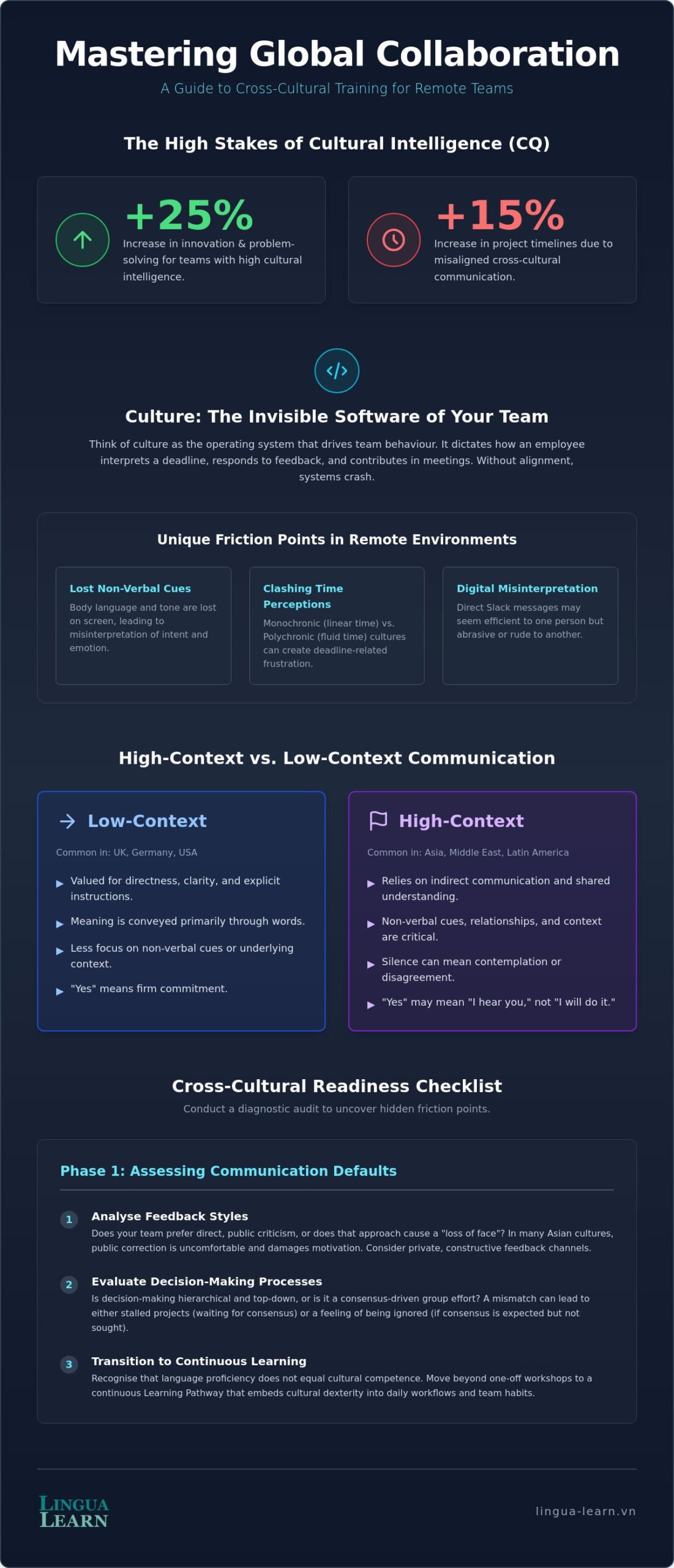
Cross-cultural training for remote teams has evolved far beyond a simple list of etiquette tips for specific countries. In 2026, we define this as the development of global dexterity; the ability to adapt your leadership and communication style fluidly across a digital workspace. This skill set is now a primary driver of business performance. Data shows that global virtual teams with high cultural intelligence (CQ) outperform those with lower CQ by 25% in innovation and problem-solving. Conversely, misaligned communication can increase project timelines by 15%, proving that cultural friction is a direct threat to your bottom line.
Think of culture as the invisible software that drives remote team behaviour. It dictates how an employee interprets a deadline, how they respond to critical feedback, and how they contribute during a brainstorming session. Whilst your team might use the same project management tools, their cultural “operating systems” determine how they interact with those tools and each other. Developing intercultural competence is the only way to ensure these different systems work in harmony rather than crashing during a critical project phase.
The lack of physical context in a virtual environment makes non-verbal cues incredibly difficult to interpret. In a traditional office, you might sense tension through body language or a change in the room’s energy. On a screen, these nuances vanish. Friction often arises from differing attitudes towards time. Monochronic cultures view time as linear and sacred; a 9:00 AM meeting starts at 9:00 AM. Polychronic cultures see time as fluid and relationship-driven. When these styles clash in an asynchronous workflow, it leads to frustration and a perceived lack of professionalism that is rarely intentional.
The digital divide also plays a role in how communication styles vary across messaging platforms. A short, direct message on Slack might seem efficient to a colleague in London, but it could appear abrasive or even rude to a team member in a more relationship-oriented culture. At Lingua Learn Vietnam, we often see how corporate soft skills training helps managers bridge these gaps by establishing shared digital norms that respect individual cultural backgrounds.
One of the most significant challenges in remote collaboration is the divide between high-context and low-context communication. Low-context cultures, such as those in the UK or Germany, value directness and explicit instructions. High-context cultures, common across much of Asia and the Middle East, rely on indirect communication and shared understanding. In a video conference, a low-context speaker might be frustrated by what they perceive as “beating around the bush,” whilst a high-context speaker might find the directness of their peer confrontational.
You can identify these styles by observing how your team handles silence or disagreement. In some cultures, silence is a sign of deep contemplation or respectful disagreement. In others, it’s an awkward void that must be filled. Misinterpreting polite agreement as a firm commitment is a common pitfall that leads to missed deadlines. Effective training teaches you to “read the air” even through a webcam, ensuring that “yes” actually means “I will do it” rather than “I hear you.”
Before you invest in cross-cultural training for remote teams, you must identify the specific gaps within your unique workforce. A generic approach rarely yields the measurable business performance modern leaders require. Think of this checklist as a diagnostic tool for your team’s health. It uncovers the hidden friction points that slow down projects and dampen morale. Involving your team in this self-assessment is vital. It fosters transparency and ensures the data reflects reality, not just your perception as a manager. This diagnostic phase mirrors the “Needs Analysis” stage of our 8-Step Learning Pathway at Lingua Learn Vietnam, where we tailor every programme to the specific cultural DNA of the client.
Start by checking your feedback styles. Does your team handle direct public criticism well, or does it cause a “loss of face” that damages long-term motivation? In many Asian cultures, public correction is deeply uncomfortable. You should also evaluate decision-making. Is it top-down or consensus-based amongst your distributed staff? Finally, review meeting etiquette. Observe who speaks first in your current culture and whether cameras are typically on or off. These small details reveal the underlying hierarchy and comfort levels of your remote staff.
Effective managing remote teams requires understanding how trust is formed. Analyse your team’s trust orientation: is it task-based (cognitive) or relationship-based (affective)? Task-based cultures trust you because you do good work. Relationship-based cultures trust you because they know you. Check for “virtual watercooler” engagement. Do remote staff interact outside of task-based calls, or is every interaction purely transactional? You should also assess power distance. Do junior staff feel comfortable challenging senior leaders in a group chat? If they don’t, you’re likely missing out on valuable insights and potential innovation.
A thorough audit ensures your training budget isn’t wasted on irrelevant modules. It allows you to build a bespoke roadmap that addresses the actual challenges your team faces daily. If you’re unsure where to start with your assessment, you can reach out to our team for a professional consultation to help guide your strategy.
A common objection amongst managers is the belief that if everyone speaks English, communication barriers should vanish. This is a dangerous assumption. Language proficiency does not equal cultural proficiency. Whilst your team might share a common vocabulary, the intent behind their words remains tethered to their cultural upbringing. In a remote setting, these differences are magnified by “Digital Body Language.” This concept refers to the subtext of our virtual interactions, such as the speed of a Slack response, the use of punctuation, or the presence of silence during a video call. Misinterpreting these cues often leads to the feelings of isolation and confusion that derail global projects.
To mitigate this, successful managers implement a “Team Culture Charter.” This document acts as a standardised agreement on how the team will communicate. It defines expectations for everything from “camera-on” policies to acceptable response times for asynchronous tasks. By making these best practices for enhancing cross-cultural communication explicit, you remove the guesswork that causes anxiety in distributed staff. It’s about creating a shared “third culture” that everyone can subscribe to, regardless of their physical location.
Language is more than just a tool for transmission; it’s a window into cultural logic. When you invest in cross-cultural training for remote teams, incorporating language basics can be transformative. For example, understanding the formal and informal structures in Italian or German reveals much about how those cultures perceive hierarchy and professional distance. Our focus on corporate staff language development at Lingua Learn Vietnam emphasises CEFR-aligned training. This ensures that professional terminology is standardised, allowing a developer in Hanoi and a project manager in London to operate from the same technical playbook without ambiguity.
Feedback is perhaps the most sensitive area of virtual collaboration. The traditional British “sandwich method”—placing a critique between two layers of praise—often fails in a multicultural context. A direct communicator from the Netherlands might only hear the praise and ignore the “filling,” whilst a colleague from a high-context culture might find the hidden criticism devastating. Managers must learn to deliver difficult news with precision. This involves encouraging “upward feedback” in cultures with high power distance, where junior staff might naturally hesitate to challenge a leader’s decision in a group chat. Adapting your delivery to the recipient’s cultural default is essential for maintaining engagement and reducing conflict.
Moving beyond the era of the “one-off” workshop is essential for managers who want lasting results. In 2026, the most successful organisations have transitioned to a continuous Learning Pathway that embeds global dexterity into the company’s DNA. Effective cross-cultural training for remote teams must be as dynamic as the digital environments it serves. By using virtual classrooms, you allow geographically dispersed staff to interact in the exact medium where their daily work occurs. This real-time interaction is far more effective than static e-learning modules, as it allows for the immediate correction of cultural missteps in a supportive environment.
Customisation is the cornerstone of any high-impact programme. Your team’s specific “blend” of cultures requires a bespoke approach rather than a generic curriculum. For instance, a team comprised of staff from Vietnam, Germany, and Brazil will face different friction points than one split between the UK and Japan. Tracking attendance and progress through a centralised system is also vital for measuring ROI. This data allows you to see exactly how the training correlates with reduced project delays and higher team engagement scores, turning “soft skills” into hard business assets.
At Lingua Learn Vietnam, we follow a structured 8-Step Learning Pathway to ensure that every minute of training delivers measurable business performance. This process begins with a comprehensive Needs Analysis and a Pre-Assessment to identify existing gaps in intercultural competence. By focusing on bespoke course design, we ensure the curriculum solves real workplace problems, such as misaligned deadline expectations or hesitant feedback loops. The pathway concludes with a Final Report and a Student Action Plan. This plan is crucial; it provides employees with a clear roadmap for immediate application, ensuring they don’t just learn theory but actually change their professional behaviour.
Security and engagement are the two pillars of modern digital training. A secure, UK-managed LMS is now a non-negotiable requirement for corporate data security, providing a safe environment for your team’s developmental data. Within the virtual classroom, we utilise interactive tools like breakout rooms and digital whiteboards to simulate real-world collaboration. These tools force participants to navigate different communication styles in high-stakes scenarios, such as mock presentations or conflict resolution exercises. This tech-forward approach aligns with the latest business English training for HR, where the focus has shifted towards integrated, high-engagement digital learning experiences.
If you are ready to move from ad-hoc sessions to a structured, results-oriented strategy, you can enquire about our bespoke training solutions to see how we can support your global team’s growth.
Lingua Learn Vietnam acts as the vital link between rigorous UK educational standards and the nuanced realities of Asian business environments. We understand that effective cross-cultural training for remote teams requires more than just a theoretical overview; it demands a practical integration of skills. By combining corporate language training with targeted soft skills development, we help your staff navigate the subtle complexities of international collaboration. This holistic approach ensures that your team doesn’t just speak the same language but actually shares the same professional vision.
Transparency and accountability are at the heart of our delivery. Unlike many providers who offer vague progress reports, we provide a proprietary, secure HR dashboard that delivers real-time analytics. This allows managers to track attendance, monitor engagement, and measure the direct impact of the training on team performance. Moving from cultural friction to a cultural competitive advantage is a strategic choice. With the right data and expert guidance, your global workforce becomes a powerhouse of innovation rather than a source of administrative headaches.
We pride ourselves on our ability to tailor programmes for global teams in over 20 different languages. Whether your staff need to master the direct communication style of a German boardroom or the relationship-driven nuances of a Vietnamese partnership, our native-speaking, qualified instructors provide the necessary expertise. Our corporate skills training is designed to be immediately applicable, focusing on real-world scenarios that your remote staff encounter every day. This bespoke design ensures that every minute spent in our virtual classroom translates into improved efficiency and reduced conflict on the ground.
The transition to a high-performing, culturally intelligent team begins with a single step. We invite you to book a consultation with our experts for a tailored needs analysis. This allows us to understand your specific challenges and design a roadmap that aligns with your 2026 business goals. Our commitment to UK-quality training ensures that you receive measurable results whilst your staff enjoy the convenience of a modern virtual classroom. There are no complex software downloads required; your team can access world-class training from any location with ease.
If you are ready to empower your workforce and streamline your global operations, please enquire about our courses today. Let Lingua Learn Vietnam help you turn your team’s diversity into your greatest professional asset.
Leading a global team in 2026 requires more than just awareness; it requires a proactive commitment to global dexterity. By auditing your team’s communication defaults and establishing a clear Culture Charter, you move from reactive problem-solving to strategic leadership. We’ve explored how understanding high-context cues and digital body language can bridge the gap amongst geographically dispersed staff. This ensures that every interaction adds value rather than confusion. Successful managers recognise that cultural intelligence is not a static trait but a skill that must be nurtured through continuous, high-quality development.
Lingua Learn Vietnam is dedicated to helping you achieve these results through our 8-Step Learning Pathway. Our training is aligned with CEFR standards and delivered via a secure, UK-managed LMS, providing you with the measurable data needed to prove ROI. Investing in cross-cultural training for remote teams is the most effective way to unlock your workforce’s full potential and turn diversity into a distinct market advantage. It’s the standard for any leader looking to build a truly borderless organisation.
Enquire about tailored cross-cultural training for your team today to begin your journey towards a more cohesive and innovative future.
The primary goal is to build global dexterity and minimise the friction caused by differing cultural operating systems. It aims to transform diversity from a potential source of conflict into a strategic advantage for innovation. By establishing shared digital norms, teams can collaborate more effectively without the misunderstandings that typically arise from mismatched communication styles or varying expectations regarding feedback.
You can often see initial improvements immediately after the implementation of a Student Action Plan, whilst more significant performance shifts typically manifest within three to six months. Measurable results depend on the consistency of the training and the team’s commitment to applying new communication frameworks. Long-term success is best achieved through a continuous Learning Pathway rather than isolated, one-off workshops.
Virtual classrooms are often more effective than in-person sessions for distributed staff because they simulate the exact digital environment where the team operates daily. Delivering cross-cultural training for remote teams online allows participants to practice using video conferencing tools and digital whiteboards to navigate cultural nuances in real-time. This ensures that the skills learned are directly transferable to their actual virtual tasks.
Whilst managers require specific leadership skills to guide a global workforce, the most successful outcomes occur when the entire team participates. Shared training ensures that everyone understands the new “third culture” and communication standards being implemented. This collective approach reduces the burden on leadership and empowers every employee to take responsibility for inclusive and efficient collaboration across borders.
We measure ROI by tracking specific performance indicators such as project delivery timelines, employee engagement scores, and the reduction of conflict reports. Our HR dashboard provides real-time analytics on attendance and progress, allowing you to correlate training milestones with improvements in team efficiency. This data-driven approach turns qualitative soft skills into quantifiable business assets that support your bottom line.
Diversity training focuses on representation and the inclusion of different identities, whereas cross-cultural training focuses on the operational logic and communication styles of different regions. Cross-cultural programmes provide the practical tools needed to navigate varying attitudes towards time, hierarchy, and feedback. Both are essential, but cultural training is specifically designed to solve the logistical and behavioural challenges of international collaboration.
Lingua Learn Vietnam ensures industry relevance through a comprehensive Needs Analysis and bespoke course design conducted before any training begins. We don’t use generic curricula. Instead, we tailor the vocabulary, case studies, and mock scenarios to mirror the specific challenges of your sector. This ensures that your team receives training that is directly applicable to their daily professional operations and industry standards.
We accommodate significantly different time zones by offering flexible scheduling through our virtual classroom platform. Our instructors are experienced in managing asynchronous communication norms, ensuring that team members can participate without undue stress on their work-life balance. We also focus on establishing “time-zone etiquette” as part of the training to ensure that no single region is consistently disadvantaged by meeting schedules.

Article by
Rob Holloway
Rob Holloway is the CEO of Lingua Learn Elevate Ltd (UK), the company operating Lingua Learn Vietnam. He works with businesses and organisations across Asia to provide high-quality online language training, corporate communication programmes and internationally recognised language certification preparation. Working with organisations across industries including engineering, finance, technology, manufacturing and professional services, Rob helps identify language training needs and connect clients with tailored learning solutions delivered by Lingua Learn’s experienced academic team. His professional focus includes corporate language training, business communication, cross-cultural communication, international education partnerships and helping organisations build the language skills needed to succeed in global business environments. Through Lingua Learn Vietnam, Rob is committed to providing UK-managed online language training delivered by qualified instructors, helping professionals and organisations communicate with confidence in today’s international workplace.
 Vietnamese
  English (UK)