
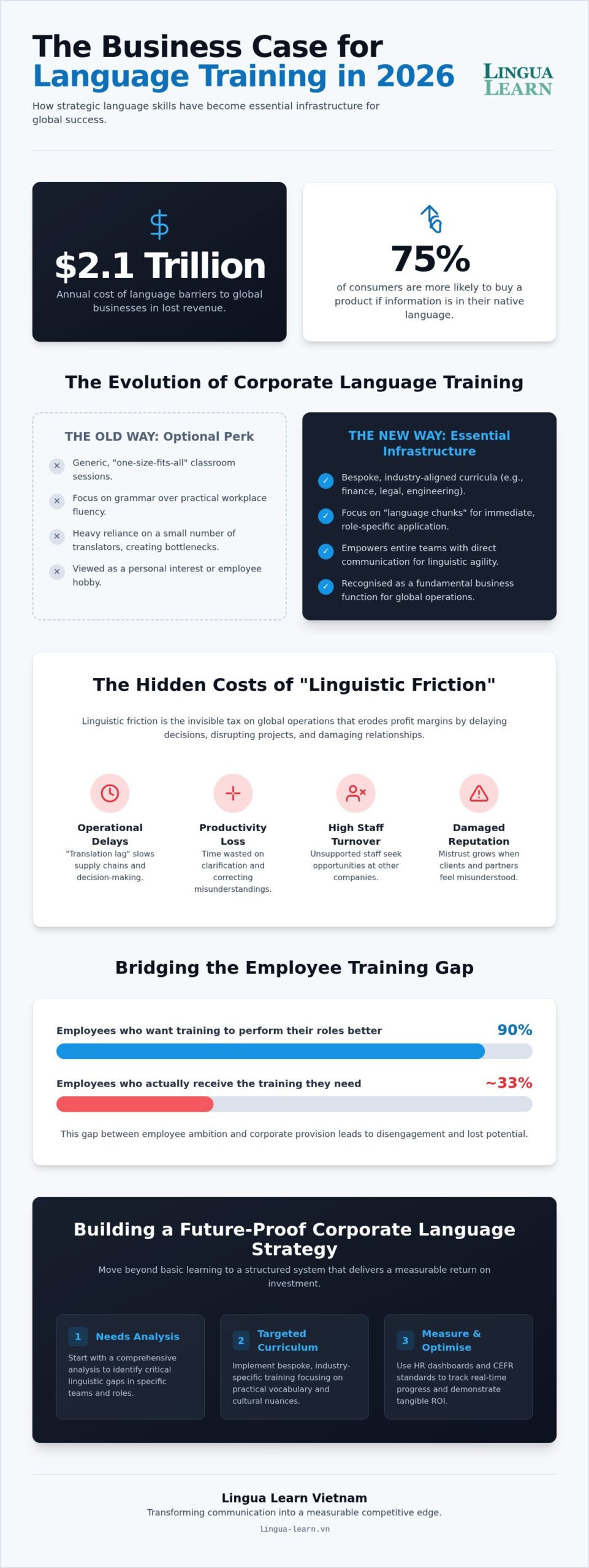
Did you know that language barriers are estimated to cost global businesses a staggering $2.1 trillion annually in lost revenue? It’s a sobering figure that many leaders recognise through personal experience, whether it’s a vital project delayed by a simple misunderstanding or a promising negotiation that stalls in a non-English market. You likely understand that whilst English remains a dominant tool, relying on it exclusively is no longer a viable strategy when 75% of consumers prefer to buy in their native tongue.
This article demonstrates how strategic language training for international business has evolved from an optional corporate perk into essential infrastructure for global success. We’ll explore the defining trends for 2026, including the integration of AI-assisted learning and the growing demand for cross-cultural communication skills. By the end, you’ll see how Lingua Learn Vietnam helps forward-thinking teams transform these communication challenges into a measurable competitive edge in international trade.
In the current commercial climate, language training for international business is defined as the strategic upskilling of teams to navigate the complexities of cross-border commerce. It isn’t merely a hobby or a personal interest; it’s a fundamental business function. As we move through 2026, the era of viewing language learning as an optional corporate perk has ended. Instead, it has become a non-negotiable requirement for companies operating within globalised supply chains. When a delay in a regional logistics hub affects a product launch half a world away, the ability to communicate directly and clearly with local stakeholders is invaluable.
This shift is driven by a critical need for linguistic agility. In previous decades, businesses might have relied on a single translator or a small handful of bilingual staff members. Today, the sheer speed of international trade requires immediate, direct interaction across all levels of an organisation. Professionals now prioritise workplace fluency, which focuses on the ability to conduct a productive meeting or resolve a technical issue, over the perfect use of obscure grammatical rules. In a fast-paced market, practical efficiency is the new gold standard for success.
The days of generic phrasebooks and “one-size-fits-all” classroom sessions are over. Modern professionals don’t have the luxury of time to learn vocabulary that isn’t relevant to their specific daily tasks. Training has transitioned towards bespoke, industry-aligned curricula that focus on “language chunks”. These are pre-fabricated phrases and terminology specific to roles in sectors like finance, engineering, or legal services. By utilising professional development language courses, employees can achieve functional proficiency much faster. This targeted approach directly impacts their career progression and significantly enhances the company’s operational speed in new markets.
Simply hiring native speakers is no longer a complete solution for modern corporate communication. Effective interaction requires a structured corporate language strategy that integrates cross-cultural soft skills with technical vocabulary. It’s about understanding the cultural nuance behind a negotiation in Tokyo or a project update in Berlin. Lingua Learn Vietnam supports this evolution by offering training in over 20 languages, ensuring that global teams can collaborate without the friction of misunderstanding. This comprehensive approach empowers staff to act as true ambassadors for their brand, building trust and rapport with international partners from the very first conversation.
Whilst many organisations view communication as a soft skill, the financial reality of “linguistic friction” suggests otherwise. Linguistic friction is the invisible tax on global operations that erodes profit margins by delaying critical decisions and disrupting project timelines. When teams cannot communicate fluently, the resulting misunderstandings create a drag on every stage of the business cycle. This isn’t a niche concern; research indicates that 90% of employees actively seek training to better perform their roles, yet only a third currently receive it. This gap between employee ambition and corporate provision often results in high-potential staff feeling unsupported and eventually seeking opportunities elsewhere.
The impact extends far beyond internal emails. A lack of language training for international business directly affects customer experience and brand reputation. If a regional partner or a high-value client feels misunderstood, trust evaporates quickly. In the competitive landscape of 2026, where 75% of consumers prefer to buy in their native tongue, a single linguistic slip can hand your market share to a competitor who has prioritised local communication. If you are concerned about how these barriers might be affecting your bottom line, discussing your team’s specific needs with an expert can help identify the most critical gaps.
One of the most tangible costs is “translation lag”. This occurs when supply chain managers or project leads must wait for external translations or multiple rounds of clarification before acting. Consider a contract negotiation where a misunderstood technical term or a misinterpreted “Incoterm” leads to a shipment being held at a port. These errors don’t just cost time; they result in demurrage fees and broken promises to end-users. Establishing high levels of language proficiency in international business ensures that negotiations remain fluid and contracts are understood by all parties from the outset.
Language barriers often create an artificial glass ceiling for skilled local managers. A brilliant engineer or operations lead may have the technical expertise to reach the C-suite but might be held back by a lack of confidence in high-level business English or another regional language. This leads to talent stagnation, where the company loses the insights of its best people because they cannot effectively voice them in global meetings. Learning and Development leaders are increasingly recognising the link between language skills for leadership roles and staff retention. By investing in your people, you don’t just improve communication; you build a loyal, high-performing leadership pipeline that is ready for the challenges of international trade.
Whilst English remains a powerful tool, it’s no longer the sole “lingua franca” for those aiming for the top of the global market. In 2026, relying only on English is a strategic risk, particularly as regional trade agreements like the Regional Comprehensive Economic Partnership (RCEP) shift the centre of gravity towards Asia. Effective language training for international business now requires a more diverse portfolio. Negotiating in a partner’s native tongue builds a level of trust and psychological safety that simply cannot be achieved through a third-party language. It demonstrates respect and a long-term commitment to the relationship, which are often the deciding factors in high-stakes deals.
Developing a globally competent workforce means looking beyond the basics. Multilingual teams can identify nuances in local regulations and consumer behaviour that mono-lingual teams frequently miss. This is especially true in specialised sectors where technical precision is paramount. By diversifying the linguistic skills within your organisation, you’re not just improving communication; you’re building a more resilient and adaptable business model.
Mandarin has become the essential language for modern manufacturing and complex supply chains. For professionals based in Vietnam, the ability to communicate directly with suppliers and logistics hubs in China is a massive advantage. Mastering Mandarin for logistics professionals allows for real-time problem solving on the factory floor, reducing the risk of costly errors. It’s also about the boardroom. Applying specific techniques from a strategic guide on Mandarin for business negotiations can help you navigate the cultural etiquette required to close significant contracts with confidence.
European markets still represent a huge portion of global trade, particularly in high-value industries like engineering and luxury goods. Language training for international business in this context often focuses on two key areas:
Lingua Learn’s French courses are designed to align with CEFR standards, ensuring that your proficiency is recognised and respected globally. This structured approach ensures your team is ready to compete on any stage, from the tech hubs of Berlin to the fashion houses of Paris.
Success in global trade isn’t accidental. It requires a robust framework that goes beyond simply providing access to a learning app. A comprehensive “Needs Analysis” is the first step in any effective language training for international business programme. This process identifies the specific communication gaps within your team, whether they’re in technical sales, legal compliance, or regional logistics. By aligning these needs with the Common European Framework of Reference for Languages (CEFR), organisations gain a globally recognised metric to track progress from beginner levels through to full professional mastery. This standardisation provides clear benchmarks for recruitment and leadership development, ensuring your investment is always measurable.
Integrating these programmes into existing corporate workflows is essential for long-term adoption. Instead of viewing training as an interruption, forward-thinking companies treat it as a core component of their operational infrastructure. When the curriculum is designed to solve real-world problems, employees are more likely to engage and apply their new skills immediately. This strategic alignment ensures that your language training for international business delivers a tangible return on investment by reducing the friction of daily cross-border interactions.
Transparency and data security are paramount for modern L&D departments. Unlike generic platforms that rely on pre-recorded content, Lingua Learn utilises a UK-managed Learning Management System (LMS) to host live, interactive virtual classrooms. This technology allows HR managers to monitor attendance and learner analytics through a transparent dashboard. Because the platform is UK-hosted and GDPR-compliant, businesses can trust that sensitive employee data remains secure whilst teams develop the fluency needed for high-stakes negotiations. Live interaction with native-speaking experts ensures that learners grasp cultural nuances that pre-recorded apps simply cannot teach.
A haphazard approach to learning often leads to inconsistent results and wasted resources. To counter this, a structured 8-step methodology guides learners from an initial pre-assessment through to a final Student Action Plan. This ensures that every course is bespoke, matching specific business objectives such as improving presentation skills or managing international supply chains. The Learning Pathway is a data-driven approach to mastery that ensures every hour spent in the virtual classroom translates into improved workplace performance. This methodical flow guarantees that both the individual learner and the organisation stay focused on the ultimate goal: seamless global communication.
Lingua Learn Vietnam provides a unique advantage by combining UK-managed technology and standards with a deep understanding of regional business culture. This dual approach ensures that your team receives world-class instruction that is directly applicable to the local trade landscape. By employing certified, native-speaking instructors, the programme focuses on building the professional confidence required to lead international teams and close complex deals. These experts act as mentors, guiding learners through the nuances of tone and etiquette that are often missing from automated learning tools.
Flexibility is at the heart of our delivery model. Employees can access their virtual classrooms from the office, home, or whilst travelling between regional hubs. This ensures that language training for international business integrates seamlessly into a busy professional schedule without disrupting daily operations. When your staff can learn in an environment that suits them, engagement levels rise and the speed of skill acquisition increases significantly.
Accountability is built into every programme through our transparent HR Dashboard. This tool allows managers to monitor progress in real-time, accessing detailed attendance records and assessment reports that are invaluable during annual performance reviews. The Final Report provides a comprehensive overview of the group’s progress, offering the data needed to prove ROI to senior stakeholders. By linking linguistic development with corporate skills training, organisations can ensure their staff are not just speaking a new language, but are also equipped with the soft skills necessary for global leadership.
Getting started is designed to be a low-friction experience. Learners receive a single-click invitation link that takes them directly into their interactive classroom, removing the technical barriers that often stall corporate learning initiatives. It’s this commitment to efficiency and quality that has made Lingua Learn Vietnam a trusted partner for global brands operating across Asia. If you’re ready to transform your team’s communication and secure a competitive edge, contact our support team today for a tailored language training proposal that aligns with your 2026 growth objectives.
As global trade continues to accelerate, the ability to communicate fluently across borders is no longer a luxury. It’s the foundation of operational success. We’ve explored how language training for international business has transformed into a strategic asset that prevents costly operational friction and unlocks new market potential. By adopting a multilingual approach and a structured learning pathway, your organisation can build a leadership pipeline that is truly ready for the global stage.
Success requires more than just a translation app; it demands a partnership built on quality and transparency. With a UK-managed LMS, CEFR-aligned international standards, and qualified native-speaking instructors, Lingua Learn Vietnam provides the infrastructure your team needs to thrive. You have the power to turn communication barriers into a measurable competitive advantage.
The future of international trade belongs to those who can speak the language of their partners. Start empowering your workforce today and watch your global performance reach new heights.
The best language training for international business in 2026 is a bespoke programme that prioritises workplace fluency over generic grammar exercises. Modern teams require industry-specific vocabulary and cross-cultural soft skills to navigate complex global markets. Programmes that combine live, interactive instruction with native-speaking experts provide the most effective results for professionals who need to apply their skills immediately in real-world negotiations.
Measuring ROI involves tracking specific metrics such as reduced project delays, improved negotiation outcomes, and higher retention rates amongst high-potential staff. By utilising a transparent HR dashboard, companies can monitor attendance and progress against defined business objectives. This data-driven approach allows leadership teams to see a clear link between linguistic development and measurable improvements in staff performance and international trade success.
CEFR alignment provides a globally recognised standard that ensures training is consistent and objective across different regions. It allows HR departments to set clear proficiency benchmarks for recruitment and internal development. When a programme follows these international standards, it guarantees that the skills acquired are measurable and respected by partners and stakeholders in any market, from Europe to Asia.
Online training is often more effective than traditional in-person classes because it offers greater flexibility and access to a diverse range of native-speaking experts. Live virtual classrooms facilitate real-time interaction and immediate feedback, which are critical for developing professional confidence. Additionally, the ability to join sessions from any location reduces the downtime and costs associated with travelling to a physical training centre.
Reaching business fluency depends on an employee’s starting point and the intensity of their study, but most learners achieve significant progress within 30 to 60 hours of instruction per CEFR sub-level. A structured Student Action Plan helps maintain focus on specific professional goals. This methodical approach ensures that the time spent in training translates directly into improved performance in high-stakes meetings and presentations.
English remains the most in-demand language for language training for international business, followed by Spanish and Mandarin. In regional trade hubs like Vietnam, there is also a significant rise in demand for German, Japanese, and Korean. Identifying the most relevant languages for your specific supply chain and target markets is essential for building a truly globally competent and resilient workforce.
A UK-managed Learning Management System (LMS) ensures that all learner data is hosted in a secure, GDPR-compliant environment. This high standard of data protection is vital for organisations handling sensitive employee information and corporate records. It also provides HR teams with a reliable and transparent platform for monitoring attendance and progress, ensuring that the training infrastructure meets international quality standards.
The 8-step Learning Pathway is a structured methodology that guides corporate teams from an initial pre-assessment through to a final Student Action Plan. This process includes a comprehensive needs analysis and custom course design to ensure the curriculum matches specific business objectives. It provides a logical and steady flow that ensures every learner stays focused on achieving the proficiency required for their professional role.

Article by
Rob Holloway
Rob Holloway is the CEO of Lingua Learn Elevate Ltd (UK), the company operating Lingua Learn Vietnam. He works with businesses and organisations across Asia to provide high-quality online language training, corporate communication programmes and internationally recognised language certification preparation.
Working with organisations across industries including engineering, finance, technology, manufacturing and professional services, Rob helps identify language training needs and connect clients with tailored learning solutions delivered by Lingua Learn’s experienced academic team.
His professional focus includes corporate language training, business communication, cross-cultural communication, international education partnerships and helping organisations build the language skills needed to succeed in global business environments.
Through Lingua Learn Vietnam, Rob is committed to providing UK-managed online language training delivered by qualified instructors, helping professionals and organisations communicate with confidence in today’s international workplace.
 English (UK)
  Vietnamese