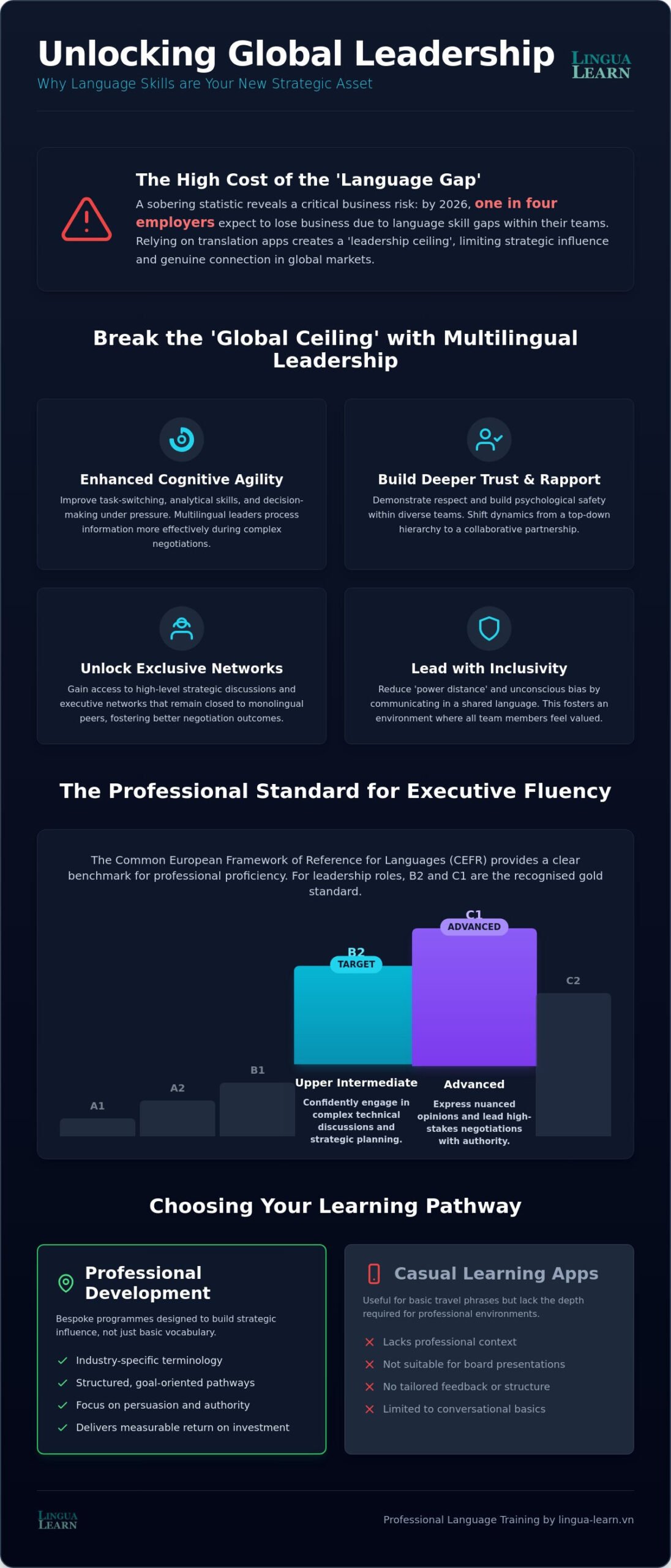
What if the most significant barrier to your global executive career isn’t your financial acumen, but your ability to connect in a second or third tongue? In 2026, one in four employers has already lost business because of language gaps within their teams. It’s a sobering statistic that highlights why traditional management styles are no longer enough to stay competitive in an increasingly interconnected economy.
You’ve likely felt the frustration of being ‘locked out’ of high-level strategy meetings or experienced the sting of a cross-cultural negotiation that stalled over a simple misunderstanding. It’s difficult to build trust with international stakeholders when you can’t quite bridge the gap that only native-level rapport provides. This guide reveals how prioritising language skills for leadership roles through targeted professional development empowers you to navigate complex markets with genuine empathy, clarity, and cognitive flexibility. We’ll explore how to achieve executive-level fluency, lead diverse teams with renewed confidence, and ensure your training time delivers a measurable return on investment for your career.
The landscape of executive success has shifted. Moving from a local manager to a global leader requires more than technical expertise; it demands a high level of cultural and linguistic agility. Whilst English remains a vital tool for international business, relying on it exclusively often creates a “leadership ceiling”. This invisible barrier prevents professionals from accessing the deepest levels of strategy and prevents them from truly connecting with stakeholders in emerging markets. Mastering language skills for leadership roles is no longer a luxury. It’s a strategic necessity for those who want to influence global operations.
Relying on translation apps or interpreters might solve immediate communication gaps, but these tools lack the nuance required for high-stakes decision-making. Multilingualism is directly linked to enhanced cognitive flexibility. Leaders who switch between languages develop better task-switching abilities and improved inhibitory control. This mental pivot allows you to process information more effectively under pressure, helping you stay calm and analytical during complex negotiations. At Lingua Learn Vietnam, we’ve observed that leaders who invest in their linguistic development often report a sharper ability to read between the lines in international boardrooms.
Beyond individual cognitive gains, linguistic effort builds psychological safety within diverse teams. When a leader attempts to speak a team’s native tongue, they demonstrate vulnerability and respect. This approach is central to understanding leadership styles that resonate on a human level. It shifts the dynamic from a top-down hierarchy to a collaborative partnership.
Proficiency in a second or third language opens doors to exclusive executive networks that remain closed to monolingual peers. When you can converse with a stakeholder in their native language, the psychological impact is profound. It signals a long-term commitment to the region and the relationship. Case studies in international mergers frequently show that negotiation outcomes are more favourable when leaders can speak directly to their counterparts, bypassing the delay and potential distortion of an interpreter. This direct line of communication fosters a level of trust that is impossible to replicate through technology alone.
Linguistic awareness acts as a powerful equaliser in the modern workplace. By utilising a shared language, you actively reduce the “power distance” that can hinder innovation in hierarchical organisations. This awareness is a critical component of inclusive leadership, as it helps prevent unconscious bias. It’s far easier to value a colleague’s insight when you aren’t subconsciously judging their proficiency in your own language. This skill is particularly essential for cross-cultural communication for sales teams, where building rapid rapport and understanding local sentiment is the difference between a signed contract and a missed opportunity.
A professional development language course is far more than a simple study of grammar and syntax. These are bespoke programmes designed to fuse linguistic fluency with industry-specific terminology and the soft skills required for high-level management. When cultivating language skills for leadership roles, the objective isn’t just to be understood; it’s to be persuasive, authoritative, and culturally resonant. It’s about moving beyond basic communication and into the realm of strategic influence.
The Common European Framework of Reference for Languages (CEFR) serves as the primary benchmark for this journey. For executives, B2 (Upper Intermediate) and C1 (Advanced) levels represent the “gold standard”. Reaching these milestones ensures you can follow complex technical discussions, contribute to strategic planning, and express nuanced opinions without hesitation. This level of proficiency creates a foundation of trust that a translation app or a basic vocabulary list simply cannot provide.
It’s vital to distinguish between casual learning tools and structured professional training. While conversational apps might help you navigate a menu, they lack the depth required for a board presentation or a sensitive HR negotiation. True executive growth requires live, interactive instruction where you can receive immediate feedback on your tone, pace, and delivery. If you are ready to assess your current level and begin a structured path, you can speak with our consultants to find the right fit for your professional goals.
Leaders require more than “survival” language; they need the ability to navigate complex corporate registers. This involves understanding formal etiquette and the subtle shifts in language that signal authority or collaboration. Professional language certifications play a crucial role here, providing a verified standard of expertise that can be shared with stakeholders. This validation proves that your communication skills are backed by a rigorous, internationally recognised framework.
Qualified native-speaking instructors act as cultural mentors who correct subtle faux pas that AI often overlooks. The difference between a polite request and an accidental demand often lies in a single word choice or intonation. At Lingua Learn Vietnam, our UK-standard online training ensures every session meets global quality benchmarks, providing a consistent experience for professionals who value their time and reputation.
Selecting which language to master requires a clear-eyed analysis of global trade trends and your specific career trajectory. In 2026, the ROI of language skills for leadership roles is measured by your ability to unlock new markets and lead teams with precision. While many professionals possess a functional grasp of a second language, the leap to executive-level communication requires a more targeted approach. A generic curriculum often fails the busy professional because it lacks the industry-specific context needed for high-stakes environments.
Even for those who consider themselves fluent, the nuances of high-level business English are often the deciding factor in securing a seat at the global table. It’s about mastering the art of diplomacy, persuasion, and complex problem-solving in a language that remains the primary medium for international commerce. For a leader, “good enough” communication can lead to expensive misunderstandings; excellence, however, facilitates seamless operations across borders.
Mandarin continues to be a dominant force for those leading supply chain and manufacturing operations, where direct communication with partners can significantly accelerate production timelines. Similarly, German and French remain indispensable for leaders in European high-tech and diplomatic sectors. For those operating within Southeast Asia, the growing importance of Vietnamese for international investors is a key trend to watch. As Vietnam solidifies its position as a global manufacturing hub, speaking the local language is a significant competitive advantage for directors and regional heads who need to build deep-rooted trust with local stakeholders.
General fluency is rarely enough for technical leaders. Transitioning to business English for IT professionals allows you to bridge the gap between complex engineering concepts and executive strategy. Whether you’re navigating the language of finance, law, or engineering, your communication must be precise and authoritative. This specialised training also covers the critical skills of networking and public speaking. It ensures you don’t just participate in international conferences but lead them with a command of the language that reflects your professional seniority. By focusing on high-impact scenarios, you ensure that every hour of training delivers a measurable boost to your leadership performance.
Time is the most valuable commodity for any director or senior manager. Developing language skills for leadership roles shouldn’t feel like an additional burden; it should be a seamless extension of your professional growth. The key lies in a structured, methodical approach that prioritises high-impact activities over generic study. By following a strategic framework, you can achieve executive-level fluency without compromising your daily operational responsibilities.
If you’re ready to see how a tailored schedule can fit into your calendar, you can enquire about our flexible executive training options today.
At Lingua Learn Vietnam, we employ an 8-step Learning Pathway to Success designed specifically for the corporate world. This process begins with a deep needs analysis to ensure the curriculum aligns with your workplace application. Every student receives a Student Action Plan that provides immediate utility, turning every lesson into a tool for your next meeting. For the busiest leaders, recorded sessions are a vital resource. If an urgent crisis forces you to miss a class, you can watch the recording later to ensure no gap in your progress occurs.
Accountability is essential for maintaining momentum. Regular attendance and progress reports help you stay on track, whilst final-course exams provide a clear sense of achievement. For many, the journey begins with mastering online business English for networking to build initial rapport. However, the ultimate goal is transitioning that foundational skill into full leadership fluency. Formal certification at the end of your course serves as a tangible record of your professional development, validating your expertise to both internal boards and international stakeholders.
Achieving executive-level fluency requires a partner that understands the intersection of linguistic precision and corporate strategy. Lingua Learn Vietnam provides a bridge between UK-standard quality and the specific needs of the Asian market. By offering access to a global network of qualified, native-speaking instructors across 20+ languages, we ensure that your training is both authentic and professionally relevant. Whether you are seeking to master Mandarin for regional expansion or refine your language skills for leadership roles in European markets, our platform provides the tools necessary for success.
Our 8-Step Learning Pathway to Success is specifically designed to deliver measurable corporate results. This structured approach moves beyond simple vocabulary acquisition, focusing instead on the practical application of language in high-pressure business environments. We specialise in tailoring corporate language training to your brand’s specific industry, ensuring that every session addresses the unique challenges your team faces. This bespoke methodology ensures that developing language skills for leadership roles becomes a hard asset for your organisation rather than just a personal goal.
For corporate clients, data security and transparency are non-negotiable. Our platform utilises UK-managed technology and UK-hosted data to ensure full GDPR compliance, providing peace of mind for organisations handling sensitive information. To help you track the return on your training investment, we provide a dedicated HR Dashboard. This tool offers real-time analytics on team progress, attendance, and assessment scores, allowing you to monitor development at a glance. Within our live interactive classrooms, we utilise advanced tools such as digital whiteboards and breakout rooms to foster a collaborative learning atmosphere that mimics the modern hybrid workplace.
The journey towards global influence begins with a single, strategic step. We invite you to book a consultation for customised leadership coaching that aligns with your specific career objectives. Every successful programme starts with a professional pre-assessment to establish a clear CEFR baseline, ensuring your path forward is both efficient and effective. Don’t let linguistic barriers limit your organisational impact. Enquire today to unlock your global potential and secure your place as a truly international leader.
The business landscape of 2026 doesn’t wait for those who rely on translation apps or limited fluency. True executive agility comes from the ability to navigate cultural nuances and technical discussions with precision. By treating linguistic proficiency as a hard cognitive asset, you bypass the “leadership ceiling” that holds back so many talented professionals. Whether you’re focusing on regional powerhouses like Vietnam or refining your command of business English, your commitment to growth signals your value to international stakeholders.
Investing in language skills for leadership roles is the most direct way to build trust and psychological safety within diverse teams. It’s about more than just words; it’s about demonstrating the respect and empathy that define modern leadership styles. With a UK-managed Learning Management System and a CEFR-aligned curriculum, you can ensure your progress meets the highest global standards.
Don’t let communication gaps define your career trajectory. Our training is trusted by global brands across Asia to deliver measurable results for their senior teams. Enquire about our professional development language courses at Lingua Learn Vietnam today and start your journey towards executive-level fluency. The world is ready for your lead; it’s time to speak its language.
Language skills for leadership roles are critical because they facilitate genuine trust and psychological safety in diverse teams. As global markets become more interconnected, leaders who can communicate without intermediaries avoid the misunderstandings that lead to stalled negotiations. This agility is no longer a soft skill; it’s a hard asset that directly impacts a company’s bottom line and international reputation.
The timeline varies based on your starting point and the complexity of the language. Generally, moving up one CEFR level requires approximately 150 to 200 hours of guided, structured study. For a busy executive, this is best achieved through consistent, twice-weekly sessions over several months. Using a “Micro-Goals” approach ensures you gain functional workplace skills long before you reach full native-level fluency.
Online language courses are often more effective for executives because they offer unparalleled flexibility and specialised tools. Virtual classrooms allow you to maintain your learning rhythm whilst travelling for business. Features like recorded sessions and digital whiteboards provide a level of review and collaboration that traditional classrooms often lack. This ensures that training fits into a high-pressure schedule without compromising on the quality of instruction.
The best ROI comes from courses that align with your specific trade corridors and industry needs. In 2026, Mandarin remains a powerhouse for supply chain leaders, whilst German and French are essential for European high-tech sectors. Advanced Business English courses focusing on persuasion and board-level diplomacy also offer immediate returns. They improve your ability to influence global strategy and secure high-value contracts.
The CEFR is an international benchmark used to describe language ability across six levels, from A1 to C2. For corporate training, it provides a transparent and objective way to measure progress and set recruitment standards. Leaders typically aim for B2 or C1 levels. Reaching these stages ensures you can handle technical discussions and navigate complex social situations with the confidence required for senior management.
HR managers can utilise dedicated digital dashboards to monitor team progress in real-time. These platforms provide detailed analytics on attendance, engagement, and assessment scores for every participant. This transparency allows organisations to measure the return on investment and identify which employees are ready for international assignments. At Lingua Learn, we provide these reports to ensure that corporate training remains accountable and aligned with business goals.
Yes, specialised courses exist that combine linguistic training with industry-specific terminology for IT, finance, and engineering leaders. These programmes focus on the precise vocabulary needed to explain complex concepts to non-technical stakeholders or international partners. By bridging the gap between technical expertise and leadership communication, these courses empower directors to lead cross-border projects with clarity and authority.
Lingua Learn ensures high standards by employing only qualified, native-speaking instructors who undergo rigorous screening. Our training follows a UK-managed quality framework and an 8-step Learning Pathway to Success. This ensures that every tutor isn’t just a speaker, but a trained educator capable of delivering results-oriented instruction. Regular reviews and student feedback loops help us maintain a consistent, world-class experience for all our learners.

Article by
Rob Holloway
Rob Holloway is the CEO of Lingua Learn Elevate Ltd (UK), the company that operates Lingua Learn Vietnam. He works with businesses and organisations across Asia to provide high-quality online language training, corporate communication programmes, and preparation for internationally recognised language certifications. Working with organisations across industries including engineering, finance, technology, manufacturing, and professional services, Rob helps identify language training needs and connects clients with tailored learning solutions delivered by Lingua Learn’s experienced academic team. His professional focus includes corporate language training, business communication, cross-cultural communication, international education partnerships, and helping organisations build the language skills needed to succeed in global business environments. Through Lingua Learn Vietnam, Rob is committed to providing UK-managed online language training delivered by qualified instructors, helping professionals and organisations communicate with confidence in today’s international workplace.
 English (UK)
  Vietnamese