
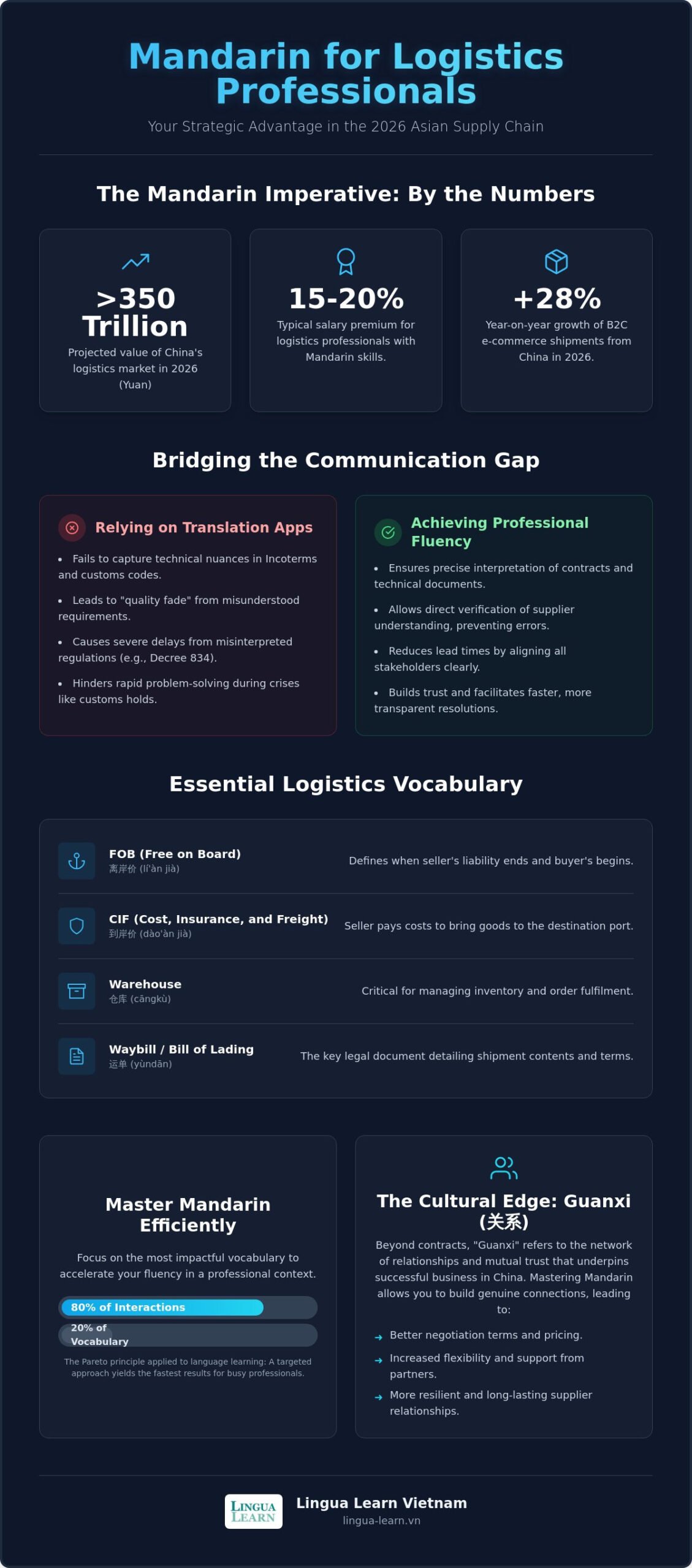
In 2026, the total value of China’s logistics market is projected to exceed 350 trillion yuan, yet the demand for specialised Mandarin for logistics professionals has never been more urgent. You’ve likely experienced the frustration of watching a shipment stall because a technical nuance was lost in translation or an unreliable app failed to decode a complex customs document. It’s exhausting to feel at a disadvantage during high-stakes negotiations. This occurs all too often whilst critical shipping deadlines are looming and costs are rising.
This guide will show you how mastering professional Mandarin can transform these hurdles into distinct competitive advantages. You’ll learn to navigate complex supply chain interactions, read technical trade documents with accuracy, and negotiate more effectively with your Chinese partners. At Lingua Learn Vietnam, we see how professional language skills empower individuals to take control of their international operations. We’ll explore the essential vocabulary for trade communication and the cultural insights needed to build stronger, more resilient relationships with suppliers, ensuring your operations remain efficient and your career continues to progress.
In the first four months of 2026, China’s total social logistics volume reached a staggering 121.7 trillion yuan. This figure represents more than just economic growth; it highlights a fundamental shift in how the world moves goods. Mandarin has transcended its role as a local tongue to become the undisputed lingua franca of the modern Asian supply chain. For those managing operations between the manufacturing hubs of China and the burgeoning trade centres of Southeast Asia, the ability to communicate with precision is no longer optional. It is the engine that drives efficiency.
The complexity of global trade has increased significantly following the implementation of new regulations in early 2026. Understanding the history of China’s foreign trade helps professionals appreciate why these shifts occur, but technical fluency is what allows them to navigate the present. With the introduction of Decree 834 in March 2026, supply chain security is now a matter of national priority in China. This means that misinterpreting a single clause regarding risk-monitoring or data gathering can lead to severe shipping delays or total operational halts. Linguistic precision reduces lead times by ensuring that every stakeholder, from the warehouse floor to the customs office, is aligned.
Relying on generic translation software for high-stakes logistics contracts is a gamble that rarely pays off. Whilst AI has improved, it often fails to capture the technical nuances of Incoterms or specific customs codes. Inaccurate communication is a primary driver of “quality fade,” where the standards of production or packaging slowly slip because the supplier hasn’t fully grasped the client’s detailed requirements. Speaking the language directly allows you to identify these issues before the cargo leaves the port. It also has a profound psychological impact. During a crisis, such as a sudden customs hold or a transport strike, a professional who can speak directly to partners in Mandarin often receives faster resolutions and more transparent information than those hidden behind an app.
The demand for Mandarin for logistics professionals is surging, particularly within the Vietnam-China trade corridor. Professionals who possess these skills often command a salary premium of 15% to 20% compared to their monolingual peers. This is driven by the rapid growth of cross-border e-commerce, with B2C shipments from China growing by 28% year-on-year in 2026. Managing these high-velocity flows requires more than just basic greetings; it demands the ability to build deep trust amongst international stakeholders. By enrolling in targeted Mandarin courses, supply chain managers can move beyond the “basic conversation” stage and achieve the technical fluency required to lead corporate teams and secure better terms with global suppliers.
Mastering technical vocabulary is the bedrock of operational success. Whilst general fluency helps with social rapport, Mandarin for logistics professionals requires a granular understanding of terms that dictate the movement of millions of pounds worth of cargo. In the context of the 2026 CAFTA 3.0 implementation, where digital trade and automated clearing are becoming standard, using the wrong character in a digital declaration can trigger automated red flags. Precision in your terminology ensures that your instructions are followed to the letter, whether you are dealing with a local driver or a senior port official.
One area where clarity is paramount is the use of Incoterms. Although international abbreviations like FOB or CIF are commonly used, verifying the Chinese equivalent in contracts prevents ambiguity. For instance, 离岸价 (lí’àn jià) refers to the FOB (Free on Board) price, while 到岸价 (dào’àn jià) denotes the CIF (Cost, Insurance, and Freight) price. Understanding these specific characters allows you to cross-reference translated contracts against the original Chinese documents to ensure your financial liabilities are clearly defined.
Efficient freight management relies on distinguishing between modes of transport and tracking statuses accurately. Use these core terms to manage your daily operations:
When checking a shipment’s progress, a phrase such as “请问货什么时候到?” (Qǐngwèn huò shénme shíhòu dào? – When will the goods arrive?) is a simple yet effective way to prompt an update from a freight forwarder.
The border is often where the most expensive delays occur. Using the correct terminology for documentation can help you resolve discrepancies swiftly amongst customs officials. Key terms include:
If you encounter an error, stating “文件不一致” (Wénjiàn bù yīzhì – Document discrepancy) immediately identifies the problem for your Chinese partner. If you find these technical terms challenging to integrate into your workflow, you might consider how professional language support can help bridge the gap in your technical communication.
In the fast-paced world of WeChat and logistics emails, professionals often use shorthand. You will frequently see “单号” (dānhào) for a tracking number and “签收” (qiānshōu) to indicate a shipment has been signed for and received. In emails, “抄送” (chāosòng) is used for CC-ing stakeholders. Recognising these patterns helps Mandarin for logistics professionals feel more intuitive during rapid-fire communication.
Technical proficiency is only half the battle. Successful Mandarin for logistics professionals hinges on understanding the cultural underpinnings of Chinese business interactions. Whilst your vocabulary allows you to read a waybill, your cultural intelligence is what secures a priority slot on a congested vessel. In the 2026 trade landscape, where the CAFTA 3.0 upgrade protocol emphasises deeper institutional cooperation, the ability to build rapport is more valuable than ever.
Central to this is the concept of “Guanxi” (关系), often translated as “relationships” or “connections.” In a logistics context, Guanxi isn’t just about networking; it represents a web of mutual obligations. A supplier with whom you have strong Guanxi is more likely to go the extra mile during a crisis, such as finding alternative routing when a primary port is blocked. Closely tied to this is “Mianzi” (面子), or “Face.” Maintaining your partner’s dignity is essential. If a shipping delay occurs, avoid blunt accusations. Instead, use indirect language to address the issue whilst allowing the partner to provide a solution without losing face. This approach preserves the partnership for the long term.
Negotiation in China is often a marathon, not a sprint. Western professionals sometimes find the indirect style frustrating, but it serves a purpose: building trust. When seeking discounts or better lead times, frame your request around the idea of “long-term cooperation” (长期合作 – chángqī hézuò). This signals that you are an invested partner rather than a transactional vendor. Negotiating flexibility during peak seasons, such as the weeks leading up to Golden Week or Chinese New Year, requires early engagement and a soft touch. Professionals who have undergone Cross-Cultural Communication Training are often better equipped to handle these high-pressure windows without damaging supplier ties.
The “Business Banquet” remains a cornerstone of trade communication. These social gatherings are where the real work of building trust happens. Socialising with your logistics leads over a meal allows you to move beyond the rigid structure of the office. Follow these tips to build rapport:
By investing linguistic effort into these social interactions, you transition from being a “foreign client” to a “trusted partner.” This shift is often the difference between a standard service level and the premium support needed to thrive in the complex world of global logistics.
Balancing a global logistics role with language study is a significant challenge, but it’s entirely achievable with a targeted strategy. You don’t need to learn every word in the dictionary to be effective. Instead, apply the Pareto principle by identifying the 20% of vocabulary that facilitates 80% of your daily interactions. For Mandarin for logistics professionals, this means prioritising terms related to freight status, contract obligations, and customs clearance over general social phrases.
Micro-learning is your most powerful tool. Use your morning commute or the gaps between meetings to listen to industry-specific podcasts or news from the China Federation of Logistics & Purchasing. This builds active listening skills and keeps you informed about the latest market trends. To ensure your progress is measurable and follows international standards, align your learning goals with the CEFR framework. This structured approach allows you to track your journey from basic comprehension to the technical fluency required for high-stakes trade.
Whilst mobile apps are useful for basic vocabulary, they lack the nuance required for professional communication. Live tutors are superior because they provide immediate feedback on tone, which is a critical component of Mandarin that can change the meaning of technical terms. At Lingua Learn Vietnam, our instructors focus specifically on Mandarin for business, moving beyond travel phrases to simulate supply chain crises and role-play negotiation scenarios. Recording these sessions allows you to review technical pronunciation and refine your delivery before you step into a real meeting.
Immersion doesn’t require moving abroad. You can create a professional Chinese environment by following industry giants like SF Express or JD Logistics on social media to see how they communicate with clients. For advanced learners, switching your logistics software or ERP interface to Mandarin provides daily exposure to essential characters. Many organisations also find that group language training for entire teams fosters a collaborative learning culture, allowing colleagues to practise role-play scenarios together. If you’re ready to build a bespoke training plan for your team, you can enquire about our corporate programmes to find a schedule that fits your operational needs.
Active listening and role-play are particularly effective for preparing for the unexpected. Practise how you would explain a port delay or a documentation error in Mandarin. By rehearsing these high-pressure moments in a supportive environment, you build the quiet confidence needed to lead international stakeholders through complex logistics challenges.
The transition from managing shipping delays to leading a seamless, proactive supply chain requires more than just a list of vocabulary. It demands a structured approach to language acquisition that mirrors the complexity of your daily operations. Lingua Learn Vietnam provides bespoke Mandarin courses designed specifically to address the technical and cultural hurdles faced by trade specialists. By focusing on Mandarin for logistics professionals, we ensure that every hour of study translates directly into improved operational efficiency and stronger supplier partnerships.
Our “8-Step Learning Pathway to Success” is engineered for corporate excellence. This methodical process begins with a comprehensive needs analysis and placement testing to identify your team’s current level. We then design a custom curriculum, matching your staff with certified native-speaking tutors who understand the nuances of international trade. Our UK-managed technology provides a stable, high-quality platform for live interactive sessions, ensuring that distance is never a barrier to high-level training. Every learner receives a “Student Action Plan,” a practical roadmap that helps them apply their new linguistic skills to specific workplace tasks, such as reviewing waybills or conducting supplier audits, from day one.
We understand that a one-size-fits-all approach fails in the high-stakes world of global logistics. Our curriculum designers build lessons around your specific supply chain challenges, whether you are navigating the new 2026 security regulations or managing cross-border e-commerce flows. To support management, our Corporate HR Dashboard provides real-time tracking of team progress, attendance, and proficiency gains. This transparency allows you to see the direct return on your training investment. Many clients choose to combine these technical lessons with cross-cultural communication training to ensure their teams can handle the delicate social dynamics of “Guanxi” and “Mianzi” with professional poise.
Transparency and accountability are the cornerstones of our programme. All our courses align with the CEFR levels, providing an internationally recognised benchmark for proficiency tracking. This alignment is vital for Mandarin for logistics professionals, as it allows organisations to set clear, measurable standards for staff working in different regions. Industry professionals report that this structured training significantly reduces miscommunication between regional offices and Chinese manufacturing hubs, leading to fewer documentation errors and more reliable lead times. If you are ready to transform your team’s communication strategy, you can organise a needs analysis today to begin building a bespoke learning pathway that meets your unique corporate objectives.
The 2026 logistics landscape rewards those who can communicate with precision and cultural intelligence. By mastering Mandarin for logistics professionals, you move beyond basic translation and start building the deep supplier trust that secures better lead times and reduces operational risk. You’ve seen how technical terminology and the nuances of Guanxi are essential for navigating the complex China-ASEAN trade corridor. Now is the time to turn these insights into a tangible career advantage.
At Lingua Learn Vietnam, we provide the structure you need to succeed whilst balancing a demanding full-time role. Our programmes follow a rigorous 8-Step Learning Pathway to Success and utilise a CEFR-aligned curriculum to ensure your progress is measurable and meets international standards. With our UK-managed training standards and certified native-speaking tutors, you’ll gain the confidence to lead high-stakes negotiations and manage complex trade documents with ease. Enquire about our tailored Mandarin courses for logistics professionals today and start your journey towards becoming a leader in global trade communication. We look forward to supporting your professional growth.
Mandarin is manageable for logistics professionals if you focus on the technical vocabulary used in your daily role. By prioritising the specific language of the supply chain, you avoid the complexity of general fluency. Many professionals find that the logical, block-based structure of Mandarin grammar actually suits the methodical nature of logistics operations, making it easier to grasp than they first anticipated.
Reaching a functional level for logistics typically takes between six to twelve months of consistent, structured study. This timeline depends on your starting point and the frequency of your training sessions. Using a CEFR-aligned curriculum allows you to track specific milestones, ensuring you can handle basic shipping updates within a few months whilst moving towards complex negotiations by the end of the year.
Yes, you can effectively learn Mandarin for logistics professionals through live online classes that simulate real-world supply chain scenarios. Lingua Learn Vietnam offers interactive online sessions with certified native tutors, allowing you to practise technical pronunciation and role-play crisis management from your home or office. This digital flexibility is essential for busy professionals who must balance training with global operational demands.
The primary difference lies in the technical depth and formal etiquette required for international trade. General Mandarin focuses on social interactions, whilst business Mandarin for trade prioritises technical terminology for warehousing, Incoterms, and customs compliance. This targeted approach ensures that your learning remains relevant to your specific role, helping you avoid unnecessary jargon and focus on the words that actually move cargo.
Lingua Learn Vietnam provides certificates of completion that align with international CEFR standards. These certificates document your specific proficiency level and can be used to demonstrate your language skills to current or future employers. We focus on ensuring your certification reflects a genuine ability to handle professional trade communication in real-world scenarios, giving you a credible advantage in the global logistics market.
Present a business case focused on the tangible reduction of lead times and customs errors. Explain how Mandarin for logistics professionals can decrease reliance on third-party translation and build stronger Guanxi with suppliers, leading to better contract terms. Highlighting the 2026 CAFTA 3.0 upgrades can also show the strategic necessity of linguistic precision for any organisation operating within the China-ASEAN trade hub.
The most critical characters to master are 提单 (Bill of Lading), 报关 (Customs Declaration), and 关税 (Tariff). Recognising these on your waybills and contracts allows you to verify information quickly without total reliance on translation apps. Mastering these specific characters ensures you can spot discrepancies in documentation before they cause significant delays in your shipping schedule or result in unexpected port fees.
Address disputes by using indirect language that focuses on the shared objective of a successful delivery. Framing the issue as a “technical discrepancy” or a “misunderstanding” allows your partner to resolve the error whilst maintaining their professional dignity. This approach preserves the Guanxi you’ve built and ensures that temporary operational disputes don’t lead to long-term damage in your vital supplier relationships.

Article by
Rob Holloway
Rob Holloway is the CEO of Lingua Learn Elevate Ltd (UK), the company operating Lingua Learn Vietnam. He works with businesses and organisations across Asia to provide high-quality online language training, corporate communication programmes and internationally recognised language certification preparation. Working with organisations across industries including engineering, finance, technology, manufacturing and professional services, Rob helps identify language training needs and connect clients with tailored learning solutions delivered by Lingua Learn’s experienced academic team. His professional focus includes corporate language training, business communication, cross-cultural communication, international education partnerships and helping organisations build the language skills needed to succeed in global business environments. Through Lingua Learn Vietnam, Rob is committed to providing UK-managed online language training delivered by qualified instructors, helping professionals and organisations communicate with confidence in today’s international workplace.
 English (UK)
  Vietnamese