
What if the primary obstacle to your professional growth isn’t a lack of hours in the day, but the outdated assumption that fluency requires hours of daily isolation? Many professionals wonder if it’s actually possible to become fluent in a language without quitting their job or facing total burnout. You’ve likely experienced the frustration of trying to squeeze in a lesson after a taxing day at the office, only to find your focus depleted and your progress stalled. It’s difficult to balance career duties with the desire for personal development, especially when self-study apps fail to deliver measurable results.
This 2026 guide explains exactly how to learn a language while working full time without compromising your professional performance. By shifting your focus toward strategic micro-learning and high-quality, UK-standard training, you can transform your routine into a sustainable path to success. We’ll explore how to leverage CEFR-aligned curricula and professional support to achieve genuine proficiency, ensuring your new skills open doors to global opportunities whilst fitting seamlessly into your busy lifestyle.
For today’s executives and managers, time isn’t just money; it’s a finite resource under constant siege. The concept of “time-poverty” is a daily reality, particularly in high-pressure corporate environments where the workday often extends far beyond the traditional eight hours. If you are struggling with how to learn a language while working full time, you’ve likely realised that the old model of attending physical evening classes is no longer viable. These rigid schedules often lead to high dropout rates amongst professionals who cannot predict when a late-night board meeting or an urgent client crisis might arise.
By 2026, global communication has shifted from a “nice-to-have” bonus to a non-negotiable professional requirement. To stay competitive, you must adopt “Strategic Fluency”. This approach prioritises the quality of your engagement over the sheer quantity of study hours. Understanding the scientific process of second-language acquisition reveals that consistency and high-quality input are more effective than sporadic, marathon study sessions. It is about working smarter, not harder, to integrate new linguistic skills into your existing professional identity.
Many professionals turn to popular mobile apps, falling into the “gamification trap”. Whilst maintaining a 100-day streak feels rewarding, it rarely translates to the ability to lead a negotiation or deliver a presentation in a foreign tongue. These platforms often lack the nuanced feedback required to prevent the fossilisation of grammatical errors. Without the accountability of a live, certified tutor, it’s easy to plateau. A professional needs a mentor who can correct pronunciation and cultural nuances in real-time, ensuring that your learning remains relevant to your career goals.
Investing in a structured programme offers a clear return on investment (ROI). Beyond personal growth, developing language skills for leadership roles is a proven way to unlock higher-tier career opportunities and manage international teams more effectively. Structured learning also eliminates “decision fatigue”. Instead of wasting mental energy deciding what to study next after a stressful day, you simply follow a proven pathway. At Lingua Learn Vietnam, our CEFR-aligned curricula and UK-managed standards provide the rigorous framework busy professionals need to make tangible progress without the guesswork.
Success in language acquisition for executives depends entirely on the quality of the initial plan. You shouldn’t simply aim to “speak French”; you should aim to “conduct a quarterly sales meeting in French at a B2 level”. This precision starts with defining your “Why”. Are you preparing for a specific negotiation, networking at international conferences, or an upcoming relocation? A professional needs analysis ensures your efforts aren’t wasted on irrelevant vocabulary. By Integrating Language Learning into Your Professional Workflow, you treat your linguistic development as a core business objective rather than a secondary hobby.
Understanding the Common European Framework of Reference for Languages (CEFR) is essential for any serious learner. This international standard scales from A1 (beginner) to C2 (mastery), providing a universal language for proficiency. Setting measurable milestones within this framework allows you to track your progress with scientific precision. If you’re curious about where you currently stand on this scale, you can speak with our advisors for a professional consultation to determine your baseline.
Step one of any effective journey is the Pre-Assessment. Knowing your exact starting point is vital for efficiency, as it prevents you from repeating content you’ve already mastered. Professional adult language learning programs online use data-driven insights to track your trajectory through a structured 8-step pathway. This methodical approach ensures you’re always challenged but never overwhelmed. Upon completion, final-course exams and UK-standard certification provide the tangible proof required to enhance your CV and demonstrate your commitment to global leadership.
Many executives struggle with how to learn a language while working full time because they lack a structured roadmap. To avoid this, your goals must be SMART:
By aligning your study with your quarterly career objectives, you create a sustainable routine. This strategy ensures that every hour spent studying contributes directly to your professional growth, making the process of learning a new language a strategic asset rather than a time-consuming burden.
Reclaiming time starts with a cognitive audit of your daily schedule. For most executives, the challenge of how to learn a language while working full time isn’t a lack of opportunity, but a failure to distinguish between “Golden Hour” and “Dead Time”. Your Golden Hour is that window when your brain is most receptive to complex grammar; for many, this is early in the morning before the influx of emails or late in the evening when the household is quiet. Conversely, Dead Time includes those minutes spent waiting for a lift or sitting in traffic. Use these moments for audio-based immersion, such as listening to professional podcasts or vocabulary drills, which allows you to study safely whilst on the move.
Even a busy lunch hour can be transformed into a high-impact micro-session. Instead of scrolling through news feeds, dedicate 15 minutes to active recall. This technique forces your brain to retrieve information rather than just passively reviewing it. You might spend this time reviewing digital flashcards or writing three professional sentences that you could actually use in tomorrow’s meeting. These small, daily wins accumulate into significant progress over a business quarter without requiring you to sacrifice your evenings.
Micro-learning is the secret weapon for the time-poor professional. By breaking down complex topics into digestible chunks, you reduce the mental barrier to entry. Utilise “buffer moments”, those brief gaps between back-to-back meetings, to review key phrases. Another effective strategy is reviewing your live lesson recordings whilst performing low-cognition tasks like filing or light exercise. This reinforces the material through repetition without requiring a dedicated, high-energy study block. At Lingua Learn Vietnam, we provide the tools to make these moments count, ensuring every minute spent is aligned with your professional goals.
The shift toward digital education has revolutionised how professionals manage their personal development. Virtual classrooms eliminate travel time entirely, allowing you to join a high-quality session from your office or home with a single click. For teams looking to upskill together, exploring online corporate language training Vietnam provides the flexibility required for modern business operations. One of the most significant advantages for executives is the ability to access recorded sessions. If a sudden board meeting forces you to miss a class, you can catch up on your own terms, ensuring your learning pathway remains uninterrupted. This level of accessibility is why structured, UK-managed online training consistently outperforms traditional classroom settings for full-time workers.
True proficiency is rarely achieved in a vacuum. Mastering how to learn a language while working full time requires more than just carving out time; it involves embedding the new language into your daily professional habits. One practical method is to start using your target language in low-stakes internal communications. Try drafting short, non-critical emails or Slack messages to colleagues who speak the language, or simply use the target language for your personal daily to-do list. This constant, low-pressure exposure builds the linguistic “muscle memory” needed for high-stakes environments.
To bridge the gap between theory and practice, we utilise Student Action Plans. These bespoke documents help you apply specific classroom skills to real-world business scenarios you face every week. If you have a presentation coming up in Spanish or a negotiation in Japanese, your plan focuses on the exact terminology and cultural etiquette required for that task. This ensures your study time is never wasted on abstract concepts that don’t serve your immediate career goals.
Our secure, UK-managed Learning Management System (LMS) acts as a digital headquarters for your development, providing 24/7 access to essential resources. Between live lessons, you can engage with AI-powered practice tasks that offer instant feedback on your syntax and vocabulary. This allows you to maintain momentum even during a busy week when a full hour of study might be impossible. Dashboards provide transparent data on your attendance and progress, helping you stay accountable to your quarterly objectives.
Within the virtual classroom, features like breakout rooms and interactive whiteboards do more than just facilitate learning; they simulate the collaborative environment of a modern international office. You aren’t just learning grammar; you are learning how to brainstorm, problem-solve, and lead in a second language. This practical focus is what distinguishes professional training from generic mobile apps.
Securing corporate support can be a game-changer for your routine. Many HR managers and department heads recognise that language upskilling is a vital component of global competitiveness and are often willing to sponsor training. Group programmes can significantly improve team cohesion, especially when the curriculum is tailored to your specific industry terminology. For a comprehensive breakdown of how to present these benefits to your leadership team, consult our online corporate language training Vietnam guide, which outlines the strategic ROI of linguistic investment.
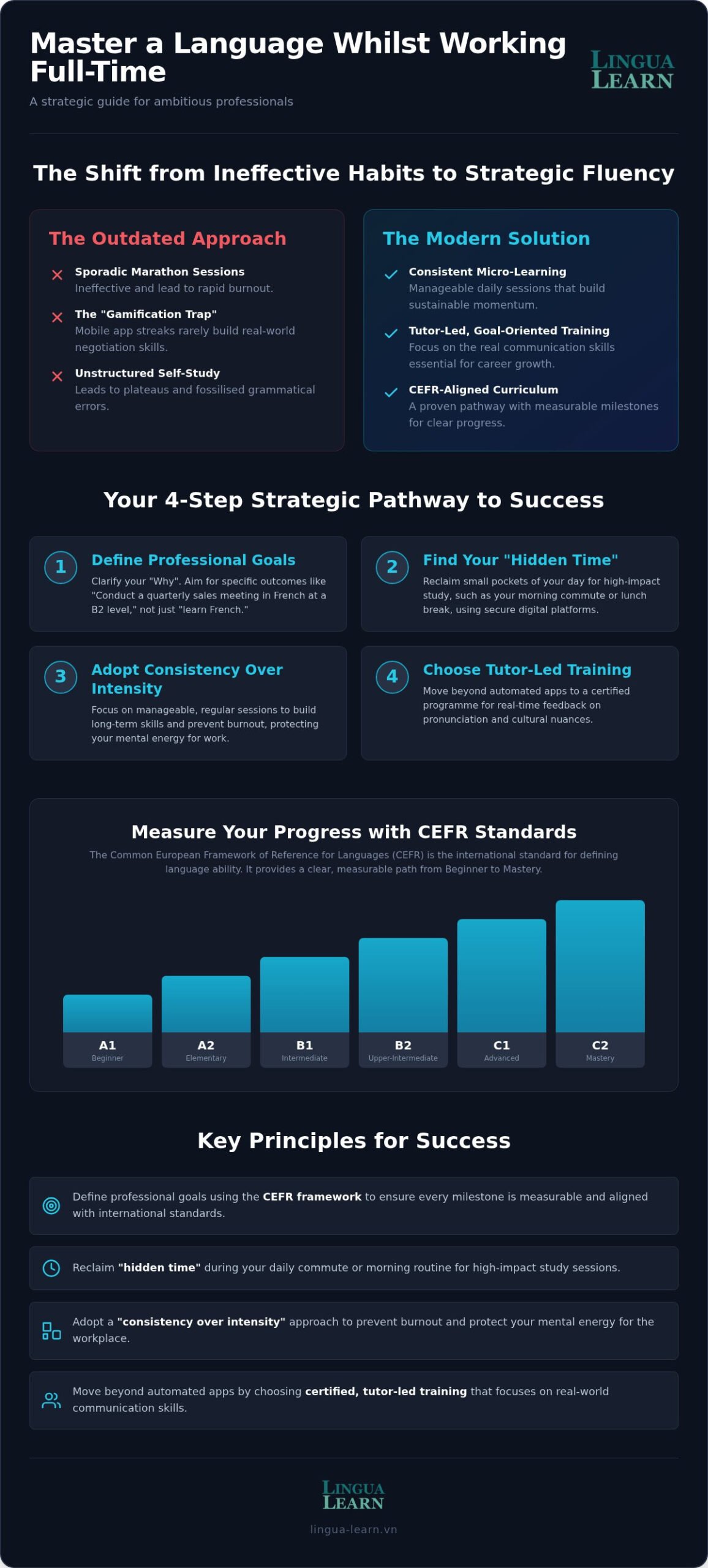
The secret to mastering how to learn a language while working full time lies in the “Consistency over Intensity” rule. Many professionals fall into the trap of the weekend binge; they attempt to cram four hours of study into a Saturday morning after a week of total neglect. This approach is rarely sustainable and often leads to rapid exhaustion. Instead, dedicating just 30 minutes daily creates a steady rhythm that allows your brain to process and retain information more effectively. Small, frequent sessions prevent the mental fatigue associated with marathon study blocks.
Managing your cognitive load is equally vital for long-term success. If you’ve just completed a high-stress board meeting or a complex negotiation, your mental energy is likely depleted. Attempting to tackle intricate grammar rules in this state is counterproductive. It’s better to choose a lighter task, such as listening to a familiar dialogue, or simply allowing yourself to rest. Professional support from Lingua Learn Vietnam includes both technical and administrative assistance, removing the friction that often derails busy executives. By outsourcing the organisation of your learning pathway, you can focus entirely on the content rather than the logistics.
Celebrating small wins is a powerful psychological tool to maintain momentum. Moving from A1 to A2 on the CEFR scale isn’t just a linguistic achievement; it’s a major career milestone that demonstrates persistence and global adaptability. These incremental victories provide the motivation needed to reach professional fluency and ensure your new skills remain a source of empowerment rather than stress.
Resilience is about your response to setbacks. If you miss a day due to an unexpected deadline, forgive yourself immediately and get back on track the following morning. Native-speaking tutors play a crucial role here, offering the encouragement and cultural context that an automated app simply cannot provide. For sustainable immersion, follow industry-specific social media or professional journals in your target language. This keeps your learning relevant to your sector whilst ensuring you’re constantly exposed to high-value vocabulary in a low-pressure environment.
The professional’s blueprint for success is our 8-step pathway. This structured journey ensures that every lesson builds logically on the last, taking you from an initial assessment to final certification with maximum efficiency. Don’t let another quarter pass without making progress on your linguistic goals. Taking the first step with a professional assessment is the most effective way to ensure your efforts are targeted, productive, and perfectly aligned with your career trajectory.
Achieving professional fluency is no longer a matter of finding extra hours in an already crowded schedule. It’s about shifting your approach toward strategic, high-quality training that works with your career rather than against it. By leveraging the CEFR framework to set measurable milestones and reclaiming hidden pockets of time for micro-learning, you can make consistent progress without the risk of burnout. The transition from a passive learner to an active global communicator requires a structured roadmap that respects your professional commitments.
Mastering how to learn a language while working full time is a significant step toward unlocking international leadership opportunities. Lingua Learn Vietnam supports your journey through a UK-managed LMS, CEFR-aligned certification, and the guidance of qualified native-speaking instructors. This professional environment provides the accountability and expertise needed to transform your communication skills and enhance your global presence. Every lesson is an investment in your future, ensuring your personal growth keeps pace with your professional ambitions.
Your path to mastering a new language is a strategic asset that will serve you throughout your career. We look forward to helping you reach your professional potential through a sustainable and rewarding learning experience that fits perfectly into your busy lifestyle.
Yes, it’s entirely possible to learn a language while working full time by adopting a strategic approach rather than a brute-force one. Success depends on integrating study into your existing routine through micro-learning and high-quality, guided instruction. By focusing on consistency and using professional pathways, you can make measurable progress without compromising your performance at the office or your personal well-being.
Most professionals find that dedicating three to five hours per week is the optimal balance for steady progress. Rather than a single long session, it’s more effective to spread this time across daily 30-minute blocks and two live lessons. This frequency keeps the language fresh in your mind and allows for better retention of complex business terminology without causing mental exhaustion.
Online courses are often more effective for adults as they provide greater flexibility and access to superior technology. Live interactive virtual classrooms with HD video and breakout rooms simulate real-world business collaboration more accurately than traditional desks. Additionally, the ability to join from the office or home eliminates travel time, making it much easier to maintain a sustainable routine.
In 2026, English remains the global standard, but Japanese, Chinese, and Korean are highly valuable for professionals in Vietnam due to strong regional trade ties. Your choice should align with your specific industry and career goals. For example, those in manufacturing or technology often find Japanese or Korean certifications particularly beneficial for leadership roles within multinational corporations.
To convince your employer, you should present a business case focused on the return on investment (ROI) and improved global competitiveness. Highlight how better communication skills will lead to more efficient negotiations, stronger international networking, and improved team cohesion. Providing a clear plan with CEFR-aligned assessments shows your manager that the training is a structured professional development tool rather than just a hobby.
If you miss a live session at Lingua Learn Vietnam, you can easily catch up by accessing the recording through our secure LMS. We understand that urgent work commitments can arise unexpectedly. Having 24/7 access to digital materials and lesson recordings ensures that your learning pathway remains uninterrupted, allowing you to review the content at a time that suits your schedule.
Reaching a B2 level of professional fluency typically requires several hundred hours of structured study, depending on the complexity of the language. When considering how to learn a language while working full time, most learners reach this benchmark in 12 to 18 months. Using a CEFR-aligned curriculum ensures that every hour you spend is focused on the specific skills needed to reach that level efficiently.
No special software installation is required to join our virtual classrooms. You can access your live lessons through a standard web browser using a single-click invitation link provided in your schedule. Our UK-managed technology is designed to be low-friction and accessible, ensuring you can focus entirely on your learning journey rather than troubleshooting technical issues.

Article by
Rob Holloway
Rob Holloway is the CEO of Lingua Learn Elevate Ltd (UK), the company operating Lingua Learn Vietnam. He works with businesses and organisations across Asia to provide high-quality online language training, corporate communication programmes and internationally recognised language certification preparation.
Working with organisations across industries including engineering, finance, technology, manufacturing and professional services, Rob helps identify language training needs and connect clients with tailored learning solutions delivered by Lingua Learn’s experienced academic team.
His professional focus includes corporate language training, business communication, cross-cultural communication, international education partnerships and helping organisations build the language skills needed to succeed in global business environments.
Through Lingua Learn Vietnam, Rob is committed to providing UK-managed online language training delivered by qualified instructors, helping professionals and organisations communicate with confidence in today’s international workplace.
 Vietnamese
  English (UK)