
Corporate language training ROI is one of the most important metrics for HR directors and business leaders investing in workforce development. If your company invests ₫500,000,000 in a new software suite, you expect a line-item breakdown of the efficiency gains, so why settle for “improved confidence” as the only metric for your team’s language skills? Many HR directors and business leaders in Vietnam find themselves in this exact position, struggling to justify the cost of development programmes when the results feel intangible. You’re likely familiar with the frustration of seeing high employee turnover shortly after a training investment or realising that the lessons don’t actually translate to better performance in international meetings. It’s difficult to scale a business globally when you can’t prove that your corporate language training return on investment is hitting the mark.
We understand that you need more than just “better communication” to satisfy the board. This strategic guide provides a clear, actionable framework to help you accurately measure, calculate, and maximise the financial and strategic impact of your training initiatives. We’ll examine how to align learning outcomes with your specific business KPIs, ensuring your workforce becomes a measurable engine for growth and global competitiveness. By the end of this guide, you’ll have the tools to transform language learning from a cost centre into a high-yield strategic asset.
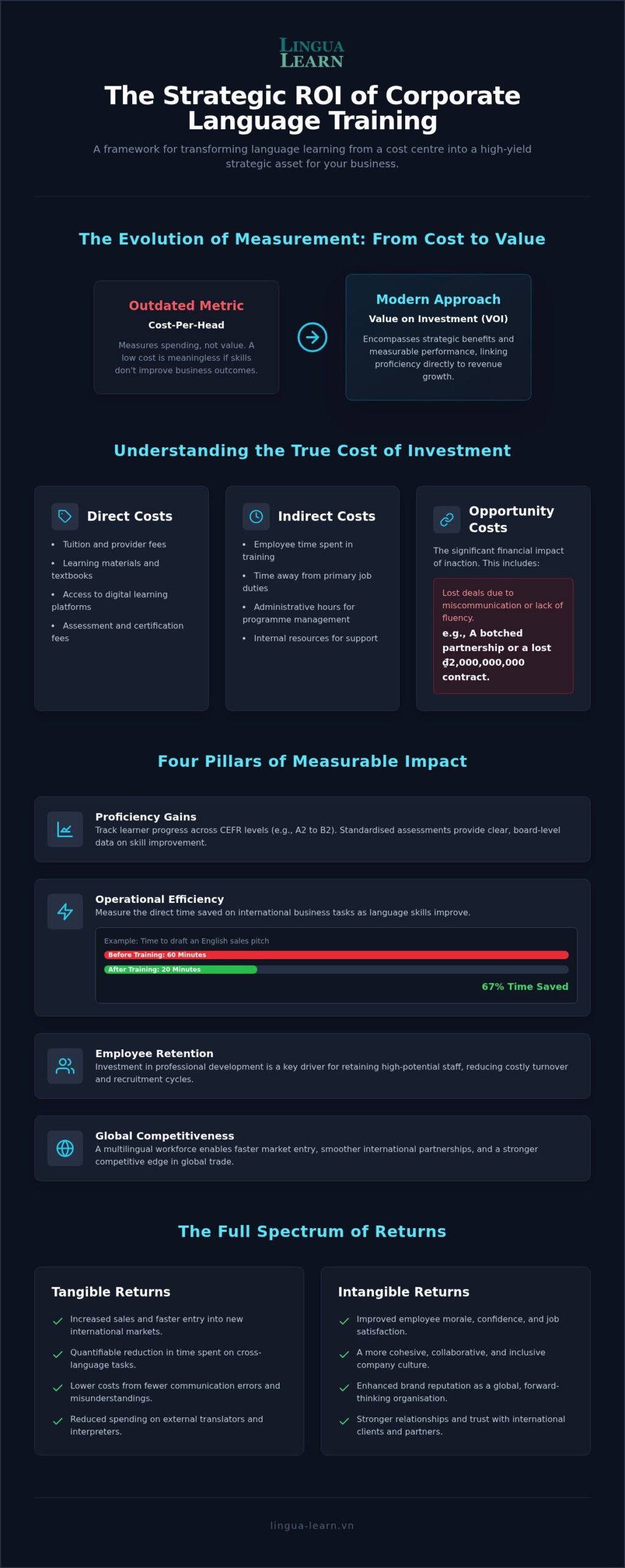
To define corporate language training ROI (return on investment), we must look far beyond simple line-item expenditure. At its core, ROI is the ratio of net profit generated by the training to the total cost of the programme itself. Whilst many businesses historically viewed language learning as a “perk” or a fixed overhead, the 2026 business environment demands a more rigorous financial perspective. Traditional “cost-per-head” metrics are increasingly seen as outdated because they measure spending rather than value. A low cost-per-head is meaningless if the training doesn’t result in a team that can successfully negotiate a contract in German or manage a supply chain in Japanese.
Instead, modern organisations are shifting towards “Value on Investment” (VOI). This broader lens encompasses the strategic benefits that don’t always appear immediately on a balance sheet, such as improved talent retention and a more cohesive company culture. The ultimate goal is measurable business performance, where linguistic proficiency acts as a direct lever for revenue growth. When your staff can communicate fluently with international partners, you reduce friction, speed up decision-making, and open doors to markets that were previously inaccessible.
Digital transformation has fundamentally changed how we track learning outcomes. By moving to online language courses, companies in Vietnam can significantly reduce overheads like travel expenses and physical classroom rentals. This shift allows for more granular data collection. When these programmes follow UK-managed standards, the quality of data is much higher, providing HR managers with a clear view of progress. As Vietnam solidifies its position in global trade, a robust corporate language policy becomes essential for maintaining a competitive edge. It’s no longer just about learning words; it’s about ensuring every hour spent studying translates into a more capable, globalised workforce.
To calculate an accurate ROI, you must account for all facets of the investment. It’s not just the invoice from your provider. A comprehensive calculation includes:
By identifying these variables, you can begin to see corporate language training return on investment as a strategic calculation rather than a simple expense. This clarity allows you to treat language training with the same financial scrutiny as any other capital investment.
Measurement isn’t just about the end result. It’s about the incremental shifts in behaviour that occur as a learner moves from a hesitant A2 level to a confident B2 speaker. Tracking these metrics is the only way to prove a positive corporate language training return on investment to your stakeholders. Many organisations make the mistake of only looking at final test scores, but a truly comprehensive evaluation looks at four distinct pillars of impact:
Data provides the objective proof that your budget is being spent wisely. Using a secure Learning Management System (LMS) allows you to track attendance and engagement rates in real-time, ensuring that employees are actually participating in the sessions you’ve funded. You can then analyse these participation rates alongside test scores and Chứng chỉ ngôn ngữ to see a direct correlation between effort and achievement. If you’re looking to establish a baseline for your team, you can contact our consultants to arrange a professional needs analysis.
Numbers only tell half the story; the other half is found in how your team carries themselves in the boardroom. Assessing employee confidence during professional networking events or high-stakes presentations provides insight into the “soft” benefits of training. You’ll likely notice a marked improvement in cross-cultural collaboration within your multinational teams as language barriers dissolve. These improvements are vital for those stepping into Language Skills for Leadership Roles, where clear communication is the foundation of authority. By focusing on these pillars, you can build a robust model for calculating corporate language training return on investment that satisfies even the most sceptical finance director.
Whilst the financial metrics discussed in the previous section provide the “what” of your investment, understanding the “why” requires looking at both tangible and intangible outcomes. A positive corporate language training return on investment manifests in ways that a spreadsheet might initially overlook, yet these factors often determine a company’s long-term survival in the competitive global marketplace. By distinguishing between these two types of returns, you can build a more persuasive case for continued professional development.
Tangible returns are the direct, observable results of improved linguistic ability. One of the most significant is the speed of entry into new international markets. When your business development team can communicate with local nuances, the time from initial contact to a signed contract decreases significantly. Consider a Vietnamese manufacturing firm seeking to partner with a German engineering conglomerate. Without the ability to navigate technical specifications and cultural etiquette in the partner’s preferred tongue, negotiations can stall for months. By removing these barriers, you aren’t just training staff; you’re accelerating your revenue pipeline. Similarly, you’ll see a sharp reduction in errors. Misunderstandings in logistics or project management often lead to costly delays that can run into hundreds of millions of ₫. Precision in language ensures that the first draft of a proposal is often the final one.
Intangible returns, though harder to pin down with a currency symbol, are equally vital for sustainable growth. In the hunt for top-tier talent across the nation, offering high-quality development makes your organisation a favourite amongst ambitious professionals. This enhances your employer branding, reducing recruitment costs over time. Within the office, you’ll notice improved workplace morale. When staff from different linguistic backgrounds can collaborate without friction, it fosters a more inclusive corporate culture where everyone feels heard and valued.
Multilingual teams are the vanguard of smoother international trade. They don’t just translate; they negotiate with empathy and cultural intelligence. Professional corporate language training acts as the bridge that allows your team to close global deals that others might miss due to a lack of rapport. This proactive approach is a cornerstone of Language Training for International Business, where the trend is moving toward deep linguistic immersion for specific commercial sectors. When your team speaks the language of your clients, you aren’t just a vendor; you’re a trusted partner.
Beyond profit, there’s the critical issue of protection. Miscommunication in legal contracts or operational manuals carries immense reputational and financial risk. By ensuring all staff can fully comprehend international safety and operational standards, you’re building a layer of compliance that protects the business from litigation. Clearer communication means fewer disputes over contract terms, ensuring that your corporate language training return on investment includes the avoidance of expensive legal fees and the protection of your brand’s integrity on the global stage.
Securing a budget for professional development requires more than a list of benefits. You need a robust proposal that speaks the language of the finance department. This means moving beyond generic “staff development” and showing how the programme directly supports your company’s 2026 strategic roadmap. Whether you’re targeting a specific expansion into the German market or aiming to streamline supply chain operations with partners in South Korea, every ₫ invested must have a corresponding business objective. Clear alignment ensures that the board sees the training as a necessity rather than an optional extra.
A critical component of a successful business case is the “Cost of Inaction”. What does it cost your firm NOT to have these skills? If your sales team lacks the fluency to negotiate complex terms, you’re likely losing significant revenue to competitors who can. This friction in communication isn’t just an inconvenience; it’s a financial leak. By framing the corporate language training return on investment as a risk-mitigation strategy, you highlight the danger of maintaining the status quo in an increasingly globalised market. Proving that training prevents loss is often just as persuasive as proving it generates profit.
Effective training must link directly to departmental targets. For instance, you might track how Business English training reduces the time it takes for your support team to resolve international tickets. When objectives are this specific, the value becomes undeniable. For a deeper look at local market conditions, our Online Corporate Language Training Vietnam guide offers insights into how leading firms are structuring their 2026 learning goals.
Transparency is the cornerstone of executive-level reporting. Utilising a UK-managed LMS provides the hard data required to prove ongoing engagement and progress. Unlike traditional in-person training, online virtual classrooms are highly scalable and offer recorded sessions. These recordings aren’t just for review; they serve as a vital tool for internal evaluation and quality assurance, ensuring that the corporate language training return on investment remains high across every department.
To achieve a high corporate language training return on investment, a structured approach is essential. Lingua Learn Vietnam utilises an 8-Step Learning Pathway to Success that removes the guesswork from professional development. This methodical process ensures that every ₫ spent is aligned with your corporate goals. The pathway is designed to provide the transparency that HR directors need whilst delivering the support that learners require to excel.
Steps 1 and 2 involve a comprehensive Needs Analysis and Pre-Assessment. This establishes a clear ROI baseline by identifying the current skill gaps within your team. Without this starting point, it’s impossible to measure growth accurately. Steps 3 and 4 focus on Custom Course Design and Delivery. Our qualified instructors create content that mirrors your daily business operations, ensuring that the vocabulary learned is immediately applicable to your specific industry.
Steps 5 and 6 provide transparency through Regular Attendance Reports and Final Exams. You can track mastery in real-time, seeing exactly how your staff are progressing through their CEFR levels. Finally, Steps 7 and 8 include Student Action Plans and Final Reports. These documents translate classroom learning into workplace performance, providing HR managers with the data needed to prove the programme’s success to the board. This closed-loop system ensures that the corporate language training return on investment is visible at every stage.
Customised programmes deliver a significantly higher ROI than generic, “one-size-fits-all” language apps. Whilst apps might help with basic vocabulary, they lack the professional context required for high-stakes negotiation or technical reporting. The inclusion of industry-specific terminology is particularly crucial in corporate soft skills training. When your team masters the nuances of professional etiquette alongside linguistic proficiency, they become far more effective ambassadors for your brand in the global market.
Transforming your team into a globalised workforce starts with a single, data-driven step. By conducting a professional Needs Analysis, you can identify exactly where your training budget will have the most significant impact. This proactive approach ensures that your development initiatives are targeted, efficient, and fully aligned with your 2026 strategic objectives.
The landscape of international business in Vietnam is evolving rapidly, and linguistic proficiency has become a non-negotiable asset for growth. By shifting from a cost-based mindset to one focused on corporate language training return on investment, you ensure that every development programme contributes directly to your bottom line. Whether it’s through faster market entry or improved employee retention, the data clearly shows that structured learning is a high-yield strategic investment.
Lingua Learn Vietnam provides the rigorous UK-managed training standards and the 8-Step Learning Pathway required to deliver these measurable results. Trusted by global brands across Asia, our approach ensures that your team’s progress is transparent and aligned with your specific corporate KPIs. It’s time to stop guessing the impact of your training and start seeing the transformation in your workforce performance.
We look forward to partnering with you on your journey towards building a truly globalised and empowered team.
You calculate ROI by dividing the net profit generated by the training by the total cost of the programme. This involves subtracting the total investment, including tuition fees and the value of employee time, from the financial gains such as increased international sales or time saved on tasks. In the Vietnam market, this often requires looking at specific ₫ gains from new global contracts or a reduction in the cost of external translation services.
The most vital metrics include standardised proficiency gains, attendance rates, and employee engagement scores. Beyond these, you should track operational efficiency gains like the reduction in time spent drafting international emails or the success rate of foreign-language negotiations. These indicators provide a holistic view of the corporate language training return on investment by showing how skills translate into daily business performance.
Initial returns often manifest within three to six months of starting an intensive programme. You’ll typically see immediate improvements in employee confidence and a reduction in communication friction during internal meetings. Long-term financial returns, such as successfully entering a new market like Japan or Germany, generally consolidate after a full course cycle of 40 to 60 hours of targeted instruction.
Online training often yields a higher ROI because it eliminates travel expenses and physical facility costs. Virtual classrooms provide greater scheduling flexibility, which reduces the indirect cost of employee downtime during the workday. Digital platforms also offer superior data tracking and session recording, making it easier for HR teams to provide the transparency required for executive-level reporting.
The cost of inaction is the financial and strategic loss incurred by failing to address linguistic gaps. This includes lost revenue from botched international bids, the high price of hiring external consultants for basic communication, and the expense of replacing top talent who leave for companies with better development programmes. It represents a significant, though often hidden, drag on a firm’s global competitiveness.
Lingua Learn utilises a structured 8-Step Learning Pathway to Success that begins with a professional needs analysis and pre-assessment. This process establishes a clear baseline for every participant. By applying UK-managed standards and proprietary tracking technology, we provide organisations with transparent data on attendance, real-time engagement, and final proficiency gains against initial benchmarks.
CEFR alignment provides a globally recognised framework for measuring linguistic progress objectively. It allows your business to move away from subjective “fluency” claims to verifiable data. When your team moves from an A2 to a B1 level, it represents a specific milestone in their ability to handle complex professional tasks independently, making it easier to justify the corporate language training return on investment.
HR dashboards offer real-time transparency into the progress and participation of every learner across the organisation. They allow managers to monitor attendance and test scores instantly, ensuring that the training budget is being utilised effectively. This level of oversight provides the hard evidence needed to report success to the board and adjust training strategies as business needs evolve.

Article by
Rob Holloway
Rob Holloway is the CEO of Lingua Learn Elevate Ltd (UK), the company operating Lingua Learn Vietnam. He works with businesses and organisations across Asia to provide high-quality online language training, corporate communication programmes and internationally recognised language certification preparation.
Working with organisations across industries including engineering, finance, technology, manufacturing and professional services, Rob helps identify language training needs and connect clients with tailored learning solutions delivered by Lingua Learn’s experienced academic team.
His professional focus includes corporate language training, business communication, cross-cultural communication, international education partnerships and helping organisations build the language skills needed to succeed in global business environments.
Through Lingua Learn Vietnam, Rob is committed to providing UK-managed online language training delivered by qualified instructors, helping professionals and organisations communicate with confidence in today’s international workplace.
 Vietnamese
  English (UK)