
Did you know that whilst Vietnam is projected to face a deficit of 800,000 tech workers by the end of 2026, the most lucrative roles are reserved for those who can bridge the gap between code and commerce? Mastering business English for IT professionals has become the essential “operating system” for any developer looking to thrive in a global market. You likely know the frustration of feeling invisible during international stand-up meetings or struggling to explain technical debt to stakeholders who don’t share your specialised background.
We understand that being a brilliant engineer shouldn’t mean your voice goes unheard. This guide will show you exactly how to sharpen your communication to lead sprint demos with confidence and write documentation that stakeholders actually value. We’ll explore the specific language skills you need to navigate Jira requirements and secure high-paying roles in international firms. By the end, you’ll see why so many developers partner with Lingua Learn Vietnam to ensure their career trajectory matches their technical talent.
In 2026, technical prowess is the entry fee, but communication is the differentiator. Whilst Vietnam faces a projected deficit of 800,000 IT professionals, the competition for top-tier roles in international firms is fiercer than ever. Simply writing clean code isn’t enough when you’re part of a distributed global team. Mastering business English for IT professionals has shifted from a “nice-to-have” soft skill to a critical hard skill that dictates your career ceiling.
This evolution aligns with the principles of Business Informatics, where information systems must be perfectly aligned with organisational goals. If you can’t articulate how a specific microservices architecture supports the business’s bottom line, your technical expertise remains trapped. Coding in a vacuum is a relic of the past; today’s developers must be collaborative architects who can bridge the gap between complex logic and stakeholder value.
Data from April 2026 shows that average IT compensation in Vietnam has surged by 35% year-over-year. However, the highest hourly rates, such as those for Senior Architects earning up to $85 per hour, are almost exclusively found in organisations where English is the primary language of operations. Technical jargon might help you pass a leetcode test, but it won’t help you lead a department or manage a cross-border project.
Clear communication is a direct cost-saving measure. Project delays often stem from misinterpreted requirements in Jira or poorly defined documentation. When you can clarify a blocker in seconds during a stand-up, you save hours of wasted development time. Mastering business English for IT professionals is about reducing this friction. For those looking to advance, our Business English Training focuses on these high-stakes scenarios. Proficiency also unlocks global tech communities and high-level certifications that aren’t available in local languages, giving you a distinct edge in the global talent pool.
There is a vast difference between being “fluent” and being “authoritative”. Conversational English might get you through a coffee break, but professional authority allows you to persuade a CTO to invest in refactoring technical debt. It’s about precision. Using the right verbs to describe a system failure or the correct tone when you need to push back on a deadline builds immense credibility. Establishing this trust with international clients requires moving beyond basic grammar to mastering the nuances of professional persuasion and clarity.
Modern software development operates in rapid Agile cycles, making efficient communication as vital as efficient code. For those refining their business English for IT professionals, the daily stand-up is the first daily test of clarity. Instead of rambling, use structured phrases to provide updates: “Yesterday, I completed the API integration,” “Today, I’ll be refactoring the legacy authentication module,” or “I’ve hit a blocker with the environment credentials.” This precision ensures your team stays aligned without wasting valuable development time.
The art of the demo lies in storytelling rather than just code execution. Don’t just show the feature; show the solution. Instead of saying, “I implemented a debounced search input,” try, “We’ve made the search feature more responsive to improve the user experience.” This shift in perspective demonstrates that you understand the business value of your work. Participating in peer reviews and retrospectives also requires a delicate balance of technical rigour and professional courtesy. According to the Harvard Division of Continuing Education, there are 5 Communication Skills Tech Leaders Need, and active listening sits at the top of that list. When reviewing a colleague’s pull request, use “I suggest” or “Have we considered…” rather than blunt corrections to maintain a healthy team culture.
Stakeholders care about outcomes, not the intricacies of your Docker configuration. Use analogies to explain complex architecture; for instance, explain technical debt as “taking out a high-interest loan that makes future building more expensive.” If a CEO asks for a definition, you might say: Functional requirements are the specific actions a system must perform to satisfy a business need. Focus on how a feature saves money or increases user retention to establish your authority as a business-minded developer.
Written communication is the backbone of remote tech teams. Whether you’re writing Jira tickets or README files, conciseness is your best friend. Organise documentation with clear headings and bullet points so a developer in another time zone can understand your API without a call. Tone also matters in Slack; a short, blunt message can often be misinterpreted as aggressive. Adding a simple “Could you please look at this?” or “Thanks for the help” goes a long way in building rapport amongst international colleagues. If you’re finding it difficult to express these nuances, you might want to speak with our advisors about customising a training plan for your team.
Vietnamese developers often face unique linguistic challenges that aren’t addressed in generic textbooks. Whilst technical skills are high, the cultural “Yes-culture” can lead to over-promising and missed deadlines. Learning to say “no” or “not yet” diplomatically is a core part of business English for IT professionals. Instead of a blunt “I can’t do that,” try “I’m currently prioritising the database migration; could we discuss the timeline for this new feature tomorrow?” This manages expectations without causing friction.
Intelligibility matters far more than a perfect accent. In technical discussions, mispronouncing words like “architecture”, “hierarchy”, or “cache” can cause confusion. Focus on clear vowel sounds and correct word stress. If you’re in a high-pressure live coding interview, don’t let the fear of a grammatical slip-up freeze you. International teams prioritise logic and problem-solving over perfect syntax. Remember that “Global English” is about being understood by diverse teams, not sounding like a native speaker.
Building rapport often happens in the three minutes before a meeting starts. Small talk in tech doesn’t have to be about the weather. Ask about a colleague’s recent project or their thoughts on a new framework. Understanding the difference between direct and indirect communication is vital. Western hubs often prefer “bottom-line” updates. In contrast, Asian hubs might value more context. When disagreements arise during sprint planning, frame your critique as a technical alternative: “That’s an interesting approach, but have we considered the latency implications?”
Technology should be your ally, not a crutch. Use AI tools to polish your emails, but ensure the final output still sounds like you. Recording your own presentations or demos for self-assessment is one of the fastest ways to improve. You’ll notice patterns in your speech that you might miss in the moment. To maintain a “tech-English” immersion environment, listen to industry podcasts or read news from global sources. This keeps your vocabulary current. Mastering business English for IT professionals requires this consistent, multi-faceted approach. At Lingua Learn Vietnam, we integrate these real-world tools into our Corporate Soft Skills Training to ensure your growth is measurable and sustainable.
Improving your command of business English for IT professionals requires a structured approach that mirrors your technical learning path. You wouldn’t attempt to master a new framework by simply reading the documentation; you’d build a project and iterate. Language acquisition works in the same way. It is a strategic process of identifying weaknesses and deploying targeted solutions to fix them.
To move from a passive understanding to active professional authority, follow this five-step framework:
Define what “proficiency” looks like for your specific role. Most Vietnamese IT professionals currently operate at a B1 level on the CEFR framework. To secure a senior position or a leadership role in a global firm, aiming for C1 is usually the required benchmark. Remember that consistency is far more effective than intensity. Spending twenty minutes every day on prioritised communication tasks is significantly better for long-term retention than a four-hour session once a fortnight.
Generic language courses often fail because they don’t address the niche vocabulary of the software development life cycle. A coach with corporate experience understands the difference between “debugging” and “troubleshooting” and can simulate high-stakes scenarios like defending a budget for refactoring legacy code. This targeted approach ensures that your training is directly relevant to your daily tasks. If you’re ready to accelerate your career growth, you can book a consultation with our team to discuss a tailored learning pathway designed specifically for the tech industry.
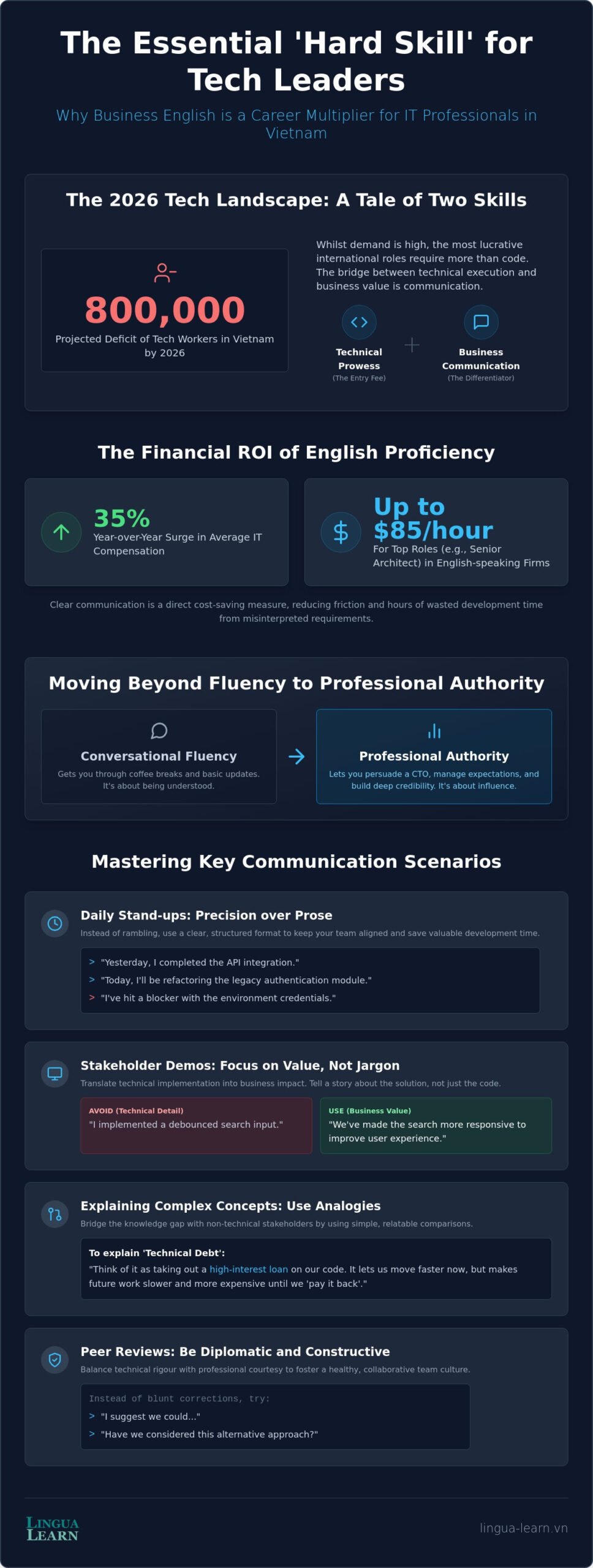
The projected deficit of 800,000 IT professionals in Vietnam by the end of 2026 presents a massive opportunity for those who can communicate effectively on a global stage. Technical skill alone is no longer the sole predictor of success; your ability to articulate value is what secures the most prestigious roles. At Lingua Learn Vietnam, we provide a specialised Business English Training programme specifically designed to help developers and architects bridge this gap. Our approach moves beyond generic grammar to focus on the high-stakes communication required in modern software development.
We guide our students through a methodical 8-Step Learning Pathway that ensures every lesson translates into measurable workplace results. This journey begins with a comprehensive initial assessment and follows a structured flow of curriculum design, expert coaching, and regular feedback loops. Because our online classroom is built for busy professionals, you can join sessions from anywhere in Vietnam without the friction of a commute. Our UK-managed standards and team of certified, experienced instructors ensure that you are learning the nuances of business English for IT professionals from experts who understand international corporate expectations.
We don’t believe in one-size-fits-all education. Our instructors customise curricula to match your specific tech stack and daily workflow, whether you’re working in AI, cloud architecture, or mobile development. We understand the pressure of delivery dates, so we offer flexible scheduling that accommodates your sprint cycles and project deadlines. If you miss a live session due to a critical deployment, you can access our secure Learning Management System (LMS) 24/7 to review recorded materials and stay on track with your professional development goals.
The first step towards a higher-paying international role is understanding where you currently stand. We invite you to book a pre-assessment to determine your current CEFR level and identify the specific linguistic “bugs” holding you back. For our corporate clients, we provide detailed reporting that allows HR managers and team leads to track progress and see the return on investment in their talent’s growth. Don’t let your technical expertise be limited by a language barrier. Contact Lingua Learn Vietnam today to design your professional English roadmap and unlock your full potential in the global tech economy.
The 2026 technology landscape demands more than just technical brilliance; it requires the ability to influence, persuade, and lead within global teams. Moving from a technical expert to a global leader involves mastering the specific nuances of business English for IT professionals. You’ve discovered how scenario-based learning and cultural awareness can transform your daily stand-ups and stakeholder demos from stressful hurdles into opportunities for professional growth.
Lingua Learn Vietnam is your trusted partner in this journey. Our UK-managed technology and standards ensure a world-class experience, whilst our CEFR-aligned curriculum provides a transparent map for your progress. Trusted by global brands across Asia, we provide access to experienced, certified native-speaking tutors who understand the unique pressures of the software development lifecycle. We don’t just teach language; we help you build the authority needed to excel in international firms.
Don’t let your technical talent be limited by a communication barrier. Enquire about our tailored Business English courses today and take the first step toward securing the high-impact roles you’ve worked so hard to achieve. We look forward to helping you turn your technical expertise into global authority.
Business English for IT focuses on the specific linguistic requirements of the software development lifecycle rather than general social conversation. It prioritises precision in technical documentation and the ability to explain complex logic to stakeholders. Whilst general English might help you navigate social settings, mastering business English for IT professionals ensures you can lead a high-pressure incident report or a cross-border project negotiation with absolute clarity.
Yes, you can effectively balance language learning with a full-time tech role through flexible online training programmes. Most developers find that sessions scheduled around their sprint cycles or in the evenings are the most sustainable. Our online language courses allow you to join from any location in Vietnam, providing the flexibility needed to maintain a consistent learning habit without disrupting your project deadlines or deployment schedules.
The most effective way to prepare for technical interviews is to practice explaining your logic out loud whilst you are actually coding. Focus on using active verbs to describe your problem-solving process and practice common behavioural questions using the STAR method. Mock interviews with a professional coach can help you refine your delivery and ensure you are using the precise terminology that international recruiters expect from senior candidates.
Most professionals notice a significant shift in their communication confidence within three to six months of consistent practice. Whilst full fluency is a long-term goal, the ability to lead a stand-up or write clearer documentation often develops much faster. Success depends on focusing on scenario-based learning rather than memorising isolated words, ensuring that every lesson is directly applicable to your current workplace tasks.
No, you don’t need to lose your accent to be successful; you only need to ensure your speech is intelligible to a diverse audience. Global tech teams are comprised of professionals from all over the world, so they value clarity and logical structure over sounding like a native speaker. Focus on correct word stress and clear vowel sounds in technical terms to ensure your expertise is never misunderstood by your international colleagues.
You can communicate more effectively by replacing technical jargon with business-focused analogies that resonate with a client’s specific goals. Instead of explaining the intricacies of a database migration, focus on how the upgrade improves system reliability and reduces long-term operational costs. Always lead with the “why” before the “how” to ensure your non-technical stakeholders understand the business value of your technical recommendations.
Whilst there isn’t a single “IT-only” English certificate, international benchmarks like the CEFR levels are the gold standard for global firms. Most international companies in Vietnam look for B2 or C1 proficiency levels to fill leadership roles. At Lingua Learn Vietnam, we use these frameworks to provide measurable progress reports, ensuring your training meets the rigorous standards expected by top-tier technology organisations worldwide.
We tailor our training by integrating your specific technical stack and daily professional challenges directly into the curriculum. Our instructors use real-world scenarios, such as conducting code reviews or defending a budget for refactoring, to make the learning process relevant. By combining UK-managed standards with certified tutors, we ensure that every lesson helps you build the authoritative voice needed to excel in the global business English for IT professionals market.

Article by
Rob Holloway
Rob Holloway is the CEO of Lingua Learn Elevate Ltd (UK), the company operating Lingua Learn Vietnam. He works with businesses and organisations across Asia to provide high-quality online language training, corporate communication programmes and internationally recognised language certification preparation. Working with organisations across industries including engineering, finance, technology, manufacturing and professional services, Rob helps identify language training needs and connect clients with tailored learning solutions delivered by Lingua Learn’s experienced academic team. His professional focus includes corporate language training, business communication, cross-cultural communication, international education partnerships and helping organisations build the language skills needed to succeed in global business environments. Through Lingua Learn Vietnam, Rob is committed to providing UK-managed online language training delivered by qualified instructors, helping professionals and organisations communicate with confidence in today’s international workplace.
 Vietnamese
  English (UK)