Success in a high-stakes boardroom in Beijing or Shanghai isn’t determined by who has the loudest voice, but by who understands the silence between the words. You’ve likely felt the frustration of a deal stalling despite a seemingly perfect pitch; this often happens because of a subtle cultural misstep or a misunderstood cue. Mastering Mandarin for business negotiations is about much more than simple vocabulary. It’s about navigating the delicate balance of Mianzi, or face, and the reputation that defines every professional interaction in the region.
We recognise that your corporate team needs more than just a basic phrasebook to close successful deals. In this guide, we’ll show you how to master the linguistic nuances and cultural strategies required to build deep trust, known as Guanxi, with your international partners. You’ll learn to decode the hidden meanings in Chinese dialogue and discover how to approach every meeting with quiet confidence. We’ll also outline how tailored training provides a measurable ROI, transforming your communication into a powerful strategic asset that secures your place in the global market.
In the current global economy, viewing Mandarin for business negotiations as a mere translation exercise is a strategic error. It is a sophisticated professional skill that goes far beyond simply swapping words from one language to another. When you engage with partners in major Asian trade centres, your linguistic proficiency serves as the primary foundation of trust. It demonstrates a level of commitment and respect that goes beyond the balance sheet. In these environments, dialogue often shifts towards Tan Pan. This term describes the dual process of discussing terms whilst simultaneously judging the character and reliability of the person across the table. If your team cannot participate in this nuanced dance, they aren’t just losing the message; they’re losing the deal.
At Lingua Learn Vietnam, we’ve seen how this shift from basic communication to strategic mastery changes the dynamic of a boardroom. For logistics professionals and trade teams, the ability to speak the language of their counterparts is no longer a luxury. It’s a requirement for ensuring that complex supply chains and high-value contracts remain secure. When you understand the underlying cultural architecture, you move from being a foreign vendor to a trusted collaborator.
Relying solely on interpreters can be a significant disadvantage in high-stakes deals. Whilst translators are technically skilled, they often miss the subtle emotional shifts or the “hidden” meanings that occur in real-time. The psychological impact of speaking a partner’s language in their own cultural context is profound. It signals that you value their perspective and are prepared to meet them on their terms. This approach is essential for moving past one-off transactions and fostering the type of long-term collaboration that relies on the concept of Guanxi, or deep personal networks. When you remove the middleman, you build a direct line of trust that an interpreter simply cannot replicate.
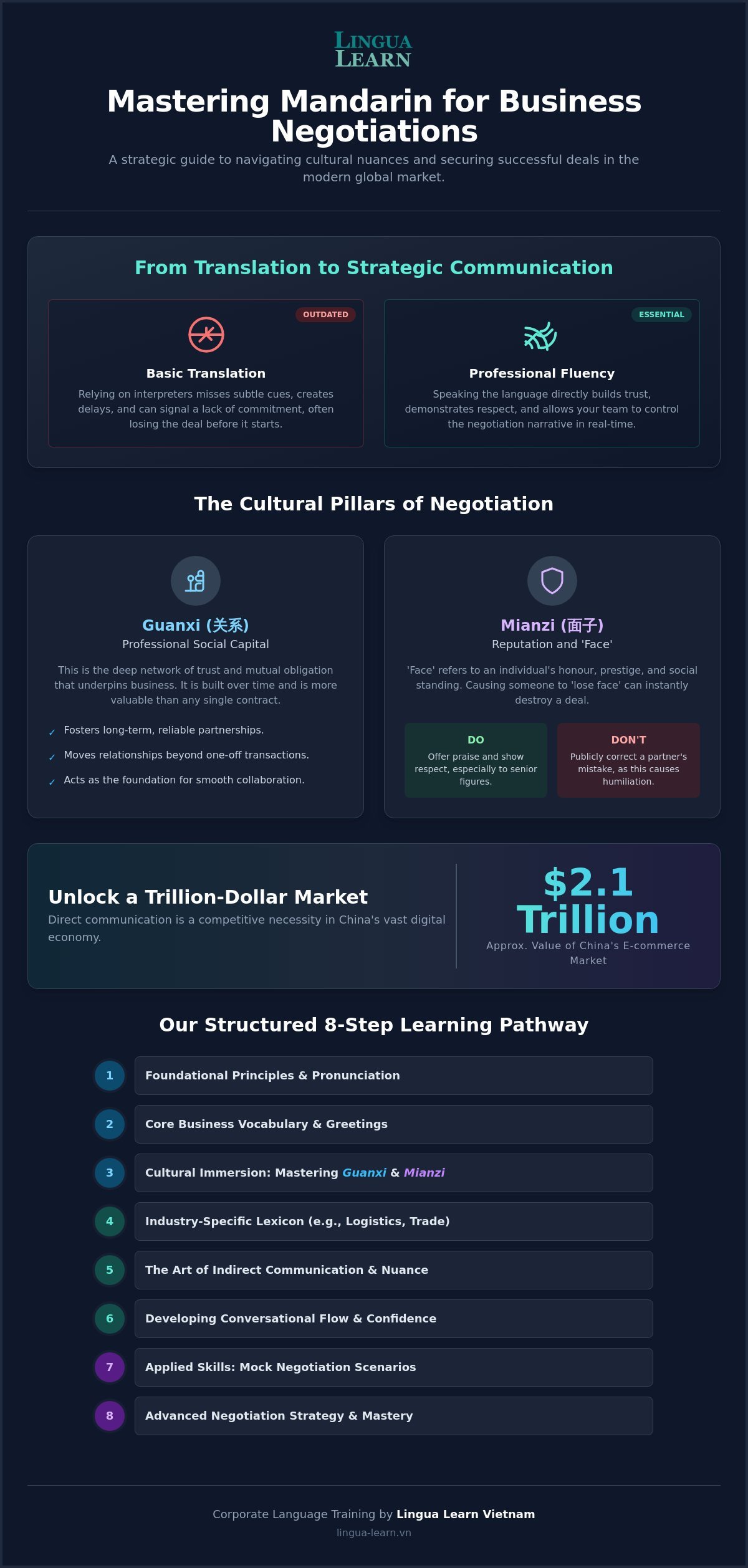
As we look toward the trade landscape of 2026, the expansion of Asian trade corridors makes professional fluency more relevant than ever. With China’s e-commerce market valued at approximately $2.1 trillion, the ability to communicate directly with stakeholders is a competitive necessity. We define business Mandarin as a bridge for cross-border synergy in modern trade, allowing teams to align their objectives without the friction of language barriers. For those in specific sectors, such as supply chain management, mastering Mandarin for logistics professionals ensures that every link in the trade chain remains secure and efficient. This level of fluency allows your team to spot opportunities and mitigate risks that remain invisible to those who rely on translation apps or third-party agencies.
Successful Mandarin for business negotiations relies on understanding that a contract is often viewed as the start of a relationship, not the final word. This perspective stems from the Confucius system, which emphasises hierarchy and social harmony. At the heart of this system are two dynamic forces: Guanxi and Mianzi. These aren’t merely abstract concepts; they are the invisible architecture of every deal. Whilst Western negotiators might focus on the legalities of a document, your counterparts are likely assessing your reliability through a lens of Chinese-style negotiation, where personal trust carries as much weight as a signature.
Guanxi acts as a mechanism for building professional social capital. It’s the network of connections that allows business to flow smoothly. Mianzi, or “face,” relates to a person’s reputation and standing. In a boardroom, causing a partner to lose face can terminate a negotiation instantly. For example, correcting a senior executive’s figures in front of their team is often seen as a public humiliation. Such a mistake signals a lack of cultural intelligence that can be impossible to recover from. If your team is preparing for a high-stakes market entry, you can speak with our consultants to tailor a programme that covers these critical social dynamics.
Organising social interactions is a vital part of the negotiation process. These sessions, often involving formal dinners or tea ceremonies, are where the real work happens. You can strengthen business ties by following these practical steps:
Effective Mandarin for business negotiations requires a high degree of emotional intelligence to protect your partner’s reputation. Delivering critical feedback must be handled with extreme care. Instead of a direct “no,” use indirect language to suggest that a proposal “might be difficult to implement.” This allows the other party to modify their position without losing face. You should also use praise strategically. Publicly acknowledging a counterpart’s expertise can break through a deadlock by making them feel valued. Finally, pay close attention to social cues. The person doing the most talking isn’t always the decision-maker; the ultimate authority often sits quietly, observing the group’s hierarchy and your team’s behaviour.
Mastering Mandarin for business negotiations requires a shift away from direct, westernised communication styles towards a more nuanced, indirect approach. In many professional settings, being too blunt or confrontational can stall progress. Instead of using definitive “no” statements, successful negotiators employ linguistic techniques that allow for clarification whilst maintaining harmony. For instance, using phrases like “we might need more time to consider this” or “this part is slightly difficult” signals a need for adjustment without causing a deadlock. These subtle cues are essential for keeping the dialogue open and productive.
Indirect language is particularly effective when exploring ‘what-if’ scenarios. Rather than asking for a specific price drop, a team might ask how the terms would change if the order volume increased. This allows both parties to test boundaries without making formal commitments too early. Interpreting silence is equally vital. In Mandarin dialogue, a pause isn’t necessarily a sign of agreement or a void to be filled; it’s often a period of careful reflection or a polite signal of hesitation. Recognising this allows your team to wait for a thoughtful response rather than rushing to fill the gap with unnecessary concessions.
The Chinese word for negotiation, Tan Pan, offers a fascinating insight into the process. The first character, Tan (谈), translates to “talk” or “discuss,” whilst the second, Pan (判), means to “judge” or “decide.” Moving from the discussion phase to the judgment phase requires a smooth transition that respects the relationship built so far. It’s helpful to remember that ‘Tan Pan’ is a mechanism for building trust, not just debating price. By focusing on the ‘Tan’ phase through open-ended questions and shared goals, the ‘Pan’ phase becomes a collaborative decision-making process rather than a confrontational battle of wills.
Whilst traditional proverbs are often cited in academic texts, they remain highly relevant in contemporary corporate settings. Adapting these concepts allows teams to use dialectic logic to find middle ground in complex disagreements. This involves looking at the “big picture” and understanding how a small compromise today can lead to significant gains in the future. For those looking to build these skills from the ground up, our Mandarin for adults courses provide the foundational vocabulary and cultural context needed to apply these stratagems effectively. Using the right vocabulary for bargaining and closing ensures that both sides feel they’ve achieved a “win-win” outcome, securing a stable foundation for your professional partnership.
Investing in Mandarin for business negotiations is most effective when approached as a collective team effort rather than an individual pursuit. In a high-stakes meeting, consistency across departments is vital. If your lead negotiator understands the cultural nuances of a deal but your technical or legal leads inadvertently cause a “loss of face” through direct confrontation, the entire partnership can be compromised. Team-based learning ensures that every person in the room speaks the same cultural and linguistic language, creating a unified front that commands respect and builds trust more rapidly.
By 2026, online delivery has become the preferred choice for busy professional teams. The flexibility of live virtual classrooms allows executives to join sessions from different time zones, ensuring that global operations remain aligned. At Lingua Learn Vietnam, we’ve seen that this digital-first approach doesn’t just save on travel costs; it provides a consistent training environment where teams can practice real-world scenarios together. This shared experience is what transforms a group of individuals into a cohesive unit capable of securing better terms in any boardroom.
Generic language courses often fail to provide the specific tools needed for professional success. A sales team requires a completely different set of vocabulary and strategies than an engineering or finance department. We begin every programme with a detailed “Needs Analysis” to identify the precise linguistic requirements of your sector. This ensures that your team isn’t wasting time on irrelevant phrases but is instead mastering the high-value terminology that drives results. For those looking to broaden their professional development, our corporate skills training can be integrated to provide a comprehensive approach to international communication.
One of the biggest challenges for HR managers is justifying the spend on language training. We address this by using the Common European Framework of Reference for Languages (CEFR) standards to provide a clear, internationally recognised benchmark for progress. Our proprietary Learning Management System (LMS) tracks attendance and performance in real-time, allowing for regular, data-driven reports. This level of accountability ensures that the training is a measurable business investment with a clear ROI. Final-course exams and personalised student action plans further ensure that the knowledge is retained and applied directly to your company’s specific negotiation goals.
Mastering Mandarin for business negotiations requires a partner who understands both the linguistic demands and the corporate environment. Lingua Learn Vietnam provides a sophisticated online training solution that mirrors the high standards of your own organisation. By shifting focus from generic language learning to strategic cultural execution, we empower your team to lead meetings with confidence. Our approach ensures that your staff don’t just speak the language, but they also command the room, securing a distinct competitive advantage in the global market.
Our methodology is centred on the 8-Step Learning Pathway to Success. This comprehensive process begins with a detailed pre-assessment to align our curriculum with your specific corporate objectives. Throughout the programme, your team is guided by certified, native-speaking instructors who bring real-world business experience to every lesson. This ensures that every hour spent in our virtual classroom translates directly into improved performance in your international deals.
We manage our learning technology according to strict UK security and data standards, providing a professional and stable platform for your corporate training. A key benefit of our digital delivery is the ability to record every live session. This allows your team to review complex negotiation tactics or specific linguistic nuances at their own pace, reinforcing their learning long after the class has concluded. Our virtual classrooms replicate the engagement of in-person training, using interactive tools to ensure every participant remains focused and productive.
Launching a training initiative shouldn’t be a complex administrative burden. We’ve streamlined our process to be as efficient as possible for busy executives. You can begin by booking a consultation for a customised needs analysis, where we’ll help you define the specific industry vocabulary and cultural strategies your team requires. Once the programme is live, participants receive simple one-click invitation links for immediate access. If you’re ready to see a measurable ROI on your team’s communication skills, contact us for a bespoke quote today.
To find out more about how our tailored language solutions can support your business growth, please enquire about our courses with Lingua Learn Vietnam.
Navigating international markets requires more than just technical expertise; it demands a deep understanding of the people behind the deals. By prioritising Mandarin for business negotiations, your team moves from being a mere observer to an active, respected participant in the boardroom, whilst demonstrating a sincere commitment to your partners’ culture. You’ve seen how mastering the cultural nuances of face and relationship-building can prevent stalled contracts and open doors to long-term collaboration.
Lingua Learn Vietnam ensures your training is a strategic business investment rather than a simple expense. Our 8-Step Learning Pathway to Success and CEFR-aligned curriculum provide a clear, international standard for measuring progress. Through our UK-managed LMS and technology, your team gains access to a secure, high-quality learning environment that fits seamlessly into a busy professional schedule.
The opportunities in the Mandarin-speaking business world are vast and growing. Equip your team with the tools they need to lead with confidence and secure the partnerships that will define your company’s future success.
Yes, your team can certainly start learning Mandarin for business negotiations as absolute beginners. We introduce foundational linguistic structures alongside essential cultural concepts like Mianzi (face) from the very first session. This ensures that even those with no prior experience begin building the strategic communication skills required for professional interactions in Mandarin-speaking markets.
Measurable results are typically visible after completing a full course cycle, which usually spans 30 academic hours. By following our 8-Step Learning Pathway to Success, teams move from initial assessment to practical application quickly. You’ll see increased confidence in boardroom settings and a better grasp of negotiation etiquette within the first few months of consistent training.
General Mandarin focuses on daily social interactions, whilst business-specific training targets the vocabulary and cultural architecture of the professional world. Our Mandarin for business negotiations curriculum emphasises high-stakes communication, such as bargaining, contract discussions, and trust-building. We prioritise the strategic use of language to achieve specific corporate outcomes rather than just basic conversational fluency.
The Common European Framework of Reference for Languages (CEFR) provides an internationally recognised benchmark for your team’s proficiency. We use these standards to map out clear learning objectives and assess progress from A1 (Beginner) through to C2 (Proficient). This framework allows HR managers to see exactly where each employee stands and ensures the training meets global certification standards.
All our training sessions are delivered live in virtual classrooms via platforms like Zoom or Microsoft Teams. We don’t use pre-recorded videos as the primary teaching tool because interactive, real-time dialogue is essential for mastering negotiation skills. This format allows students to receive immediate feedback from certified instructors and practice scenarios with their colleagues in a supportive environment.
Yes, we can customise the curriculum to align with your specific sector, whether it’s logistics, manufacturing, or finance. We perform a thorough Needs Analysis before the programme begins to identify the technical terminology and industry scenarios most relevant to your business. This ensures that your team learns the precise language required to manage supply chains or negotiate production contracts effectively.
Our proprietary Learning Management System (LMS) provides HR managers with real-time data on employee attendance, participation, and test scores. You’ll receive regular performance reports that justify the training spend and highlight areas of improvement. This level of transparency makes it easy to track the ROI of the programme and ensure that your team is meeting its professional development goals.
If a team member misses a live virtual session, they can access a recorded version of the class through our LMS. This allows busy professionals to catch up on missed content at their convenience without falling behind the rest of the group. These recordings also serve as a valuable resource for reviewing complex negotiation tactics or specific vocabulary before an important meeting.

Article by
Rob Holloway
Rob Holloway is the CEO of Lingua Learn Elevate Ltd (UK), the company operating Lingua Learn Vietnam. He works with businesses and organisations across Asia to provide high-quality online language training, corporate communication programmes and internationally recognised language certification preparation. Working with organisations across industries including engineering, finance, technology, manufacturing and professional services, Rob helps identify language training needs and connect clients with tailored learning solutions delivered by Lingua Learn’s experienced academic team. His professional focus includes corporate language training, business communication, cross-cultural communication, international education partnerships and helping organisations build the language skills needed to succeed in global business environments. Through Lingua Learn Vietnam, Rob is committed to providing UK-managed online language training delivered by qualified instructors, helping professionals and organisations communicate with confidence in today’s international workplace.
 English (UK)
  Vietnamese