What if the reason your Chinese stakeholders seem hesitant isn’t your business proposal, but the unintended “childish” register of your vocabulary? It’s a common frustration for many professionals in Vietnam who have reached a functional level of Mandarin but still struggle to articulate complex strategies or interpret formal contracts. You’ve likely felt that sting of anxiety when a misplaced tone or a basic word choice undermines your years of industry expertise.
Mastering advanced business Mandarin vocabulary is about more than just adding words to a list; it is about adopting the sophisticated register required for leadership in 2026. At Lingua Learn Vietnam, we understand that sounding professional is just as important as being professional. This guide will help you bridge the gap between intermediate proficiency and the high-level fluency recognised by international standards like the new HSK 3.0 framework. We will examine the specific terminology needed for successful negotiations, how to navigate the linguistic nuances of legal documents, and the cultural intelligence required to build lasting partnerships in the Chinese-speaking business world.
Basic Mandarin might help you navigate a taxi ride in a bustling Chinese city, but it won’t help you navigate a complex merger. For senior executives in Vietnam, the distinction between functional and professional fluency is critical. Whilst “survival” phrases might build a brief rapport, they don’t suffice when you’re discussing equity, risk mitigation, or long-term strategic alignment. In the high-stakes environment of 2026, where China’s real GDP is projected to grow by 4.8%, linguistic precision is the primary currency of trust.
Mastering advanced business Mandarin vocabulary signals that you’ve invested the effort to understand the nuances of Standard Chinese. This depth of knowledge acts as a professional gatekeeper. It separates those who are merely observing the market from those who are actively shaping it. When you speak with precision, you demonstrate a level of cultural and professional respect that resonates deeply with Chinese stakeholders, turning a standard transaction into a high-level partnership. At Lingua Learn Vietnam, we’ve seen how this shift in communication style directly impacts a professional’s ability to close deals and secure investments.
Vietnam’s role as a global manufacturing hub has tightened its economic ties with China. Managing these cross-border supply chains requires a command of technical logistics and commercial terminology that basic courses simply don’t cover. Vietnamese professionals are now prioritising advanced Mandarin to facilitate smoother trade and gain commercial influence across Southeast Asia. This isn’t just about language; it’s about becoming an indispensable asset in a regional corridor that demands clear, high-level communication to avoid costly delays or misunderstandings in logistics contracts.
Your perceived expertise is often tied to the sophistication of your speech. Sounding authoritative in a second language provides a significant psychological edge during a pitch or a tense board meeting. It’s about the quiet confidence that comes from knowing your message is being received exactly as intended. Investing in language skills for leadership roles is a direct investment in your professional value. Those who can articulate complex strategies in Mandarin are frequently the first chosen for senior management positions within multinational firms across Vietnam, often seeing a measurable return through faster career progression and expanded networking opportunities.
Successful negotiations in the Chinese-speaking world rely on a delicate balance of technical accuracy and emotional intelligence. Whilst intermediate learners might grasp basic transaction terms, senior leaders require advanced business Mandarin vocabulary to navigate the subtleties of “Shuāngyíng” (win-win) and mutual benefit. This isn’t merely about translation; it’s about signalling a long-term commitment to “Guanxi” (relationships). In a global market where China’s top 500 brands have surpassed a total value of ₫50,000,000,000,000,000 in 2026, the ability to articulate shared goals provides a distinct competitive advantage in the future jobs market.
When moving from verbal agreements to formal documentation, the stakes rise significantly. You must be comfortable navigating “Tiǎokuǎn” (terms and conditions) and “Zérèn” (liabilities) with absolute precision. Misinterpreting these terms isn’t just a linguistic error; it’s a significant financial risk. Modern executives must also master financial jargon, such as “tóuzī huíbàolǜ” (ROI), “gǔquán” (equity), and “shìchǎng shèntòu” (market penetration), to hold their own in boardrooms from Hanoi to Beijing. If you’re looking to refine these specific skills, you might find it helpful to speak with a professional consultant about tailored training.
Negotiation is an art form that requires specific terms for “ràngbù” (concessions) and “chéngjiāo” (closing the deal). At an advanced level, you’ll learn to use indirect language to probe for information without appearing aggressive. For instance, instead of asking for a direct price cut, an expert might discuss “adjusting the cooperation framework.” This approach allows you to manage conflict and de-escalate tension whilst maintaining the momentum of the meeting. It’s about having the right phrases to pivot when a discussion hits a stalemate.
At this level, the focus shifts from literal meaning to cultural significance. “Mianzi” (face) is perhaps the most critical concept to master. Disagreeing with a partner requires a specific set of honorifics and formal addresses to ensure no one loses face. Using a phrase like “Wǒmen kěyǐ zài shāngliáng” (we can discuss this further) is a polite way to signal a “no” without the bluntness that can damage a relationship. Your choice of vocabulary should also signal respect for hierarchy within the corporate structure, using appropriate titles that acknowledge the status of everyone in the room. This linguistic sensitivity demonstrates that you value the partnership as much as the profit.
Developing a command of advanced business Mandarin vocabulary involves more than just expanding your word count; it requires a deep understanding of the “Business Register”. This term refers to the specific level of formality required in professional settings. Whilst you might use casual language with colleagues over lunch, the boardroom demands a shift toward “Shūmiànyǔ” (written or formal language). For professionals in Vietnam working with Chinese partners, failing to make this transition can result in sounding unintentionally “childish” or unprofessional, regardless of your actual expertise.
Tonal accuracy is often the deciding factor in how your expertise is perceived. In a second language, a slight slip in pitch can transform a professional statement into a confusing or even embarrassing error. For example, the difference between “buying” and “selling” often rests entirely on the tone used. Precision in your word choice is equally vital. In a financial report, a word like “hǎo” (good) is far too vague. An authoritative professional would instead use “yōuxiù” (excellent) or “kěxíng” (feasible) to provide a clearer, more measurable assessment of performance.
Adapting your speech to the seniority of your audience is a hallmark of high-level fluency. Navigating the hierarchy within a Chinese-led organisation requires you to choose verbs that reflect the status of your interlocutor. Using a well-placed Chengyu (four-character idiom) like “Mǎdàochénggōng” (immediate success) signals high-level education and cultural awareness. Below is a comparison of how common verbs shift between casual and professional contexts:
| Casual Verb | Professional Alternative | Professional Context |
|---|---|---|
| Wèn (Ask) | Qǐngjiào (Consult/Seek advice) | Addressing a senior executive or mentor. |
| Bāng (Help) | Xiézhù (Assist/Coordinate) | Formal project collaboration or support. |
| Kāishǐ (Start) | Qǐdòng (Initiate/Launch) | Official project kickoff or system launch. |
Legal Mandarin requires a specific subset of “fixed” vocabulary that leaves no room for interpretation. When reviewing an “Hétóng” (contract), you must be certain of the terminology used for clauses and obligations. A common pitfall for learners in Vietnam is attempting to translate technical jargon literally from English or Vietnamese into Mandarin. This often leads to phrasing that sounds awkward or, at worst, legally unenforceable. Sticking to standard Putonghua (Standard Mandarin) ensures clarity across multinational teams, preventing the regional dialect variations that can sometimes cloud technical discussions. Refining these nuances through structured Chinese Language Courses can help you avoid these costly misunderstandings.
Mastering advanced business Mandarin vocabulary requires a structured approach that moves beyond simple rote memorisation. Static apps and flashcards often fail to provide the situational context needed for high-level trade negotiations. To truly internalise professional terminology, you need a strategy that mirrors the complexity of the modern workplace. Follow these five strategic steps to ensure your learning translates into measurable performance.
Real-time feedback is essential for mastering the “feeling” of professional speech. You cannot learn the art of a persuasive boardroom debate from a pre-recorded video. Role-playing specific business scenarios with native instructors allows for immediate correction, which is vital for building the confidence needed to lead. At Lingua Learn Vietnam, we use recorded sessions within our proprietary LMS, allowing you to revisit complex terminology and pronunciation as often as needed to ensure complete mastery.
A secure Learning Management System (LMS) acts as a digital mentor, tracking your progress through every stage of your journey. This methodical approach ensures that your learning is both logical and goal-oriented. AI-powered practice tasks can reinforce vocabulary retention between your scheduled classes, whilst 24/7 access to digital materials allows busy executives to fit their studies around a demanding schedule. This blend of human expertise and technological efficiency is what makes professional training so effective in 2026.
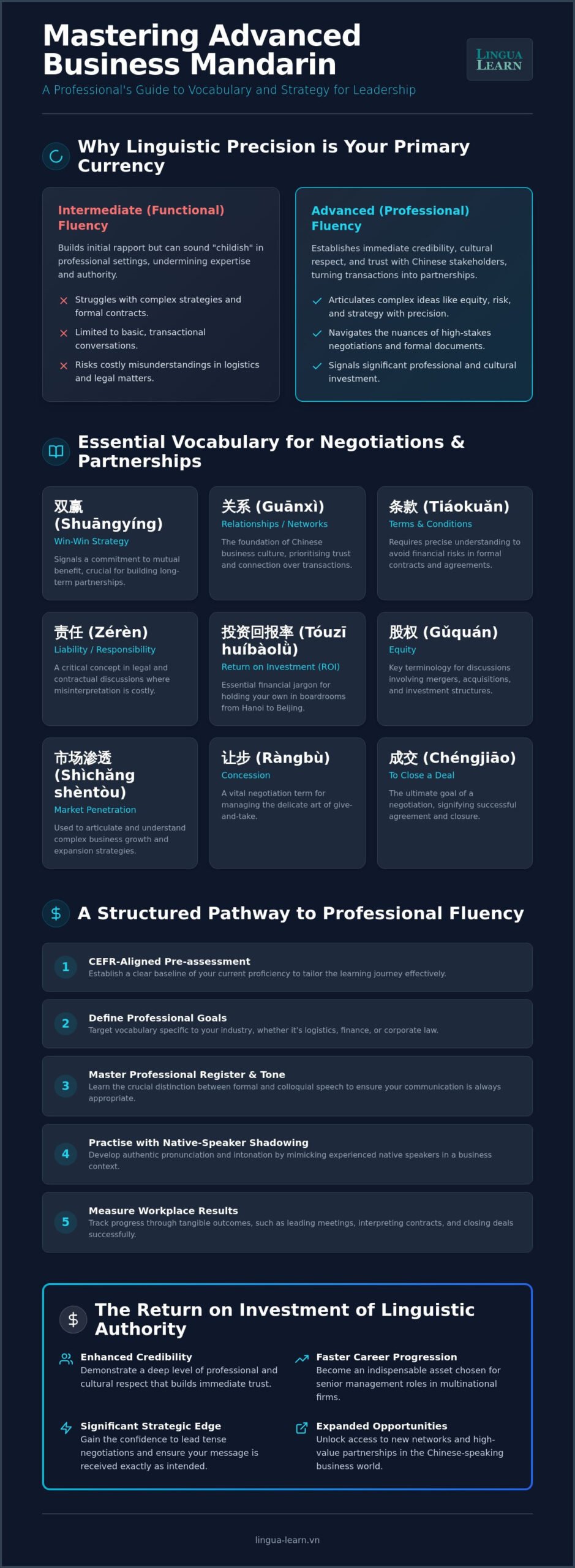
Mastering advanced business Mandarin vocabulary is a significant undertaking that requires more than just self-study. It demands a structured framework that is both academically rigorous and practically relevant. At Lingua Learn Vietnam, we provide this through our proprietary “8-Step Learning Pathway to Success”. This methodology ensures that every learner moves from their current proficiency level to their desired professional outcome with absolute clarity. Our Mandarin courses are specifically designed to meet the demands of the 2026 global trade environment, ensuring you don’t just learn the language, but the specific terminology of your industry.
Unlike many local providers, we operate under strict UK-managed standards. This means your training is governed by international quality benchmarks and aligned with the Common European Framework of Reference for Languages (CEFR). Our qualified native instructors are more than just teachers; they are specialists in workplace fluency and Chinese business etiquette. They understand the cultural nuances discussed earlier, such as “Mianzi” and “Guanxi,” and integrate these into every lesson to ensure you are truly boardroom-ready. This combination of academic authority and practical expertise is what sets our graduates apart in the competitive Vietnamese market.
We believe that one size does not fit all. Every course begins with a comprehensive needs analysis to ensure the curriculum aligns with your specific corporate objectives. For organisations, we provide detailed reporting for HR managers, allowing you to measure the ROI of your training and track employee progress with ease. Our virtual classrooms are designed to replicate the engagement and intensity of in-person training, providing a flexible solution for busy professionals across Vietnam without compromising on quality. This methodical approach ensures that every minute spent in our virtual classroom translates into measurable business performance.
Getting started is a straightforward, low-friction process. Your journey begins with a professional pre-assessment to identify your exact CEFR level. This ensures you are placed in a programme that challenges you without being overwhelming. In the Lingua Learn online classroom, you’ll experience a dynamic, interactive environment where you can practice real-world scenarios in real-time. It’s time to transform your professional potential and command the respect you deserve in every negotiation. We are here to act as your trusted partner and knowledgeable guide through every stage of your linguistic development.
Transitioning from functional to professional fluency is the most effective way to distinguish yourself in the 2026 global trade landscape. By mastering advanced business Mandarin vocabulary, you move beyond simple communication and begin to project the authority required for senior leadership. You’ve seen how precision in negotiation terminology and a command of the formal business register can transform your professional relationships and secure high-stakes partnerships.
Lingua Learn Vietnam is dedicated to your success through our UK-managed training network and CEFR-aligned curriculum. We provide the certification and expert guidance trusted by global brands for corporate upskilling. Our native instructors ensure you don’t just learn words; you learn to lead with confidence and cultural intelligence. The opportunity to elevate your professional profile is within reach.
Take the first step toward achieving a professional level of fluency that opens doors to new international partnerships and leadership roles. We look forward to being your partner in this transformative journey.
Moving from an intermediate level to mastering advanced business Mandarin vocabulary typically takes between 12 and 18 months of consistent study. The 2026 HSK 3.0 standards expanded the advanced proficiency band to include approximately 5,600 new words. Your specific timeline will depend on your starting proficiency and the number of hours you can dedicate to live practice each week.
The HSK is a standardised test specifically for Mandarin, whilst the CEFR is an international framework used to describe language ability across all languages. Under the 2026 HSK 3.0 updates, the advanced levels 7 to 9 are designed to align more closely with the C1 and C2 CEFR bands. Lingua Learn Vietnam uses CEFR-aligned assessments to provide you with a globally recognised benchmark of your professional fluency.
Online learning is exceptionally effective when it features live, real-time interaction with a qualified instructor. Our virtual classrooms facilitate the same level of engagement as in-person training, allowing for role-playing and immediate correction. This format provides the flexibility busy professionals in Vietnam require whilst ensuring they master the subtle nuances of professional register and tonal accuracy.
Critical phrases include “Dáchéng xiéyì” (to reach an agreement) and “Yìjià” (to bargain). You should also prioritise terms for “hézuò huǒbàn” (business partners) and “shàngyè mìmì” (trade secrets). Mastering these allows you to navigate discussions with the subtlety required in high-stakes meetings, ensuring you can lead negotiations without sounding overly aggressive or unprofessional.
We maintain high standards by recruiting qualified native speakers who possess significant experience in corporate environments. Every instructor is vetted through a rigorous selection process that evaluates their teaching methodology and subject matter expertise. This ensures they can provide the sophisticated feedback required for advanced learners. Our UK-managed standards govern every aspect of the teaching process, providing a consistent and reliable experience.
Yes, our bespoke training solutions are designed to address the unique linguistic demands of your industry. During the initial needs analysis, we identify the specific advanced business Mandarin vocabulary required for your role. Whether you are navigating the complexities of the finance sector or the technical jargon of engineering, our native instructors customise the curriculum to ensure the terminology is immediately applicable to your work.
You will receive a professional certificate upon the successful completion of your course. This document specifies your proficiency level according to the CEFR framework, providing a clear and credible record of your achievement. It is a valuable addition to your professional profile and is widely recognised by HR managers and international organisations. This certification validates your ability to operate at a high level within the Chinese-speaking business world.
Maintenance requires regular exposure to the formal business register through active engagement. We suggest subscribing to Chinese financial publications or using shadowing techniques with industry-specific podcasts. Participating in periodic refresher sessions with a live tutor can also help you retain complex terminology. Consistent engagement ensures your skills remain sharp, even whilst you aren’t involved in daily negotiations with Chinese stakeholders.

Article by
Rob Holloway
Rob Holloway is the CEO of Lingua Learn Elevate Ltd (UK), the company operating Lingua Learn Vietnam. He works with businesses and organisations across Asia to provide high-quality online language training, corporate communication programmes and internationally recognised language certification preparation. Working with organisations across industries including engineering, finance, technology, manufacturing and professional services, Rob helps identify language training needs and connect clients with tailored learning solutions delivered by Lingua Learn’s experienced academic team. His professional focus includes corporate language training, business communication, cross-cultural communication, international education partnerships and helping organisations build the language skills needed to succeed in global business environments. Through Lingua Learn Vietnam, Rob is committed to providing UK-managed online language training delivered by qualified instructors, helping professionals and organisations communicate with confidence in today’s international workplace.
 English (UK)
  Vietnamese