
How to choose a corporate language provider in Vietnam is one of the most important decisions HR directors and Learning & Development managers make when selecting a long-term training partner. What if your company’s language training budget was a transparent investment you could track in real-time, rather than a ‘soft skill’ expense that feels impossible to quantify? Many HR directors across Vietnam struggle with inconsistent teaching quality and a lack of clear progress reporting, making it difficult to justify the spend to the board. Understanding how to choose a corporate language provider Vietnam is no longer just about finding a tutor; it’s about securing a strategic partner that aligns with international standards and UK-quality benchmarks.
We recognise that traditional classroom models often clash with busy corporate schedules, whilst inconsistent delivery can leave teams feeling frustrated. This guide promises to reveal the essential criteria for selecting a training partner that delivers measurable ROI through automated reporting and CEFR-aligned assessments. We’ll preview the latest 2026 trends in digital-first learning and show you how to ensure your team’s development remains consistent, flexible, and fully integrated with your business goals.
Success in corporate training begins long before the first lesson starts. Before you begin interviewing vendors, you must have a clear map of your internal communication landscape. Identifying specific gaps within your national departments is the first step in understanding how to choose a corporate language provider Vietnam that actually delivers results. For instance, your procurement team might struggle with negotiating contracts in English, whilst your technical staff might lack the specialised vocabulary needed to interpret international safety manuals. Applying fundamental language education principles ensures that your training isn’t just a generic exercise, but a targeted solution for your specific business needs.
Establish a clear timeline for expected proficiency milestones from the outset. It’s not just about finishing a textbook; it’s about reaching a stage where a manager can lead a high-stakes meeting without a translator. You should also assess the need for cross-cultural training alongside linguistic skills. In a market as dynamic as Vietnam, linguistic fluency often isn’t enough to bridge the gap between a local team and a global headquarters. Understanding cultural nuances in negotiation or feedback is equally vital for long-term success.
Language skills are the fuel for international trade and global competitiveness. If your 2026 strategy involves expanding into new markets, your workforce needs more than just basic conversational ability. Focus on identifying ‘high-potential’ employees who require intensive corporate soft skills training or executive coaching to represent your brand on a global stage. By setting measurable KPIs for workforce upskilling, you turn a training cost into a strategic asset. Lingua Learn Vietnam supports this by helping HR managers define these objectives during the initial consultation phase, ensuring the programme aligns with your broader commercial goals.
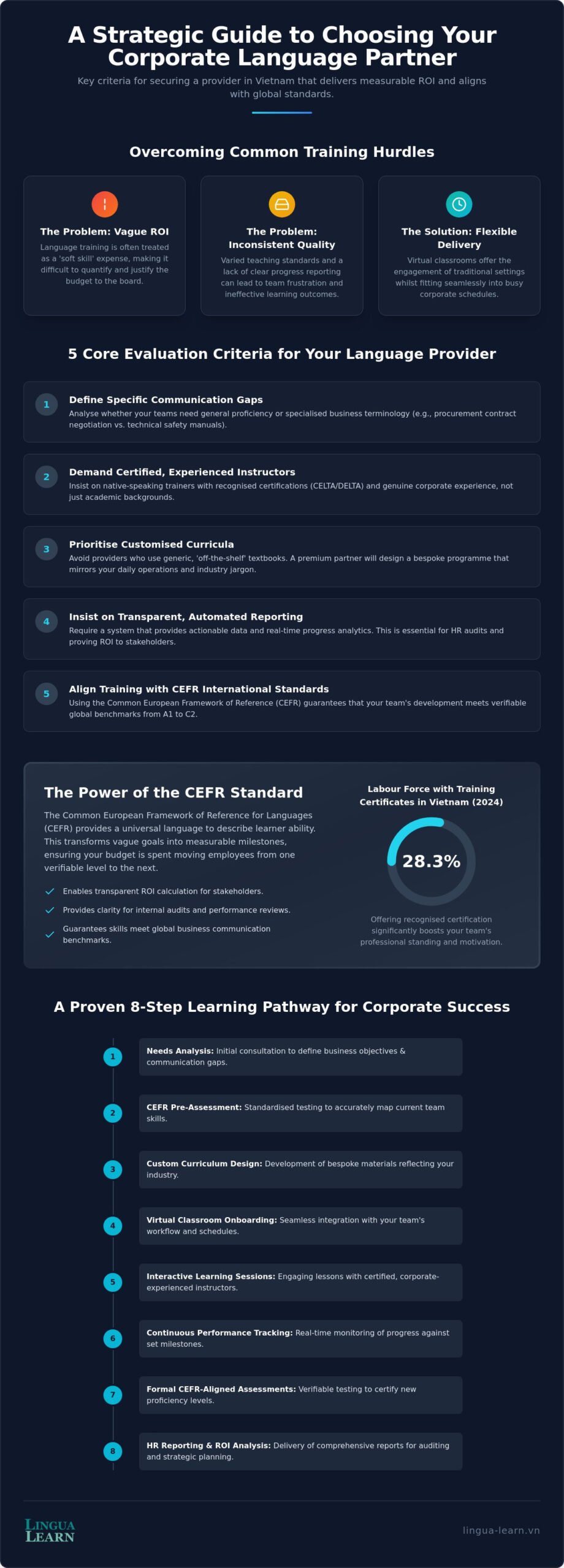
The Common European Framework of Reference for Languages (CEFR) is the global benchmark for a reason. It provides a universal language to describe what a learner can actually do. Moving away from vague terms like ‘intermediate’ and adopting specific CEFR levels (A1 to C2) allows for much tighter goal setting. Ensure your provider uses standardised pre-assessments to map current skills accurately. This transparency ensures that your budget is spent moving an employee from one verifiable level to the next, providing the clarity needed for internal audits and ROI calculations. In 2024, only 28.3% of Vietnam’s labour force held a training certificate, so partnering with a provider that offers recognised certification can significantly boost your team’s professional standing.
Selecting the right partner requires a rigorous audit of their professional standards. When researching how to choose a corporate language provider Vietnam, you should look far beyond flashy marketing brochures. Demand native-speaking instructors who hold recognised teaching certifications such as CELTA or DELTA. Crucially, these trainers must possess genuine corporate experience. A coach who understands the high-stakes pressure of a quarterly board meeting will be far more effective than one who only teaches general grammar. This level of expertise forms the foundation of a robust corporate language strategy that drives global expansion and internal cohesion.
Avoid ‘off-the-shelf’ textbooks at all costs. These generic resources rarely reflect the linguistic nuances of the Vietnamese market or the specific jargon of your sector. A premium provider should offer bespoke curriculum customisation that mirrors your daily operations. For example, if your firm operates in the manufacturing industry, your team needs to master supply chain terminology and safety protocols rather than learning how to order a meal in a restaurant. This tailored approach ensures that every minute spent in training translates directly into workplace productivity.
Evaluate the technology infrastructure with the same scrutiny you would apply to any other IT vendor. Stability and security are non-negotiable for busy professionals handling sensitive data. A UK-managed LMS provides high security and GDPR compliance, which is essential for multinational firms operating within Vietnam. Scalability is equally important. Your chosen provider must be capable of managing a single executive’s intensive coaching whilst simultaneously upskilling hundreds of staff members across multiple national branches. If you would like to see how these standards are applied in a real-world setting, you can reach out to our consultants for a detailed programme overview.
Professional language coaches offer significantly more value than simple conversational tutors. They utilise active methodologies that prioritise live interaction over passive learning. Pre-recorded content often leads to high dropout rates and poor engagement. Instead, look for programmes that incorporate continuous feedback loops. This ensures that learners receive immediate corrections and understand their progress relative to their goals before moving to the next module.
Learning shouldn’t be confined to the scheduled lesson time. Your staff require 24/7 access to digital materials and lesson recordings to review complex topics at their own pace. Complexity is often the greatest enemy of programme adoption. A ‘one-click’ entry system into virtual classrooms reduces technical friction and encourages consistent attendance. Should any issues arise, live administrative support must be available to resolve them instantly, ensuring that valuable training time is never wasted.
The decision between traditional classroom settings and digital platforms is a pivotal moment when deciding how to choose a corporate language provider Vietnam. Whilst in-person sessions were once the default, the logistical reality of major cities like Ho Chi Minh City or Hanoi often makes them impractical. Traffic congestion and travel time can easily consume hours of a professional’s day, leading to fatigue and diminished focus. Virtual classrooms eliminate these barriers, allowing teams to dedicate their full energy to learning rather than commuting.
Many leaders worry that online training lacks the ‘human touch’, but modern technology has bridged this gap effectively. High-quality virtual environments now replicate the engagement of traditional settings through interactive whiteboards and breakout rooms for peer-to-peer practice. When evaluating the effectiveness of a language training program, it’s clear that the ability to maintain consistent quality across multiple national office locations is a significant advantage. Whether your staff are based in Da Nang, Hai Phong, or Can Tho, they receive the same UK-standard instruction without the need for expensive trainer travel or physical infrastructure overheads.
A rigid training schedule is often the first thing to fail when a project deadline looms. Online training offers the essential flexibility that modern work life demands. Employees can join their lessons from home, the office, or whilst travelling for business, ensuring continuity in their progress. Adult language learning programs online provide the flexibility required by today’s executives, allowing them to balance professional development with their primary responsibilities. If a lesson is missed due to an urgent meeting, recorded sessions ensure that no one falls behind the rest of the group.
One of the most powerful reasons to opt for a digital-first approach is the level of oversight it provides. Virtual platforms offer automatic tracking of attendance and participation levels, removing the administrative burden from HR teams. These systems can integrate directly with Corporate HR Dashboards for real-time oversight of the training budget’s impact. Additionally, many platforms now leverage AI-powered practice tasks between lessons. These tools provide personalised reinforcement, helping with knowledge retention and ensuring that the investment in training yields a measurable return on performance.
When investigating how to choose a corporate language provider Vietnam, many HR managers overlook the actual mechanics of the learning process. A provider might have excellent teachers, but without a structured methodology, the training often lacks direction and measurable outcomes. You must look for a vendor that treats language acquisition as a logical, step-by-step journey rather than a series of disconnected lessons. Transparency is the cornerstone of a successful partnership; you should receive far more than just a monthly attendance sheet. A professional report ought to detail specific linguistic gains, engagement levels, and areas requiring further development.
Security is another critical factor that often goes unvetted. As your employees will be sharing personal data and potentially discussing sensitive business operations during lessons, the Learning Management System (LMS) must be robust. A high standard of integrity requires that your provider can demonstrate how they protect this information, particularly in a digital-first environment. Every programme should also culminate in a ‘Student Action Plan’. This ensures that the skills learned in the virtual classroom are immediately applied to the workplace, bridging the gap between theory and professional practice.
A methodical approach ensures that no part of the learner’s journey is left to chance. Lingua Learn Vietnam utilises an 8-step pathway designed to guarantee consistency across large teams. The process begins with a deep-dive needs analysis and standardised pre-assessments to establish a clear baseline. Following this, a bespoke course design is created to match your industry requirements. During the delivery phase, you receive regular progress updates, culminating in final-course exams. The final steps include personalised action plans for every employee and a comprehensive final report for HR, providing the data needed for internal audits and ROI tracking.
In the Vietnamese market, data security standards can vary significantly between local vendors. Choosing a provider with UK-managed technology ensures your company adheres to the highest international data protection standards. This include full GDPR compliance and registration with the Information Commissioner’s Office (ICO). Secure data hosting and encrypted communication channels protect your corporate interests whilst providing a seamless user experience. You can learn more about our corporate staff language development methodology to see how these security protocols are integrated into our daily operations.
Choosing the right partner is the final step in securing your company’s linguistic future. Lingua Learn Elevate Ltd brings prestigious British standards directly to the Vietnamese market, acting as a bridge between local talent and global expectations. By choosing a provider that prioritises academic authority alongside a supportive, student-centred approach, you ensure that your workforce doesn’t just learn a language, but masters the art of professional communication. This strategic alignment is essential when considering how to choose a corporate language provider Vietnam that can truly scale with your business.
For multinational organisations operating across Asia, our unified system offers an unparalleled advantage. Managing multiple vendors across different countries often leads to fragmented reporting and inconsistent teaching quality. Our proprietary, UK-managed LMS provides a single, secure platform for all your regional teams. This consistency ensures that a manager in Hanoi receives the same high-standard instruction and rigorous assessment as a colleague in Singapore or Dubai. Our 8-Step Learning Pathway serves as your guarantee of measurable results, providing a logical and transparent journey from the initial needs analysis to the final proficiency report.
Generic training rarely meets the demands of high-stakes sectors. We provide customised solutions specifically designed for the complexities of finance, engineering, and international trade. Your team’s ability to navigate technical discussions or negotiate complex contracts directly impacts your brand’s global image. Beyond English, we offer expert instruction in over 20 languages, including:
The long-term value of investing in high-performing, multilingual teams cannot be overstated. As we move towards 2026, the ability to communicate across borders will be the primary differentiator for successful firms in Vietnam. Empowering your staff with these skills fosters loyalty and positions your organisation as an employer of choice for top-tier talent. You can explore our business English training for HR to see how we specifically support learning and development goals through strategic trends.
Ready to transform your workforce communication? The next step is simple. Book a comprehensive needs analysis or a pilot programme to experience our methodology first-hand. Our consultants will work with you to identify specific gaps and design a curriculum that aligns with your 2026 corporate objectives. Contact Lingua Learn Vietnam today to discuss your corporate training requirements and begin your team’s journey towards global proficiency.
Building a workforce that can compete on the global stage requires more than just basic language lessons. It demands a strategic partnership built on transparency, international benchmarks, and technological reliability. By prioritising CEFR-aligned curricula and a structured 8-step pathway, you ensure that every training hour contributes to your bottom line. High-performing teams are the foundation of successful international trade, and the right training partner makes this transformation possible.
Understanding how to choose a corporate language provider Vietnam is the first step toward building a truly international workforce. Look for providers that offer a UK-managed LMS and technology standards to guarantee both quality and security. With GDPR-compliant data security and real-time HR dashboards, you can manage your team’s progress with absolute confidence and ease.
Investing in your team’s communication skills is an investment in your company’s future growth. When your staff feel empowered to lead, negotiate, and collaborate in multiple languages, your business potential becomes limitless. We look forward to helping you unlock that potential.
Measure ROI by tracking the reduction in communication errors and the increase in successful cross-border negotiations. You should compare pre-training performance metrics with post-course KPIs, such as the time taken to draft international contracts or the confidence levels of staff during global meetings. Using a provider that offers automated reporting makes this data collection seamless for HR departments.
Online providers offer superior logistical flexibility and cost-efficiency compared to traditional schools. Digital platforms eliminate travel time for busy executives and ensure that training remains consistent across multiple office locations. This model allows for recorded sessions and 24/7 access to materials, which is particularly beneficial for professionals with unpredictable work schedules.
A UK-managed Learning Management System is vital for ensuring GDPR compliance and high-level data security. When learning how to choose a corporate language provider Vietnam, it’s essential to verify that your vendor uses secure, encrypted platforms registered with international data protection authorities. This prevents sensitive corporate information from being compromised during the training process.
Ensure relevance by demanding a bespoke curriculum that incorporates your sector’s specific terminology and communication scenarios. A high-quality provider will conduct a thorough needs analysis to understand your daily operations, whether you are in finance, engineering, or international trade. This ensures that staff learn practical skills they can apply immediately to their specific job roles.
HR managers should expect real-time analytics dashboards that track attendance, participation, and verifiable linguistic progress. Beyond simple attendance sheets, professional reports should include CEFR-aligned assessment scores and individual student action plans. This level of transparency is crucial for internal audits and justifying the training budget to the board of directors.
The CEFR standard provides a globally recognised framework for defining exactly what an employee can do at each proficiency level. By moving away from vague labels like ‘advanced’, the CEFR allows you to set clear, measurable goals for your workforce. It ensures that everyone in the organisation is measured against the same international benchmarks, making progress tracking highly accurate.
Yes, online training is the most effective way to deliver high-quality instruction to large, geographically dispersed teams. Virtual classrooms ensure that staff in Da Nang receive the same UK-standard coaching as those in Ho Chi Minh City. This unified approach maintains quality control and allows for large-scale upskilling without the logistical nightmare of physical classroom management.
The 8-Step Learning Pathway is a methodical framework that guides a learner from their initial assessment to post-course application. It includes stages for needs analysis, bespoke design, live delivery, and final certification. This structured approach ensures that the training is not just a series of lessons, but a goal-oriented process designed to achieve specific business outcomes.

Article by
Rob Holloway
Rob Holloway is the CEO of Lingua Learn Elevate Ltd (UK), the company operating Lingua Learn Vietnam. He works with businesses and organisations across Asia to provide high-quality online language training, corporate communication programmes and internationally recognised language certification preparation. Working with organisations across industries including engineering, finance, technology, manufacturing and professional services, Rob helps identify language training needs and connect clients with tailored learning solutions delivered by Lingua Learn’s experienced academic team. His professional focus includes corporate language training, business communication, cross-cultural communication, international education partnerships and helping organisations build the language skills needed to succeed in global business environments. Through Lingua Learn Vietnam, Rob is committed to providing UK-managed online language training delivered by qualified instructors, helping professionals and organisations communicate with confidence in today’s international workplace.
 English (UK)
  Vietnamese