
By 2026, the global market for business English language training is projected to reach $23.1 billion, marking a significant shift in how organisations view communication. For many HR professionals, the frustration of miscommunication during international recruitment or the difficulty of managing conflict in English-speaking environments is all too familiar. You likely agree that generic language courses often fail to provide a measurable return on investment, leaving your team without the specific tools needed for global success.
This article promises to show you how modern business English training for HR is transforming departments into sophisticated global talent hubs through strategic communication. At Lingua Learn Vietnam, we understand that language proficiency should be a driver of employer branding rather than a barrier to growth. We will explore the latest trends in work-integrated learning, the importance of standardised CEFR frameworks, and how clear data on employee progress can finally align your training budget with tangible business outcomes. From AI-supported practice to blended learning models, discover how to empower your workforce for the challenges of 2026.
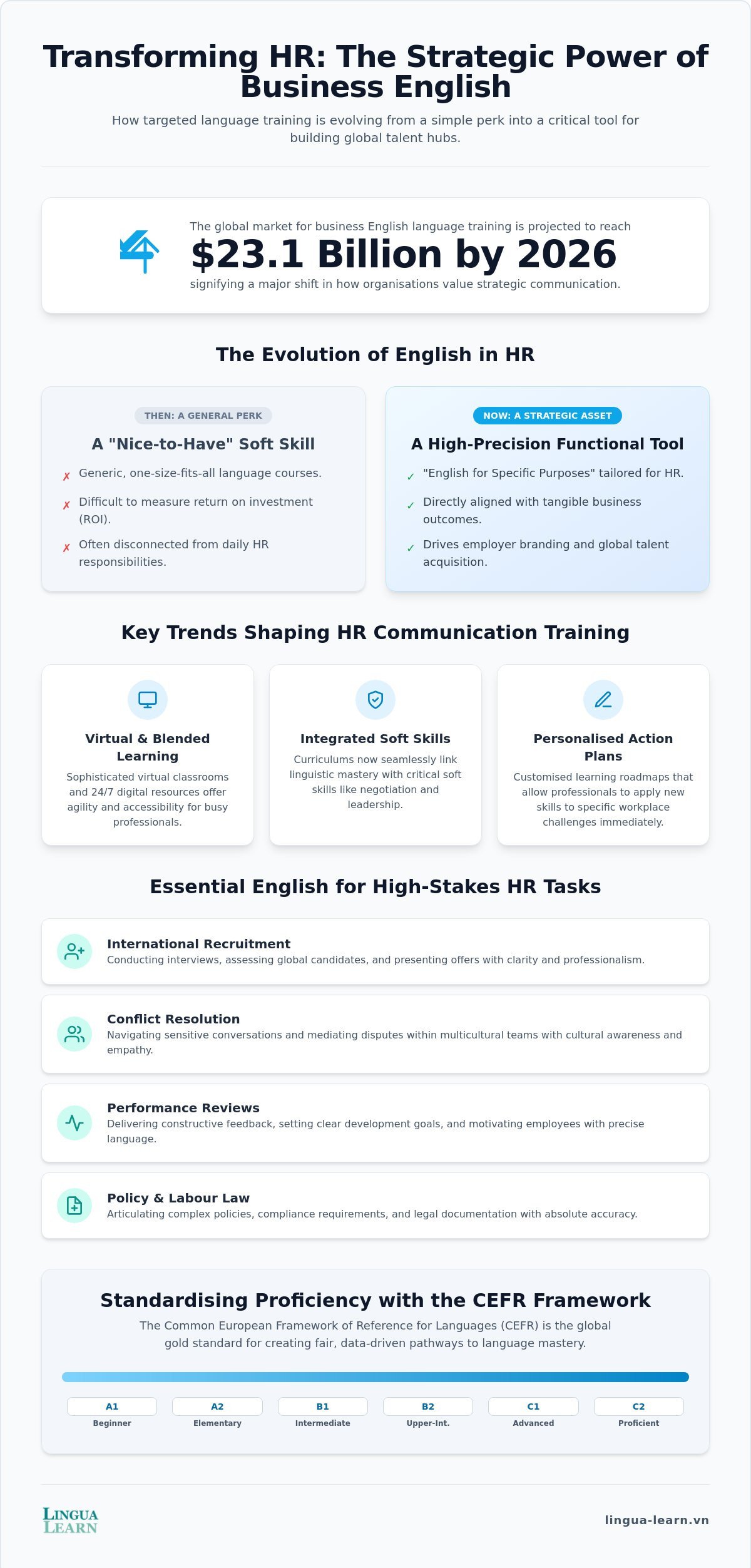
The role of language in the workplace has undergone a fundamental transformation. In 2026, the concept of Business English has shifted from a general “nice-to-have” skill to a high-precision functional tool for organisational growth. For HR departments, this evolution is particularly stark. Generic English courses often fail because they treat HR professionals like any other learner, overlooking the nuanced vocabulary required for labour law, conflict resolution, or international recruitment. Effective business English training for HR must be viewed as a strategic enabler rather than a simple perk.
We are seeing a decisive move towards “English for Specific Purposes” (ESP). This approach ensures that every hour of study translates directly into workplace efficiency. HR teams are the architects of company culture; when they communicate with clarity and sophistication, they foster a truly inclusive environment where cross-border teams feel heard and respected. A multilingual workforce thrives only when its leaders can articulate complex policies and values with absolute precision.
HR’s role has expanded far beyond traditional personnel management. Modern departments act as global talent hubs, sourcing the best minds from every corner of the world. Your team’s ability to communicate professionally in English directly impacts your employer branding. If a candidate’s first interaction with your organisation is marred by miscommunication, their perception of your brand suffers immediately. In 2026, HR must lead by example, demonstrating the high-level proficiency that is now a prerequisite for leadership. Through specialised Corporate Soft Skills Training, HR professionals can ensure that every interview and onboarding session reflects the global standards of the organisation.
Standardisation is the key to fairness in a globalised workforce. By utilising the Common European Framework of Reference for Languages (CEFR), HR can accurately benchmark staff proficiency across different regions. These standardised levels are essential for fair performance appraisals, ensuring that promotions and responsibilities are based on verified capability rather than subjective impressions. Using a common language for assessment allows Lingua Learn Vietnam to provide clear, data-driven reports that help HR managers track progress against business goals. The CEFR is the global gold standard for language measurement, providing a clear, six-level scale that defines exactly what a learner can do in their target language.
Professional development in 2026 is defined by agility and accessibility. The traditional classroom has been replaced by sophisticated virtual environments that offer 24/7 access to digital resources. HR professionals are no longer looking for generic language lessons; they require a curriculum where soft skills and linguistic mastery are inextricably linked. This shift towards integrated learning ensures that business English training for HR delivers immediate value through personalised “Student Action Plans”. These plans act as a roadmap, allowing learners to apply new vocabulary to their specific workplace challenges the very next day. Mastering Essential English Skills for HR is now about more than grammar; it’s about the strategic application of language in high-pressure scenarios.
Managing a global workforce requires more than just basic fluency. It demands the ability to project authority and empathy through a screen. High-definition video and interactive whiteboards are now essential components of effective training, bridging the gap between physical and digital spaces. By choosing Lingua Learn Vietnam, your team gains access to a platform designed for remote soft skills development. This ensures that managers can lead international teams with confidence, whilst maintaining the nuances of professional etiquette. If you are ready to modernise your team’s communication, you can reach out to our consultants for a tailored strategy.
The era of “attendance-based” training is over. HR leaders now demand granular data to prove the return on investment for every training pound spent. Modern platforms provide real-time reporting, allowing you to track progress against specific KPIs and CEFR benchmarks. AI-powered feedback loops also play a vital role in knowledge retention, identifying areas where a learner might struggle before it impacts their performance. This data-driven approach transforms business English training for HR into a measurable business asset, ensuring that every minute spent in the virtual classroom contributes to the bottom line.
HR professionals sit at the heart of an organisation’s communication network. They don’t just speak; they negotiate, mediate, and inspire. Because of this, general fluency is rarely sufficient for the high-stakes interactions inherent in the role. Whether you’re announcing a global policy change or negotiating complex employee benefit packages, the precision of your language dictates the outcome. Effective business English training for HR bridges the gap between basic communication and strategic influence. It provides the linguistic tools to handle industrial relations with legal accuracy whilst maintaining a supportive, professional tone that aligns with your brand’s values.
The recruitment process is often a candidate’s first window into your corporate culture. Crafting job descriptions that resonate with international talent requires a sophisticated grasp of tone and nuance. It’s about more than just listing requirements; it’s about selling a vision. Once the interview stage begins, HR teams must conduct multi-stage dialogues with absolute precision. This involves using indirect questioning to probe for “culture fit” and assessing a candidate’s soft skills through subtle linguistic cues. High-quality training ensures that your team can identify the best global talent without language barriers clouding their judgement.
Mediation is one of the most demanding tasks an HR professional faces. In a multilingual environment, misinterpretation can quickly turn a minor misunderstanding into a significant workplace grievance. Using diplomatic language to de-escalate tension is a skill that must be practised. This involves mastering “hedging” techniques and cross-cultural communication strategies to ensure all parties feel heard and respected. Exploring our latest corporate communication insights can help your team stay ahead of these challenges.
Delivering sensitive performance reviews is another area where linguistic mastery is vital. Constructive feedback must be balanced; it should be firm enough to encourage improvement but encouraging enough to maintain morale. HR professionals also need to master the art of professional writing for internal policies and global announcements. These documents must be unambiguous to prevent confusion across international branches. Strategic business English training for HR ensures that every review and policy update strengthens the bond between the organisation and its employees.
A successful training initiative requires more than a simple login or a generic textbook. To transform your department into a global hub, you must build a programme that aligns with your specific organisational objectives. This process begins with a comprehensive needs analysis. Instead of assuming all staff require the same support, you should identify the high-stakes communication gaps that currently hinder your operations. Whether it’s a lack of precision in contract negotiations or difficulty in delivering sensitive feedback, your business English training for HR must be purpose-built to solve these genuine problems. The results are clear. When training is relevant, engagement soars.
Grouping learners is equally vital. By utilising pre-assessments to benchmark staff against the CEFR levels discussed earlier, you ensure that every session is pitched at the correct difficulty. This prevents advanced speakers from becoming bored whilst ensuring beginners aren’t overwhelmed. Accountability is the final piece of the implementation puzzle. Regular attendance tracking and monthly progress reports provide the transparency HR leaders need to justify their training budget. It’s about moving away from “hope-based” learning and towards a structured, data-driven framework.
Lingua Learn Vietnam follows a methodical approach to ensure every student reaches their potential. This pathway begins with a deep-dive analysis and pre-assessment, followed by the design of a curriculum tailored to your industry terminology. Learners then engage in live virtual sessions led by certified experts. We don’t stop there. A mid-course review identifies any areas for adjustment before final exams conclude the formal instruction. Perhaps most importantly, every graduate receives a Student Action Plan. This document provides a clear roadmap for post-course growth, ensuring that the skills learned in the classroom are applied effectively in the workplace. This structured journey not only improves proficiency but also boosts employee morale and professional standing through recognised certification.
Selecting a vendor is a strategic decision that impacts your company’s future. In the Asian market, the demand for UK-managed technology and academic standards has never been higher. You should evaluate potential partners based on their ability to provide tailored language training that respects the nuances of specific HR roles. Transparency is non-negotiable. Your provider must offer granular reporting that allows you to track ROI in real-time. In 2024, online modules accounted for 48% of total enrollments in the business English market, proving that digital delivery is the preferred choice for modern professionals. If you’re ready to implement a world-class framework for your team, you can book a consultation for your team today.
Lingua Learn Vietnam provides a premium virtual environment that brings UK-standard academic excellence directly to your team. Our business English training for HR is led by certified native-speaking tutors who possess the professional background necessary to navigate the complexities of corporate communication. These experts don’t just teach grammar; they mentor your staff in the subtle art of international business etiquette. By using our browser-based platform, your employees can join sessions from any location without the need for complex software installations or technical hurdles. This seamless access ensures that learning fits into a busy professional schedule rather than disrupting it.
Transparency is a core pillar of our service. The Corporate HR Dashboard gives you a bird’s-eye view of your entire training initiative, allowing you to monitor attendance and achievement in real-time. This level of insight is essential for scaling your programme, whether you are supporting a single high-potential executive or upskilling a multinational team across several regions. You’ll always have the data required to prove that your investment is delivering tangible results. Our structured approach ensures that every learner remains on track to meet the CEFR benchmarks that matter to your organisation.
We offer customised modules that target the specific functions of your department. From the technical vocabulary of payroll and benefits to the persuasive language needed for learning and development (L&D) initiatives, our curriculum is as versatile as the HR role itself. You can explore our Business English course to see how we help individuals unlock their career potential through linguistic mastery. This flexibility ensures that your training is never generic but always aligned with your immediate operational needs. We focus on the practical application of language, ensuring that your team can move from the classroom to a board meeting with absolute confidence.
Investing in professional communication is a long-term strategy for business growth. A multilingual workforce is more agile, more inclusive, and better equipped to handle the challenges of a globalised economy. By choosing Lingua Learn Vietnam, you aren’t just buying lessons; you’re building a sustainable culture of excellence. We’ve seen how standardised training pathways can reduce miscommunication costs and improve employee retention by providing clear career progression. We invite you to enquire about our bespoke business English training for HR to discover how we can help your department lead the way in 2026.
Modern HR departments in 2026 are more than just administrative centres; they’re strategic partners in global expansion. By mastering the nuances of professional communication, your team can lead international recruitment and mediate complex workplace relations with absolute confidence. Implementing structured business English training for HR is the most effective way to bridge the gap between local operations and global standards.
Lingua Learn Vietnam supports your journey through our proven 8-step Learning Pathway and a CEFR-aligned curriculum that ensures measurable progress. Our UK-managed technology and certified tutors provide the reliability you need to scale training across your organisation. It’s time to empower your staff with the linguistic precision required for the modern corporate landscape.
Enquire about customised Business English training for your HR team today and take the first step towards unlocking your organisation’s full potential. We look forward to helping you build a more connected and communicative workforce.
HR-specific training focuses on the functional language required for labour law, grievances, and payroll management rather than generic social interactions. Whilst general courses cover basic fluency, specialised business English training for HR provides the precision needed for sensitive legal and personnel matters. It ensures your team can articulate complex policies without ambiguity. This functional approach means every lesson translates directly into workplace efficiency and professional authority.
Precision in language allows HR teams to craft compelling job descriptions that attract high-quality international candidates. During multi-stage interviews, linguistic mastery enables recruiters to probe deeper into a candidate’s soft skills and “culture fit” through nuanced dialogue. This reduces the risk of expensive hiring mistakes caused by misinterpretation. When your recruitment team speaks with absolute clarity, it significantly strengthens your employer branding in the global market.
Using CEFR standards provides an objective, global benchmark for assessing staff proficiency across different regions. It removes the guesswork from performance appraisals by providing clear, standardised data on what an employee can actually achieve in English. This framework is essential for grouping learners effectively, ensuring that everyone receives instruction at the correct level. It creates a fair, transparent environment for professional development within your organisation.
Modern virtual classrooms utilise HD video and interactive whiteboards to provide an experience that is often superior to traditional settings. Online delivery offers the flexibility that busy HR professionals require, allowing for 24/7 access to digital resources. In 2024, online training modules represented nearly half of all business English enrollments, proving that digital platforms are the preferred choice for global organisations seeking high-quality, flexible learning results.
Most learners see significant improvements within three to six months when following a structured business English training for HR programme. The speed of progress depends on the intensity of the sessions and the learner’s starting level. By using the Lingua Learn 8-step pathway, we ensure that progress is always measurable through regular assessments and data-driven reporting. This allows you to track the exact return on your training investment.
Cross-cultural communication is the foundation of effective mediation and international team management. It helps HR professionals recognise subtle linguistic cues and cultural nuances that might lead to workplace friction if ignored. By mastering these skills, your team can de-escalate tensions and foster a more inclusive corporate culture. This is particularly vital in 2026 as organisations continue to expand into diverse and increasingly multilingual markets.
HR managers can monitor their team’s engagement through a dedicated Corporate HR Dashboard. This tool provides unparalleled transparency by offering real-time data on attendance, lesson completion, and overall achievement. Instead of relying on manual updates, you can access automated reports that help you justify training budgets with ease. This data-driven approach ensures that every member of your staff remains accountable for their professional growth and learning outcomes.
Every participant undergoes a final exam to verify their progress and earn a formal certificate of completion. This certification serves as a recognised proof of their professional standing and linguistic capability in a corporate environment. Beyond the individual’s achievement, it provides the organisation with a verified record of the team’s upskilling efforts. Such milestones are excellent for boosting employee morale and confirming the success of your strategic training programme.

Article by
Rob Holloway
Rob Holloway is the CEO of Lingua Learn Elevate Ltd (UK), the company operating Lingua Learn Vietnam. He works with businesses and organisations across Asia to provide high-quality online language training, corporate communication programmes and internationally recognised language certification preparation.
Working with organisations across industries including engineering, finance, technology, manufacturing and professional services, Rob helps identify language training needs and connect clients with tailored learning solutions delivered by Lingua Learn’s experienced academic team.
His professional focus includes corporate language training, business communication, cross-cultural communication, international education partnerships and helping organisations build the language skills needed to succeed in global business environments.
Through Lingua Learn Vietnam, Rob is committed to providing UK-managed online language training delivered by qualified instructors, helping professionals and organisations communicate with confidence in today’s international workplace.
 English (UK)
  Vietnamese