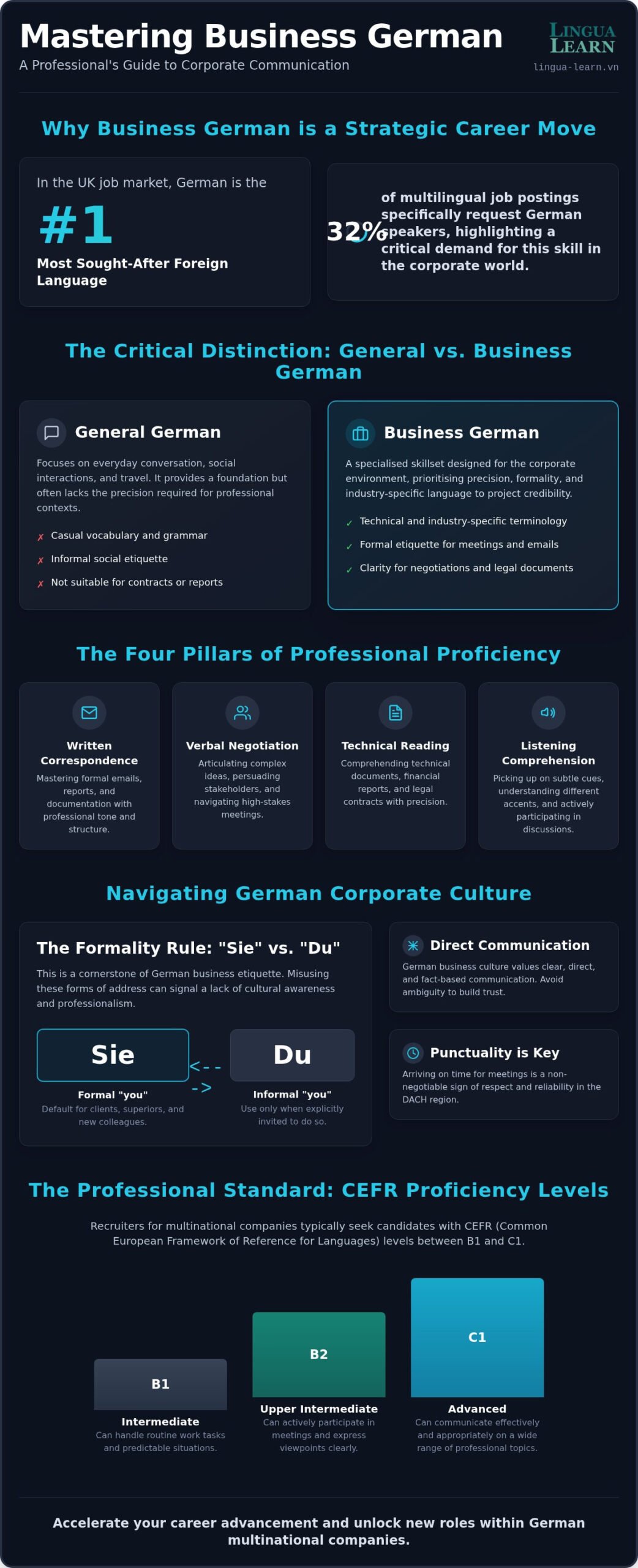
Did you know that German is the most sought-after foreign language in the UK job market, with 32% of multilingual job postings specifically requesting German speakers? In a corporate environment where precision is paramount, your ability to articulate complex ideas can be the difference between a missed opportunity and a significant career breakthrough. Mastering business German for professionals is no longer just an advantage; it’s a strategic necessity for those looking to lead in the European market.
It’s natural to feel a sense of hesitation when transitioning from casual conversation to formal corporate dialogue. You might worry that a limited vocabulary makes you appear less capable or that a cultural misunderstanding could stall a vital negotiation. This guide provides the clarity you need to move past those anxieties and communicate with the authority your role demands.
By reading on, you’ll gain the essential linguistic and cultural tools required to excel in the German-speaking corporate world. We’ll explore the specific vocabulary needed for high-stakes meetings, provide frameworks for polished email correspondence, and examine the professional etiquette that unlocks new opportunities within global organisations.
Business German for professionals is a specialised branch of the German language designed specifically for the nuances of the corporate environment. It goes far beyond the basics of daily conversation, focusing instead on technical vocabulary, formal etiquette, and the precise communication styles required in a boardroom. Whilst general German courses provide a solid foundation for social interactions, they often lack the depth needed to handle complex financial reports or legal contracts.
In high-stakes professional environments, general fluency is rarely sufficient. German business culture places a high premium on precision. A slight misuse of a term in a contract or a failure to use the correct formal register can inadvertently signal a lack of professionalism. This is why most international recruiters look for specific CEFR (Common European Framework of Reference for Languages) levels, typically ranging from B1 to C1, when hiring for roles that require business German for professionals. These certifications prove you can navigate professional hierarchies and technical discussions with ease.
The DACH region, comprising Germany, Austria, and Switzerland, remains a powerhouse of European trade and innovation. For professionals in sectors like engineering, finance, and high-tech manufacturing, German is often the primary language of technical documentation and high-level strategy. Proficiency opens doors to major multinational corporations that have a massive footprint across the globe, including here in Asia. When you can speak the language of headquarters, you position yourself as a vital bridge between regional offices and European leadership, significantly accelerating your career trajectory.
For the modern executive, time is the most valuable commodity. This has made online German language courses Vietnam the preferred choice for those balancing a demanding career with personal development. Digital learning platforms allow for a level of flexibility that traditional classrooms simply cannot match. At Lingua Learn Vietnam, we recognise that professional learners often need to revisit complex grammar or industry-specific terminology. The ability to access recorded sessions for review ensures that no detail is lost, allowing you to refine your skills at a pace that suits your schedule. This methodical approach transforms language learning from a chore into a manageable part of your professional routine.
Developing true proficiency in business German for professionals requires a balanced mastery of four distinct areas: written correspondence, verbal negotiation, reading technical documents, and listening comprehension. Each of these pillars supports your professional persona in different ways. Whilst your reading ability might allow you to digest a complex market analysis, it’s your listening comprehension that enables you to pick up on subtle cues during a high-stakes board meeting. Balancing these skills ensures you aren’t just understood, but that you’re also seen as a peer by your German-speaking colleagues.
One of the most critical shifts for international professionals is the transition from the informal “Du” to the formal “Sie”. In a German corporate setting, “Sie” remains the default for colleagues, clients, and superiors unless an explicit invitation to use “Du” is extended. This distinction is a cornerstone of German business etiquette and demonstrates your respect for professional boundaries and hierarchy. Adopting the correct register immediately signals that you understand the cultural framework of the DACH region, which is often the first step in building a foundation of trust.
Authority in the workplace isn’t just built on perfect grammar; it’s cemented through the use of industry-specific terminology. Whether you’re working in the automotive sector, finance, or renewable energy, using the exact technical term demonstrates your expertise and attention to detail. However, technical knowledge alone isn’t enough. Modern language training must integrate soft skills, such as knowing how to deliver feedback politely or manage a team with cultural empathy. If you’re looking to refine these specific competencies for your organisation, you might enquire about our corporate training options to see how we can support your team’s growth.
German corporate communication values structure and clarity above all else. When writing emails or official letters, always use the “Sie” form and include correct professional titles, such as “Sehr geehrter Herr Direktor” or “Sehr geehrte Frau Dr. Schmidt”. A well-structured report that follows a logical sequence is expected and highly valued. You should avoid overly flowery language and instead prioritise directness and factual accuracy to build long-term credibility with your German counterparts.
Successful negotiation in German relies on logical argumentation and persuasive vocabulary. You must be prepared to defend your position with data-backed evidence and clear reasoning. During presentations, the Q&A session is often the most rigorous part of the interaction. Handling these questions with poise requires specific phrases to acknowledge, clarify, and respond to inquiries professionally. For those aiming for executive positions, developing these language skills for leadership roles is essential for managing cross-border teams and driving international strategy effectively.
Success in the DACH market requires more than just a grasp of grammar. It demands an understanding of the cultural values that underpin every transaction. One of the most significant concepts you’ll encounter is “Pünktlichkeit”, or punctuality. In a German professional context, arriving exactly on time is often considered late. Arriving five to ten minutes early demonstrates that you value your partner’s time and are a reliable professional. This builds a foundation of trust before a single word of business German for professionals is even spoken.
You’ll likely notice a level of directness that can feel startling at first. In Germany, feedback is focused on the task rather than the person. This “Sachebene” (factual level) communication ensures efficiency by removing ambiguity. It isn’t intended to be rude; it’s a tool for progress. Similarly, there’s a clear separation between professional and private life. Respecting the concept of “Feierabend”, the end of the working day, is vital. Don’t expect colleagues to answer emails on weekends or discuss deeply personal matters in the office. This boundary helps maintain a focused and productive work environment.
Small talk exists but follows specific boundaries. Safe topics include the weather, your journey, or general interests like sports and travel. It’s best to avoid sensitive subjects such as personal finances, religious beliefs, or political affiliations during initial meetings. This keeps the atmosphere professional whilst still allowing for the necessary human connection that precedes formal negotiations. By staying within these safe zones, you show that you’re culturally aware and respectful of local norms.
German meetings are characterised by their rigid structure. They typically start exactly on time and follow a predetermined agenda without deviation. The “Protokoll”, or meeting minutes, serves as a formal record of decisions and assigned tasks that everyone is expected to follow. Direct communication in a German context is a sign of respect and efficiency; it shows you value the other person’s time enough to be clear and honest. This clarity prevents the misunderstandings that often plague less structured corporate environments.
Networking in Germany, Austria, and Switzerland is often more formal than in many other global markets. It’s less about casual socialising and more about demonstrating your “Expertise” (expertise) and professional standing. Formal qualifications carry significant weight in these regions. If you want to provide tangible proof of your skills to a prospective employer or partner, consider exploring the German certifications page to find a path that aligns with your career goals. Having a recognised certificate can be the deciding factor in a competitive hiring process.
Mastering the specific lexicon of the German workplace is the quickest way to boost your professional standing. Whilst general vocabulary gets you through the day, business German for professionals requires a more nuanced toolkit. You’ll find that formal German often relies on “Nominalisation”, which is the process of turning verbs into nouns. For instance, instead of saying “we are negotiating”, a professional might refer to “die Verhandlungen” (the negotiations). This shift in structure immediately makes your speech sound more authoritative and aligned with the high standards of German corporate communication.
Precision is especially important when navigating different professional scenarios. Consider these essential phrases for your daily interactions:
You should also be wary of “False Friends” that can lead to awkward misunderstandings. In a business context, “eventuell” means “possibly” rather than “eventually”, and “aktuell” means “current” rather than “actual”. Perhaps most importantly, remember that your “Chef” is your boss, not the person cooking your lunch in the canteen. Avoiding these common pitfalls ensures your message remains clear and professional at all times.
The way you open and close an email sets the tone for the entire interaction. For a recipient you don’t know, “Sehr geehrte Damen und Herren” remains the standard. If you have a specific contact, use “Sehr geehrter Herr [Name]” or “Sehr geehrte Frau [Name]”. Whilst “Mit freundlichen Grüßen” is the traditional and safest closing, “Beste Grüße” is becoming a popular, slightly more modern alternative in established relationships. A professional follow-up might begin with: “Ich beziehe mich auf unser Telefonat von letzter Woche” (I am referring to our telephone call from last week).
In the industrial and technology sectors, the margin for error is non-existent. Technical descriptions must be absolute and unambiguous. Using terms like “die Schnittstelle” (the interface) or “die Wartung” (maintenance) correctly demonstrates your technical competence. For those working in these highly specialised fields, our detailed guide on professional German for engineering provides the deep niche knowledge required to lead complex technical projects and teams effectively.
Choosing the right training partner is as critical as the learning itself. Lingua Learn Vietnam provides a structured, UK-managed approach that transforms the challenge of mastering business German for professionals into a manageable, results-oriented journey. Our proprietary 8-Step Learning Pathway to Success ensures you aren’t just memorising words but building a functional skill set that translates directly to the boardroom. This methodical framework guides you from your initial assessment through to final certification, providing a clear roadmap for your professional development.
Our commitment to quality is reflected in our UK-managed technology and secure Learning Management System (LMS). This platform serves as your central hub for all course materials, schedules, and recorded sessions. Beyond the technology, we provide every learner with a personalised Student Action Plan. This document bridges the gap between the virtual classroom and the office, offering specific strategies for immediate workplace application. For companies looking to upskill their teams, our corporate HR dashboard provides real-time visibility into progress, ensuring that every training hour contributes to the organisation’s broader strategic goals.
Every professional journey begins with a comprehensive Needs Analysis and Pre-Assessment. We don’t believe in one-size-fits-all solutions; instead, we tailor our curriculum to the specific industry of the professional, whether that’s automotive engineering, international finance, or logistics. Unlike pre-recorded apps that offer generic phrases, our live, interactive lessons allow you to practice real-world scenarios with qualified instructors. This real-time feedback is essential for mastering the subtle nuances of formal German and building the confidence needed to lead international teams.
We prioritise transparency and measurable outcomes. At the end of your programme, you’ll sit a final-course exam designed to validate your progress against international standards. Upon successful completion, you’ll receive a CEFR-aligned certification that serves as a powerful addition to your professional portfolio. For our corporate clients, we provide a comprehensive Final Report that details individual performance and areas for future growth. If you’re ready to take the next step in your career, visit our German course page to find the right programme for your needs.
Mastering a new language is an investment in your future. At Lingua Learn Vietnam, we provide the expertise, technology, and support needed to ensure that investment pays off. Whether you’re an individual professional or an HR manager looking to empower your workforce, we’re here to help you unlock the full potential of the German-speaking market. Enquire today to learn more about how our tailored training can accelerate your career advancement.
Mastering business German for professionals is more than a linguistic achievement; it’s a decisive career move. By combining technical vocabulary with a deep understanding of DACH corporate etiquette, you position yourself as a credible leader in one of the world’s most stable economies. You’ve seen how precision in correspondence and respect for cultural norms serve as the foundation for long-term professional trust.
At Lingua Learn Vietnam, we’re dedicated to your success through our proven 8-Step Learning Pathway. Our CEFR-aligned curriculum and UK-managed quality standards ensure that your training is both rigorous and relevant to your specific industry. With the support of our dedicated mentors and a structured Student Action Plan, you’ll gain the confidence to lead negotiations and manage complex projects with ease.
The opportunities within the German-speaking market are vast, and the right tools are now within your reach. Start your journey toward professional mastery today and watch your career reach new heights.
Online German learning is highly effective for busy professionals because it removes travel time and allows for immediate digital resource integration. Lingua Learn Vietnam uses live, interactive sessions that replicate the classroom experience whilst offering the convenience of a digital environment. This approach allows you to focus on high-priority skills like presentation and negotiation without the logistical hurdles of a physical school.
General German focuses on social interactions and daily survival skills, whereas business German for professionals targets the specific vocabulary and etiquette of the corporate world. You’ll move beyond ordering food to mastering phrases for contract negotiations, financial reporting, and formal email correspondence. It also emphasises the “Sie” form of address, which is vital for maintaining professional boundaries in the DACH region.
Reaching a B2 level usually requires between 600 and 800 hours of guided instruction and independent study. For an absolute beginner, this often translates to one or two years of consistent training. However, your progress can be significantly accelerated through intensive courses and daily immersion in professional technical documents or German-language business news, which helps solidify complex grammatical structures more quickly.
Yes, every programme at Lingua Learn Vietnam concludes with a formal assessment that results in a CEFR-aligned certificate. These certifications are recognised globally by employers and academic institutions as a reliable measure of your language proficiency. Having a B1 or B2 certificate on your CV provides tangible proof of your ability to function effectively in a German-speaking corporate environment.
You can certainly record and revisit your lessons at any time. Our secure Learning Management System (LMS) automatically stores every live session, allowing you to review complex terminology or specific feedback from your instructor. This feature is particularly useful for professionals who may need to refresh their memory on a specific negotiation tactic or technical term before an important meeting.
You don’t need to install any specialised software to access our online classroom. The platform is entirely browser-based, meaning you can join your session from a laptop, tablet, or desktop with a stable internet connection. This low-friction setup ensures that you can focus entirely on your training rather than troubleshooting technical issues, making it ideal for executives with tight schedules.
Punctuality and adherence to a formal agenda are the most critical rules in German business meetings. Arriving even a few minutes late is often viewed as a sign of unreliability. Additionally, you should be prepared for direct, task-oriented communication where feedback is factual rather than personal. Respecting the “Sie” form of address until invited otherwise is also a fundamental aspect of business German for professionals.
The 8-Step Learning Pathway bridges the gap between study and work by using a detailed Needs Analysis and a personalised Student Action Plan. We identify the specific tasks you perform in your role, such as leading tech stand-ups or writing financial audits, and tailor your lessons to those scenarios. This ensures that the skills you learn in the morning can be applied in your afternoon emails or calls.
Article by
Rob Holloway
Rob Holloway is the CEO of Lingua Learn Elevate Ltd (UK), the company operating Lingua Learn Vietnam. He works with businesses and organisations across Asia to provide high-quality online language training, corporate communication programmes and internationally recognised language certification preparation.
Working with organisations across industries including engineering, finance, technology, manufacturing and professional services, Rob helps identify language training needs and connect clients with tailored learning solutions delivered by Lingua Learn’s experienced academic team.
His professional focus includes corporate language training, business communication, cross-cultural communication, international education partnerships and helping organisations build the language skills needed to succeed in global business environments.
Through Lingua Learn Vietnam, Rob is committed to providing UK-managed online language training delivered by qualified instructors, helping professionals and organisations communicate with confidence in today’s international workplace.
 English (UK)
  Vietnamese