
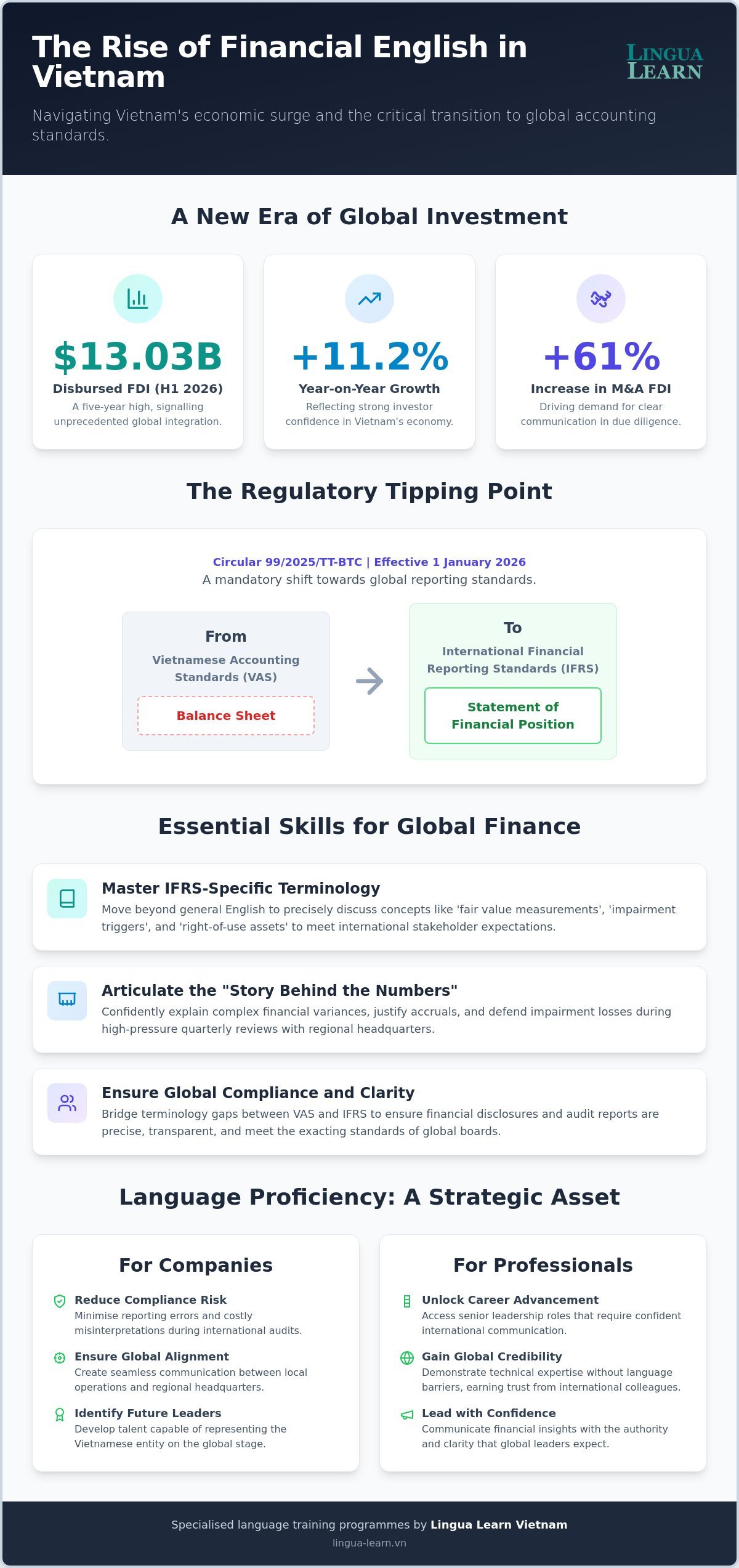
Business English for finance professionals in Vietnam has become one of the most valuable skills for accountants, auditors and finance leaders working with multinational organisations. Did you know that disbursed FDI in Vietnam reached a five-year high of USD 13.03 billion in the first half of 2026? This massive surge in global investment is creating incredible opportunities, yet it also demands a new level of professional communication. As the country moves towards IFRS alignment under Circular 99/2025/TT-BTC, the need for high-quality business English for finance professionals Vietnam has reached a tipping point.
It’s likely that you’ve experienced the stress of an international audit or felt the challenge of explaining a complex financial variance during a global board meeting. You have the technical skills, but finding the right words to convey nuance in a high-stakes negotiation can be daunting. We understand that your career progression depends on your ability to bridge the gap between local execution and international reporting standards.
This comprehensive guide provides the roadmap you need to master the specialised language of modern finance. You’ll learn how to navigate the latest regulatory changes with confidence and present financial data with the authority that global leaders expect. We’ll explore the essential resources and training pathways designed to help you excel in Vietnam’s rapidly evolving multinational sector.
Vietnam’s economic trajectory is nothing short of remarkable. With disbursed FDI reaching USD 13.03 billion in the first half of 2026, an 11.2% year-on-year increase, the Economy of Vietnam is integrating with global markets at an unprecedented pace. This influx of capital has transformed the country into a primary regional hub for multinational corporations, particularly in the semiconductor and AI sectors. For accountants, auditors, and financial controllers, this shift means that “knowing English” is no longer a generic soft skill; it’s a technical necessity for survival.
Effective business English for finance professionals Vietnam is a highly specialised toolset. It isn’t just about conversational fluency or writing polite emails. Instead, it’s about mastering the precise vocabulary required for global compliance, rigorous risk assessment, and transparent financial reporting. Whilst general English helps you interact with colleagues, it won’t help you defend a complex impairment loss or explain a deferred tax asset during a high-pressure quarterly review with regional headquarters.
The regulatory environment is also driving this demand. The Ministry of Finance’s Circular 99/2025/TT-BTC, which became effective on 1 January 2026, signals a definitive move toward closer alignment with International Financial Reporting Standards (IFRS). This transition replaces the traditional “Balance Sheet” with the “Statement of Financial Position,” demanding that local professionals adapt their linguistic and technical frameworks simultaneously to maintain professional credibility.
The move from Vietnamese Accounting Standards (VAS) to IFRS introduces significant linguistic friction. Many local concepts don’t have a direct one-to-one translation in the global standard, creating terminology gaps that often cause friction during international audits. Precision in financial disclosures is vital. A slight mistranslation in the “Notes to the Financial Statements” can alter a stakeholder’s perception of risk. Professionals must learn to bridge these gaps to ensure their reports meet the exacting standards of global boards. Strong business English for finance professionals Vietnam enables accountants to explain complex IFRS concepts accurately and confidently to international stakeholders.
Multinational firms increasingly view language as a risk management tool. In the context of cross-border mergers and acquisitions, which have seen a 61% increase in registered FDI as of June 2026, clear communication prevents costly misinterpretations of valuation models or due diligence findings. Companies prioritise proficiency because it:
At Lingua Learn Vietnam, we’ve observed that specialised language training acts as a catalyst for career advancement. It allows talented individuals to step into senior leadership roles that were previously out of reach, ensuring they can communicate their financial expertise with confidence and authority.
Vietnam’s position as a regional economic powerhouse is attracting more foreign direct investment than ever before. This growth places local finance teams under a global microscope. To thrive in this environment, you must move beyond basic fluency and master the precise terminology of international finance. Proficiency in business English for finance professionals Vietnam ensures that your technical expertise isn’t lost in translation when discussing the Statement of Financial Position, the Statement of Profit or Loss, or complex Cash Flow forecasts.
Mastering these statements requires a deep understanding of IFRS-specific nuances. For instance, whilst local standards might focus on historical costs, international stakeholders often require discussions around “fair value measurements,” “impairment triggers,” and “right-of-use assets.” Being able to explain the “story behind the numbers” is what separates a bookkeeper from a strategic financial partner. You must be able to justify why certain accruals were made or how a specific provision impacts the bottom line during a high-stakes board review.
Audit-ready English is the cornerstone of international transparency and builds immediate trust with global stakeholders. When liaising with external auditors or regional controllers, your ability to use professional “signposting” is vital. Instead of vague explanations, use structured phrases such as “The variance is primarily attributable to…” or “We have performed a comprehensive reconciliation to ensure data integrity.” This level of precision demonstrates a high standard of internal control and reduces the likelihood of costly misunderstandings during the year-end closing process.
Data is only as valuable as your ability to present it. In financial modelling, you need a sophisticated vocabulary to describe trends and projections with accuracy. Use active verbs to drive your narrative; describe how costs were “optimised,” how revenue “surged” due to market expansion, or how margins “stabilised” after a period of volatility. If you want to dive deeper into these specific linguistic techniques, explore our detailed guide on professional English for finance.
Beyond the spreadsheets, soft skills like negotiating budgets require a balance of firmness and diplomacy. You must be able to advocate for your department’s needs whilst aligning with the broader corporate strategy. If you feel that your team would benefit from practicing these high-pressure scenarios in a supportive environment, you can enquire about our corporate training options to see how we can help you bridge the communication gap. Developing business English for finance professionals Vietnam helps finance teams reduce misunderstandings during audits, improve reporting accuracy and communicate with greater confidence.
For many multinational organisations, business English for finance professionals Vietnam has become an essential skill for career progression into senior finance and leadership positions.
Choosing the right path for professional development is a critical decision. Whilst free resources offer a tempting entry point, they often fail to address the specific challenges for Vietnam’s labor force, particularly the linguistic barriers in technical sectors. Self-study requires immense discipline and lacks the immediate feedback loop necessary for mastering complex financial concepts. You might learn the definition of an asset, but you won’t learn how to defend its valuation in a high-pressure audit.
Generic “off-the-shelf” language apps are useful for basic phrases, but they don’t provide the depth required for business English for finance professionals Vietnam. You won’t find simulations of IFRS audits or budget negotiations on a mobile game. Structured corporate programmes offer live interaction with experts who understand the industry-specific jargon that defines your daily workload. This professional guidance ensures you’re practicing real-world scenarios rather than just memorising vocabulary lists.
Security is another vital consideration for the finance sector. Discussing real-world balance sheets or internal controls requires a secure environment. Lingua Learn Vietnam utilises UK-managed technology to ensure that all training data and sessions remain confidential. This provides a higher standard of data security and reliability than many locally hosted or free platforms, giving corporate teams peace of mind whilst they learn.
Virtual learning has become the standard for the modern workplace. Lessons can be joined from a Ho Chi Minh City office or a home study in Da Nang, offering unparalleled flexibility. Our proprietary LMS records every session, allowing busy accountants to revisit complex terminology at their own pace. Collaborative whiteboards make it possible to analyse real-time financial statements together, turning a digital screen into a dynamic boardroom simulation that mirrors your daily professional life.
For individual career growth, our English course for adults provides a clear path to success. However, at the corporate level, training must be a measurable investment. We provide HR managers with detailed pre-assessments and attendance reports through a transparent dashboard. This data-driven approach makes it simple to justify the training budget to the CFO by demonstrating tangible progress and high engagement levels across the entire finance department.
Mastering a specialised language requires more than just attending lessons; it demands a proactive approach to daily immersion. Whilst our structured courses provide the foundation, supplemental resources can significantly accelerate your progress. For those seeking the highest standard of business English for finance professionals Vietnam, integrating international frameworks into your routine is a proven strategy for success.
International accounting certifications like the ACCA or CPA are excellent language learning frameworks. The study materials for these qualifications are written in precise, professional English, offering a wealth of technical vocabulary that mirrors the expectations of global firms. Reading the annual reports of multinational competitors or following reputable financial news outlets such as the Financial Times and The Economist will also expose you to the sophisticated register used in international markets. These habits help you internalise how complex economic trends are articulated by native speakers.
Daily immersion doesn’t require leaving your desk in Ho Chi Minh City or Hanoi. You can transform your commute or lunch break into a learning opportunity by:
A dedicated Learning Management System (LMS) acts as a digital library that you can access 24/7. This allows you to revisit lesson recordings and digital materials whenever a specific technical term slips your mind. To move beyond basic definitions, focus on memorising the idioms and collocations used in global boardrooms. Phrases such as “mitigating exposure,” “leveraging assets,” or “streamlining operations” carry specific weight in financial contexts. Using AI-powered practice tools after your live sessions can further reinforce these terms, ensuring they transition from your short-term memory into your active professional vocabulary.
A structured approach to business English for finance professionals Vietnam ensures that technical vocabulary becomes part of your everyday communication rather than something you only recognise when reading reports.
Building rapport with international colleagues is often where finance professionals feel the most pressure. Communication isn’t just about data; it’s about building trust through clarity and cultural awareness. Participating in global financial webinars and engaging in the Q&A sessions is a fantastic way to practice real-time interaction. For more targeted advice on this, you can read our guide on online business English for professional networking.
If you are ready to take the next step in your professional development and want a programme tailored to your specific career goals, we invite you to contact our team today to discuss our specialised training options.
Success in Vietnam’s competitive multinational sector requires more than just technical knowledge; it demands a structured approach to professional communication. At Lingua Learn Vietnam, we’ve developed an 8-Step Learning Pathway to Success specifically designed to help professionals reach their full potential. This methodology ensures that business English for finance professionals Vietnam isn’t just a vague goal but a measurable outcome that drives corporate growth.
Every journey begins with a comprehensive needs analysis. We don’t believe in generic solutions for such a technical field. Instead, we dive deep into the specific challenges your accounting or finance department faces daily. Our CEFR-aligned assessments provide a clear baseline, allowing teams to track their progress against recognised international standards. This rigorous, UK-managed approach is why our online classroom is the preferred choice for multinational companies seeking reliable results in Vietnam.
Our curriculum is built around the actual tasks your team performs. Whether you’re focusing on international audit standards, complex tax reporting, or treasury management, we tailor the content to fit your sector. Our qualified, native-speaking instructors provide professional feedback that goes beyond simple grammar, focusing instead on the nuances of financial logic and clarity. We also integrate essential soft skills, such as English presentation skills for executives, to ensure your leaders can command a global boardroom with confidence.
We understand that corporate training is a significant investment that requires a clear return on investment (ROI). Our proprietary LMS features a transparent corporate dashboard, allowing HR managers and Finance Leads to monitor real-time attendance and engagement levels. This level of oversight ensures accountability and helps you see exactly how your training budget is being utilised across the department.
Upon completion of a module, every learner receives a comprehensive Final Report. This document serves as a vital tool for planning future professional development and identifying internal talent ready for global promotion. If you’re ready to empower your team with the specialised language skills needed to excel in 2026, we encourage you to contact us today for a tailored consultation.
The landscape of finance in Vietnam is evolving rapidly. With the definitive shift towards IFRS alignment and the continued influx of global capital, technical expertise must be matched by a command of the international language of business. Mastering business English for finance professionals Vietnam is no longer a luxury; it’s a strategic requirement for anyone aiming to lead in a multinational environment. By focusing on precise reporting, audit-ready communication, and strategic networking, you can transform your career trajectory and bridge the gap between local operations and global standards.
Lingua Learn Vietnam is dedicated to supporting this transformation through our comprehensive 8-Step Learning Pathway. Our UK-managed technology and CEFR-aligned standards ensure that every lesson provides measurable results, whilst our corporate dashboards offer the transparency that modern organisations demand. We’re proud to be a partner trusted by global brands for high-quality corporate training.
Don’t let a language barrier limit your potential in this dynamic market. Enquire about our specialised Business English for finance professionals today and take the first step towards global fluency. We look forward to helping you unlock new opportunities and achieve the professional growth you deserve. Investing in business English for finance professionals Vietnam today can open opportunities with multinational companies, regional headquarters and global leadership teams.
Below are some of the most common questions about business English for finance professionals Vietnam and how specialised training can improve your career.
It is essential because it allows you to navigate international reporting standards and communicate effectively with global stakeholders. As Vietnam integrates further with global economies, your ability to explain complex financial data in English becomes a key differentiator for leadership roles. This proficiency ensures that technical expertise is supported by clear communication, reducing the risk of reporting errors whilst increasing your professional credibility in a multinational environment.
We tailor our courses by conducting a specific needs analysis to identify the unique challenges of your accounting or finance department. Instead of using generic materials, we build curricula around real-world tasks such as audit communication, tax reporting, or treasury management. This approach ensures that the business English for finance professionals Vietnam we provide is directly applicable to your daily professional responsibilities, making the training highly relevant and efficient.
Yes, you can focus on IFRS terminology as part of a customised training programme. Our instructors help you bridge the gap between local standards and international frameworks by practicing the precise language of financial disclosures and notes. This focused training ensures you can present a Statement of Financial Position or explain impairment losses with the accuracy required by global boards, ensuring your reporting meets the exacting standards of the international finance community.
The 8-Step Learning Pathway is our proprietary methodology designed to ensure measurable results through a structured, logical journey. It begins with a deep needs analysis and placement testing, followed by customised course design and continuous assessment. For corporate teams, this pathway provides a clear roadmap to success. It ensures that training goals are met and that every team member achieves their target proficiency level with confidence and clarity.
You don’t need to install any complex software to join our online classes. Our proprietary Learning Management System (LMS) is fully web-based and accessible through a standard internet browser on your computer or tablet. This ensures a low-friction start for busy professionals, allowing you to log in securely from your office or home. You can access all digital materials, recorded sessions, and live classrooms instantly without technical delays.
Progress is measured through regular CEFR-aligned assessments and a comprehensive final proficiency report. We track attendance and engagement in real-time through our corporate dashboard, providing HR managers with tangible data on training ROI. This structured reporting ensures that every team member’s development is documented. It makes it simple to see how business English for finance professionals Vietnam training is impacting overall team performance and individual career advancement within the company.
Our instructors at Lingua Learn Vietnam are highly qualified, native-speaking professionals who have extensive experience in delivering specialised language training. They understand the nuances of the finance sector and provide the expert feedback necessary to master technical jargon and boardroom idioms. This ensures you receive a high standard of instruction that balances linguistic accuracy with a deep understanding of the professional financial context, helping you communicate with authority.
You can easily review your lessons because every live session is recorded and uploaded to our proprietary LMS. This feature is particularly helpful for busy accountants and financial controllers who may have conflicting deadlines or urgent year-end closings. You can access these recordings 24/7, allowing you to catch up on missed content or revisit complex terminology at a time that suits your professional schedule, ensuring no learning gaps occur.
Article by
Rob Holloway
Rob Holloway is the CEO of Lingua Learn Elevate Ltd (UK), the company that operates Lingua Learn Vietnam. He works with businesses and organisations across Asia to provide high-quality online language training, corporate communication programmes, and preparation for internationally recognised language certification. Working with organisations across industries including engineering, finance, technology, manufacturing, and professional services, Rob helps identify language training needs and connects clients with tailored learning solutions delivered by Lingua Learn’s experienced academic team. His professional focus includes corporate language training, business communication, cross-cultural communication, international education partnerships, and helping organisations build the language skills needed to succeed in global business environments. Through Lingua Learn Vietnam, Rob is committed to providing UK-managed online language training delivered by qualified instructors, helping professionals and organisations communicate with confidence in today’s international workplace.
 English (UK)
  Vietnamese