
Could a single linguistic ambiguity in your financial reporting be the difference between a successful international merger and a costly compliance error? In the fast-paced markets of 2026, where the US Federal Funds Rate sits at a target range of 3.50% to 3.75%, the ability to articulate complex fiscal shifts is no longer just a “soft skill.” It’s a core requirement for any ambitious professional across Vietnam’s growing financial sector.
You probably recognise the pressure of explaining intricate data to stakeholders who don’t share your technical background, or the tension that arises during high-stakes audits. Mastering professional English for finance is about more than just expanding your vocabulary; it’s about gaining the quiet confidence to lead conversations in global corporate environments. This guide promises to equip you with actionable strategies to refine your reporting accuracy and command the room during quarterly presentations.
We’ll examine how to navigate IFRS and GAAP standards with ease and provide a clear roadmap to improving your career mobility within the world’s most prestigious finance centres. By focusing on precision and logic, you’ll learn to turn linguistic barriers into your greatest competitive advantage whilst staying ahead of the latest global regulatory trends.
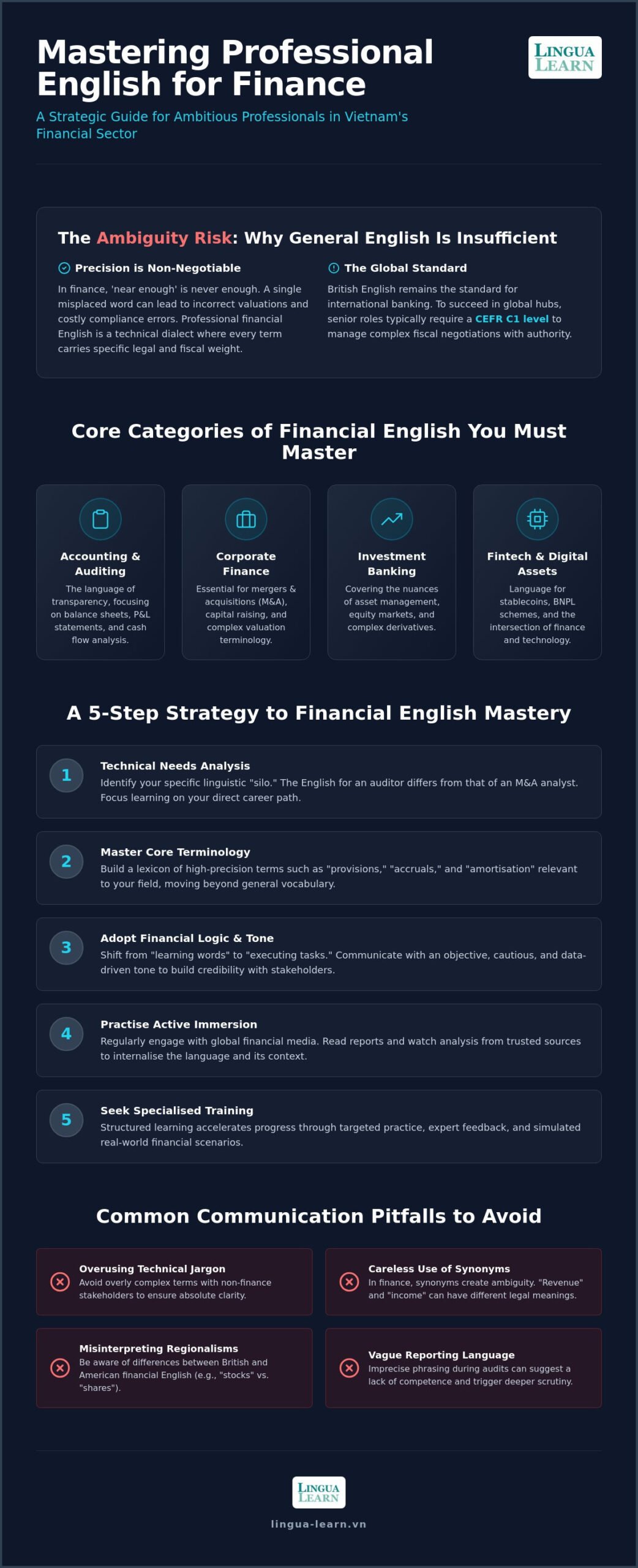
General fluency helps you navigate social situations or order a coffee in London, but it won’t help you defend a balance sheet in a high-pressure boardroom. In the financial sector, “near enough” is never enough. We define professional English for finance as a specialised register where 100% accuracy is the baseline rather than the goal. It’s a technical dialect where every word carries specific legal and fiscal weight. When you’re dealing with millions of Vietnamese Dong (₫) or navigating international currency shifts, linguistic precision becomes a form of risk management.
This leads to what experts call the “Ambiguity Risk.” In everyday conversation, synonyms add variety to your speech. In finance, they create confusion. Using a general synonym for a technical term can lead to catastrophic misinterpretations of data. British English remains the global standard for international banking and legal frameworks, particularly amongst institutions operating in major hubs like Singapore, Hong Kong, and London. For Vietnamese professionals, benchmarking progress against the Common European Framework of Reference for Languages (CEFR) is essential. Most senior roles in global firms require at least a C1 level to manage the nuances of complex fiscal negotiation and reporting.
A simple confusion between “revenue” and “profit” in a quarterly report can lead to incorrect valuations and investor panic. Whilst general English allows for creative expression, finance demands linguistic rigidity. During rigorous international audits, auditors look for specific phrasing that aligns with global standards. If your reporting is vague, it suggests a lack of technical competence. This is why obtaining specialised English certifications is a vital step for career progression. It proves to employers that you can handle the high-stakes environment of international finance without making costly errors.
Mastering this field means adopting a specific tone that is objective, cautious, and relentlessly data-driven. You aren’t just learning words; you’re learning how to think in a second language. Professional English supports strict compliance with IFRS and GAAP standards by providing the exact terminology required for transparency. The goal is to move from “learning words” to “executing tasks.” When you discuss “provisions” or “accruals,” you are performing a technical function. This shift in mindset allows you to communicate with the same authority as a native speaker, ensuring your insights are respected by stakeholders at every level.
To excel in the global financial sector, you must first identify which linguistic “silo” aligns with your specific career path. Whilst general business fluency is helpful, the professional English for finance required for a tax auditor differs significantly from that of a fintech developer or an investment analyst. Choosing the right focus area ensures you aren’t just memorising words, but are instead building the technical capacity to perform your role with authority. In Vietnam’s evolving market, where international firms increasingly seek local talent for regional roles, mastering these categories is a strategic career move.
The primary domains you should prioritise include:
Precision in accounting prevents the “Ambiguity Risk” mentioned previously. You must distinguish between internal audits, which focus on process improvement, and external audits, which provide independent verification for stakeholders. Mastering terms like depreciation (for tangible assets) and amortisation (for intangible ones) is vital for accurate reporting. Accrual accounting is a financial reporting method where revenue and expenses are recorded when they are earned or incurred, regardless of when the actual cash transaction occurs. If you feel you need to refine these specific technical skills, you might consider how a structured professional training programme could bridge your current knowledge gaps.
In investment banking, your ability to describe market volatility can influence high-stakes decisions. With the US Federal Funds Rate maintaining a target range of 3.50% to 3.75% in mid-2026, professionals must be able to explain how these benchmarks impact local interest rates and investment yields. You should be comfortable using “bullish” to describe an optimistic market outlook or “bearish” when expecting a decline. Effective communication in this field involves more than just stating numbers; it requires the ability to interpret economic indicators, such as the 4.2% increase in the US Consumer Price Index, and explain their relevance to your clients’ portfolios with confidence.
Transitioning from general fluency to technical mastery requires a methodical approach rather than a random collection of vocabulary lists. You need a strategy that integrates technical knowledge with linguistic agility. In the competitive landscape of 2026, where global standards like the FCA’s new non-financial misconduct rules demand clear communication, your ability to articulate complex ideas is a vital asset. Follow this structured five-step plan to elevate your professional English for finance and command respect in any corporate setting.
Before committing to a study programme, you must establish your baseline. Assessing your current CEFR level is crucial; most finance roles in international firms require a minimum of B2 or C1 for effective performance. You need to identify whether your primary challenge lies in drafting precise technical reports or in the spontaneous interaction required during boardroom debates. Many learners find that whilst their reading comprehension is high, their “active” vocabulary for speaking remains limited. Starting with professional adult English courses that offer a diagnostic pre-assessment ensures your learning path targets your specific linguistic gaps from day one.
Step 2: Engage in Active Immersion
Passive reading isn’t enough. When you read The Economist or the Financial Times, don’t just look for facts. Analyse the sentence structures and the “cautious” tone used to describe market shifts. For instance, look at how analysts discuss the 4.2% increase in the US Consumer Price Index; notice the verbs they use to describe inflationary pressure. Try to replicate this style in your own drafting to align with global standards of professional expression.
Numbers rarely speak for themselves; they require a narrative to become actionable insights. Data storytelling involves turning a static spreadsheet into a compelling verbal or written report that non-finance managers can easily digest. Use transition phrases such as “this trend is primarily driven by,” “the deficit was partially offset by,” or “projections indicate a steady recovery.” This technique helps you guide your audience through the logic of your findings rather than just reciting figures. Data storytelling has emerged as the most critical skill for CFOs in 2026 because it bridges the gap between raw fiscal data and strategic decision-making for non-finance stakeholders.
Step 4: Utilise Live Feedback Loops
You can’t master technical English in a vacuum. Engaging in a live virtual classroom allows you to receive immediate corrections on your pronunciation and usage of technical terms. This real-time feedback from certified tutors helps you iron out subtle errors before they become habits. It’s particularly useful for practising high-stakes scenarios, such as explaining new “buy-now-pay-later” (BNPL) regulations or defending a budget proposal.
Step 5: Apply Immediate Action Plans
Knowledge that isn’t applied is quickly forgotten. Create a weekly action plan where you commit to using three new technical phrases in your emails or meetings. If you’ve just learned the nuances of “accrual accounting,” find an opportunity to explain it to a junior colleague. This immediate application reinforces the neural pathways required for long-term retention and builds the “muscle memory” needed for professional confidence.
Even the most technically gifted accountants can struggle if they fail to adapt their language to their audience. One of the most frequent errors in professional English for finance is the over-use of dense jargon when presenting to non-technical stakeholders. Whilst your peers understand “accruals” or “EBITDA”, your colleagues in Marketing or HR might find these terms alienating. This lack of clarity often leads to friction during budget approvals or strategic planning. To succeed, you must learn to translate complex fiscal concepts into plain English without losing the underlying technical accuracy.
Another subtle but significant pitfall is the failure to account for cultural nuances in negotiation. In Vietnam’s corporate culture, communication is often indirect and hierarchical. When using English as a global bridge, you must balance the directness of Western financial logic with the polite professional etiquette expected in local boardrooms. Neglecting these soft skills can undermine your authority, regardless of how accurate your spreadsheets are.
Consistency in your choice of dialect is essential for maintaining a professional image. Mixing British and American terms in a single report suggests a lack of attention to detail. In major Asian financial hubs like Singapore and Hong Kong, British English standards are traditionally preferred due to historical legal frameworks. If you’re reporting to a London-based headquarters, using American terms could lead to confusion during internal audits. Use the table below to ensure your terminology remains consistent.
| British English | American English |
|---|---|
| Debtors | Accounts Receivable |
| Creditors | Accounts Payable |
| Turnover | Revenue / Sales |
| Share Capital | Common Stock |
| Gearing | Leverage |
Conciseness is the hallmark of professional authority. Senior executives don’t have time to wade through “wordy” paragraphs. Instead of using passive, filler-heavy phrases like “It is our recommendation that we should consider,” simply say “We recommend.” Using active verbs such as “forecast,” “optimised,” or “mitigated” creates a sense of momentum and clarity. If you want to refine your drafting style, our corporate skills training provides specific modules on high-impact report writing. You can enquire about our specialised finance programmes to start personalising your learning journey today.
Lingua Learn Vietnam understands that a finance professional’s time is their most valuable asset. We don’t believe in generic, one-size-fits-all curricula that fail to address the specific technical demands of your role. Instead, we apply our signature 8-Step Learning Pathway to ensure that every minute you spend in our virtual classroom translates into measurable career progress. By combining academic authority with a supportive, student-centred approach, we help you master professional English for finance whilst maintaining your focus on your daily corporate responsibilities.
Our live virtual classrooms provide a safe yet challenging environment to practise high-stakes presentations and negotiations. You’ll receive real-time feedback from certified tutors who understand the nuances of global financial standards. Our technology is UK-managed, ensuring the highest levels of data security and providing you with clear, data-driven reports on your learning results. This structured approach is designed to elevate your professional English for finance, whether you operate in Vietnam’s real estate market, the tech sector, or large-scale manufacturing.
We tailor our curricula to align with the technical requirements of IFRS and GAAP, ensuring you use the exact terminology required by international auditors. A key feature of our programme is the use of recorded sessions. These allow you to review your own performance, refine your “Data Storytelling” techniques, and track your improvement over time. It’s this level of accountability that leads HR managers to trust our corporate language training when they need to see a clear return on investment for their teams.
We focus on the practical application of language. You won’t just learn about finance; you’ll learn how to execute tasks, defend budget proposals, and lead cross-cultural teams with quiet confidence. This methodical flow from assessment to action ensures that your learning is always relevant to the current market conditions in Vietnam and beyond. By adopting our structured action plans, you ensure that new skills are integrated immediately into your workplace communication.
Joining our programme means becoming part of a professional network of learners across Asia. Our online platform offers the flexibility that busy executives require, allowing you to fit high-quality training into a demanding schedule. We’re here to act as your knowledgeable guide, providing the structured support you need to achieve global standards of communication and improved career mobility.
Don’t let linguistic ambiguity hold back your potential in the global market. Take the first step towards mastering the language of global finance by speaking with our dedicated team of experts. Contact Lingua Learn Vietnam to organise your finance English pre-assessment and begin your journey towards professional empowerment today.
Mastering technical communication is a strategic investment in your professional authority. By moving beyond general fluency and adopting the precise logic of global financial standards, you protect your organisation from ambiguity whilst positioning yourself for senior leadership roles. Whether you’re navigating IFRS reporting or delivering high-stakes presentations, the ability to turn raw data into a compelling narrative will be your greatest asset in 2026.
Lingua Learn Vietnam provides the structured support needed to bridge your specific linguistic gaps. Our CEFR-aligned curriculum is delivered by certified native-speaking instructors who bring genuine corporate experience to every session. Through our UK-managed Learning Management System, you’ll access secure, measurable training that respects your demanding schedule. Expanding your career mobility requires more than technical skill; it demands the confidence to communicate your expertise on a global stage.
Book your professional English for finance consultation with Lingua Learn Vietnam and start transforming your potential into professional excellence today.
General English focuses on social fluency and everyday communication. In contrast, professional English for finance is a technical register where precision is the absolute priority. It requires a mastery of specific terminology used in IFRS and GAAP reporting, where a single misunderstood word can lead to significant fiscal errors. Whilst general English allows for synonyms and creative phrasing, financial English demands rigid accuracy to ensure transparency and compliance in global corporate environments.
Proficiency depends on your starting CEFR level. If you’re already at a B2 level, a focused 30 to 40 hour specialised course can often bridge the gap to technical fluency. Moving between full CEFR levels, such as from B2 to C1, typically requires 100 to 150 hours of guided study. For busy professionals in Vietnam, structured weekly sessions ensure that progress is consistent whilst allowing you to apply new skills immediately in your workplace.
Yes, we generally recommend a minimum of a B2 (Upper Intermediate) level on the CEFR scale. This baseline ensures you have the grammatical foundation to handle complex sentence structures. Without this, you might struggle to articulate the logic behind financial shifts, even if you’ve memorised the technical vocabulary. If you’re currently at a lower level, our general English courses can help you reach the necessary standard before you specialise.
British English is often considered the standard for international banking, particularly in Asian hubs like Hong Kong and Singapore. Most international accounting standards and legal frameworks are rooted in British terminology. However, the most important factor is consistency. Mixing dialects within a single report can appear unprofessional. At Lingua Learn Vietnam, we help you master the nuances of British English to ensure your communication aligns with global expectations.
Online learning is exceptionally effective when conducted through live virtual classrooms. This format allows for real-time interaction and immediate feedback from certified tutors, which is vital for perfecting technical pronunciation and tone. It offers the flexibility that executives in Hanoi or Ho Chi Minh City require, allowing you to practise high-stakes presentations or role-play negotiations from your office without the need for travel, whilst maintaining high academic standards.
You should prioritise the “language of the balance sheet.” Terms such as revenue, accruals, depreciation, and equity are fundamental across all sectors. Understanding the distinction between “turnover” and “profit” is also essential for accurate reporting. Mastering professional English for finance starts with these core concepts because they form the basis of every P&L statement and audit report, regardless of whether you work in manufacturing, tech, or real estate.
Our customisation begins with a thorough technical needs analysis for the entire team. We identify specific departmental gaps, such as a need for better audit report drafting or improved confidence when presenting to non-finance stakeholders. We then tailor the curriculum to match your organisation’s internal reporting standards and industry sector. This bespoke approach ensures that the training is directly relevant to your team’s daily tasks and provides a measurable return on investment.

Article by
Rob Holloway
Rob Holloway is the CEO of Lingua Learn Elevate Ltd (UK), the company operating Lingua Learn Vietnam. He works with businesses and organisations across Asia to provide high-quality online language training, corporate communication programmes and internationally recognised language certification preparation. Working with organisations across industries including engineering, finance, technology, manufacturing and professional services, Rob helps identify language training needs and connect clients with tailored learning solutions delivered by Lingua Learn’s experienced academic team. His professional focus includes corporate language training, business communication, cross-cultural communication, international education partnerships and helping organisations build the language skills needed to succeed in global business environments. Through Lingua Learn Vietnam, Rob is committed to providing UK-managed online language training delivered by qualified instructors, helping professionals and organisations communicate with confidence in today’s international workplace.
 English (UK)
  Vietnamese