Imagine sitting in a high-stakes design review with a leading automotive firm in Stuttgart, only to find that your technical expertise is masked by a struggle to articulate specific DIN standards. It’s a frustrating reality for many ambitious professionals who find that general language skills aren’t enough when faced with complex technical documentation or fast-paced stakeholder meetings. Mastering professional German for engineering is the vital bridge between being a capable technician and becoming a respected leader within the world’s most innovative industrial organisations.
We recognise that balancing intensive study with a full-time engineering schedule is a significant challenge. You’re likely looking for a way to communicate technical concepts accurately whilst ensuring you meet the rigorous safety and quality expectations of European firms. This guide will show you how to navigate these linguistic hurdles and advance into senior roles. We’ll explore the essential language levels required for the German market and how Lingua Learn Vietnam supports your journey toward professional excellence and global career mobility.
Professional German for engineering is far more than a collection of technical nouns. It’s a specific linguistic register known as “Fachsprache”, or specialised language. Whilst everyday German helps you order a coffee or greet a neighbour, Fachsprache provides the precise tools needed to describe complex mechanical systems, electrical circuits, and civil infrastructure. It serves as the primary bridge to understanding European quality standards and integrating into some of the world’s most advanced industrial environments. Mastering professional German for engineering allows you to move beyond basic communication and into the heart of technical innovation.
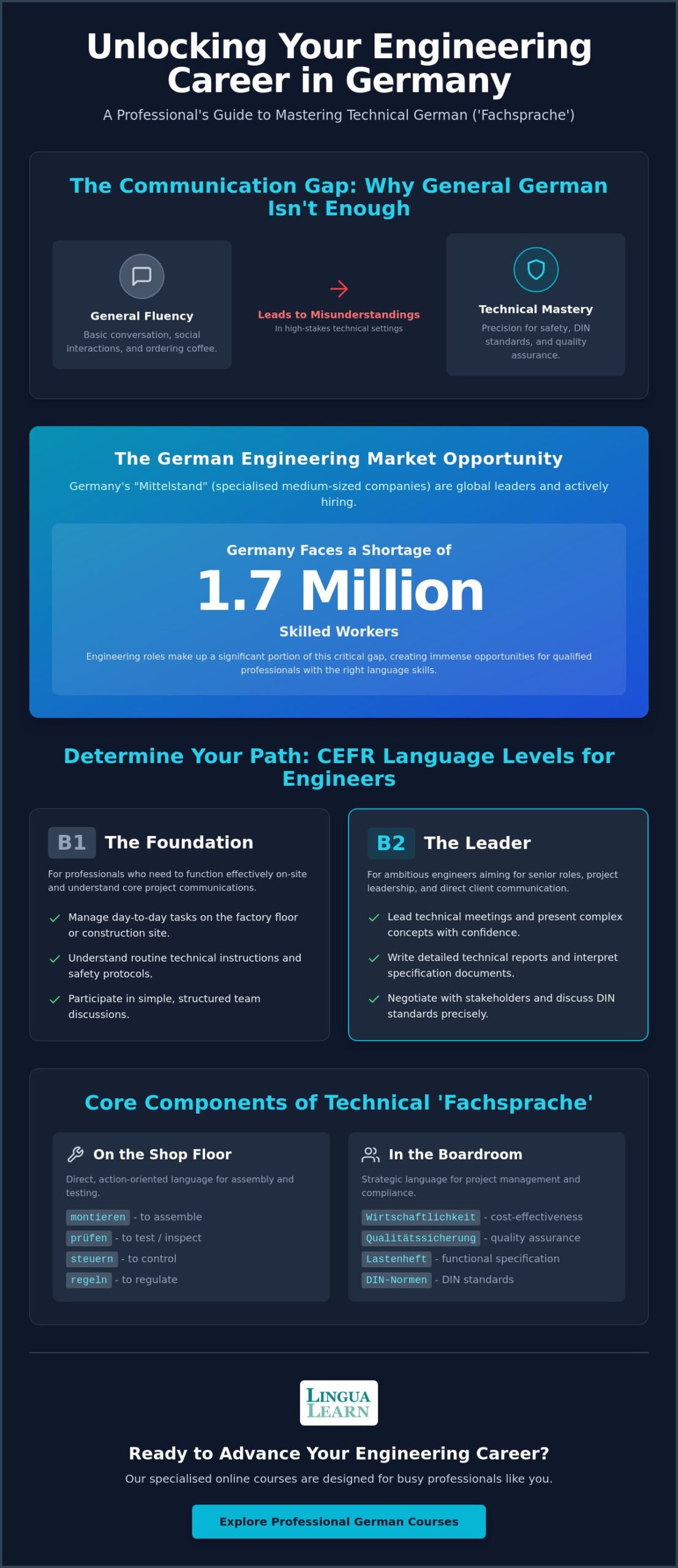
In the high-stakes sectors of automotive manufacturing and renewable energy, precision is a non-negotiable safety requirement. A slight misunderstanding of a technical specification isn’t just a social faux pas; it can lead to structural failures or project delays. By developing skills in this niche area, you ensure that your technical expertise is communicated with the exactness that German “Ingenieure” (engineers) expect. This mastery allows you to contribute effectively to global projects, ensuring that safety protocols and DIN standards are met with absolute accuracy.
The transition from general fluency to technical mastery is significant. You’ll find yourself moving beyond “Guten Tag” to interpreting a “Lastenheft”, which is a functional specification document that dictates the entire lifecycle of a project. General fluency often fails in high-pressure technical environments because it lacks the specific syntax required for objective reporting. Technical German frequently employs the passive voice and complex compound nouns to describe processes with clinical objectivity. Mastering these structures is a core component of a high-quality German course designed for professionals. It transforms your ability to write reports that are both authoritative and legally sound.
As we move through 2026, the demand for German-speaking engineers has reached a critical point. Germany currently faces a shortage of over 1.7 million skilled workers, with engineering roles making up a significant portion of this gap. Much of this demand comes from the “Mittelstand”, the highly specialised, medium-sized companies that lead the global market in niche technologies. These firms are expanding their presence in Asia, creating a need for professionals who can act as linguistic and technical liaisons. Accessing the German language in science and technology provides you with a distinct competitive advantage. It enables you to read original patent documentation and research papers that haven’t yet been translated, putting you at the forefront of innovation within your field.
Effective communication in a technical setting requires a structured approach to vocabulary. You cannot simply translate English terms and expect them to carry the same weight. Technical German is built on the foundation of “DIN” (Deutsches Institut für Normung) standards. These standards dictate not just the physical dimensions of a component, but the very language used to describe it. Mastering professional German for engineering involves learning these standardised terms to ensure your specifications are understood across all departments, from the design office to the assembly line.
The vocabulary you’ll need varies significantly depending on your environment. On the shop floor, the language is often direct and focused on immediate action, using verbs such as “montieren” (to assemble) or “prüfen” (to test). In contrast, boardroom communication requires a more sophisticated lexicon focused on strategy and compliance. You’ll need to discuss “Wirtschaftlichkeit” (cost-effectiveness) and “Qualitätssicherung” (quality assurance) whilst maintaining the technical precision of your engineering background. This dual-layered approach is a central feature of our German courses for professionals.
Whether you’re specialising in robotics or renewable energy, your vocabulary must reflect the latest advancements in “Industrie 4.0”. You’ll need to master verbs that describe automated processes, such as “steuern” (to control) and “regeln” (to regulate). Understanding circuit diagrams (Schaltpläne) and technical specifications (technische Datenblätter) in German is essential for troubleshooting and innovation. For those looking to bridge the gap between their current skills and these high-level requirements, you can enquire about our specialised training to focus on these industry-specific terms.
Clear documentation is the backbone of German engineering excellence. You’ll be expected to draft maintenance logs and accident reports that are concise and legally watertight. A critical concept in project management is the “Soll-Ist-Vergleich”, or the target-versus-actual comparison. This analysis is used to monitor project timelines and budget adherence. Drafting a technical proposal that meets corporate expectations requires a deep understanding of these nuances. By mastering this specific vocabulary, you demonstrate a level of professionalism that builds trust with German stakeholders and proves your readiness for senior leadership roles.
Understanding where you stand on the Common European Framework of Reference for Languages (CEFR) is vital for your career progression. Whilst general language learners often aim for broad fluency, engineers need to map these levels to specific workplace responsibilities. Most German industrial leaders set B2 as the minimum entry requirement for international hires. This ensures you can function independently without constant supervision or translation assistance. Mastering professional German for engineering at this level means you’re no longer just a spectator in technical discussions; you’re an active contributor.
The transition between levels often defines your role within an organisation. At the B1 level, you can handle routine technical tasks and follow basic site instructions. It’s a solid foundation for “on-site” survival but lacks the nuance required for high-level documentation. Moving to B2 allows you to participate in technical meetings and write detailed reports that meet European quality standards. For those aiming for executive or senior consultant roles, C1 proficiency is essential. This level enables you to lead complex negotiations with global suppliers and define high-level project strategy with absolute confidence.
B2 is considered the threshold for independent professional use because it requires a grasp of complex grammatical structures. You’ll need to master the passive voice and “Nominalstil” (nominal style) to draft authoritative technical papers that resonate with German stakeholders. Preparing for German certifications specifically for engineers focuses your study on these high-value areas. It moves you beyond general conversation and into the precise linguistic territory required to navigate DIN standards and complex functional specifications.
Progress isn’t always linear, especially when you’re balancing a demanding engineering career. We recommend starting with a thorough pre-assessment to identify your current CEFR level. This prevents you from wasting time on concepts you’ve already mastered. Tracking your progress through regular reporting and feedback is essential for maintaining momentum. At Lingua Learn Vietnam, we use a bespoke Student Action Plan to target your specific technical gaps. This structured approach ensures every hour of study brings you closer to your goal of professional integration within the European engineering sector.
Succeeding within a German Multinational Corporation (MNC) in Vietnam or abroad requires more than a grasp of technical jargon. Whilst your technical proficiency is the foundation, your ability to navigate the unique corporate culture determines your long-term success. In the world of German engineering, communication is characterised by a high degree of directness. This focus on efficiency over small talk can sometimes feel abrupt to those used to more circuitous styles. In a professional setting, this directness is a sign of respect for your colleagues’ time and a commitment to project clarity. It’s about getting the job done right.
Punctuality, or “Pünktlichkeit”, is another pillar of the German professional identity. It’s not merely about showing up on time; it’s about respecting the structured project timelines that define the industry. Delays are viewed as a lack of discipline and can quickly erode trust amongst international teams. Navigating hierarchy and feedback also requires a specific approach. Feedback in German firms is typically blunt and task-oriented. It’s vital to separate professional criticism from personal value, as the goal is always the refinement of the final product. Combining your language studies with Corporate Soft Skills Training ensures you possess the emotional intelligence to thrive in these high-pressure environments.
German meetings are highly structured and goal-oriented. Presenting technical data persuasively requires an objective, data-driven approach rather than emotional appeals. You’ll need to master specific phrases for professional disagreement to ensure your voice is heard without causing friction. A key element is the “Protokoll” (minutes). In German decision-making, the written record of a meeting is often considered a binding commitment. Ensuring you understand and can contribute to these documents is a critical part of professional German for engineering.
Building trust amongst international engineering teams relies on reliability and transparency. German stakeholders value data-driven arguments and evidence-based solutions. Reliability is the currency of trust. Avoiding common cultural faux pas, such as using the informal “Du” too early or failing to provide detailed documentation, is essential for maintaining professional credibility. If you’re looking to refine your approach to working within these global leaders, you can get in touch with our team to discuss a tailored training programme that meets your specific career goals.
Selecting the correct training partner is the final, most critical step in your professional transformation. For engineers, the standard of instruction must mirror the precision of the industry itself. Live, interactive virtual classrooms provide a dynamic environment where you can practice complex terminology in real-time. Unlike static apps, our sessions allow for immediate feedback from certified, native-speaking tutors. These experts understand the technical nuance of “Fachsprache” and can guide you through the linguistic subtleties of the workshop and the boardroom alike.
Our UK-managed technology ensures a secure and consistent learning environment, providing a stable platform for your development. This infrastructure is a key differentiator, as it guarantees that your training remains uninterrupted and professional. You’ll also have 24/7 access to recorded sessions and digital materials. If a site visit or a late shift prevents you from attending a live class, you can catch up at your convenience, ensuring no gap in your learning journey. This flexibility is essential for maintaining momentum whilst managing a demanding engineering career. For a comprehensive overview of how to structure your studies around a busy schedule, our guide to online German language courses in Vietnam outlines the UK-standard programmes and structured pathways available to Vietnamese professionals in 2026.
The Adult Language Courses at Lingua Learn Vietnam are specifically designed to adapt to your technical requirements. We utilise a rigorous 8-step Learning Pathway that begins with a comprehensive needs analysis. This process ensures that your study of professional German for engineering is focused on the areas that matter most to your specific role. From the initial assessment to the final certification, your progress is tracked against a bespoke Student Action Plan. This structured method allows you to balance a demanding full-time schedule whilst making measurable strides toward your career goals.
We bring world-class UK training standards to the local market, offering a level of quality and management that is unique in the region. Our commitment to excellence is reflected in our detailed reporting systems. You’ll receive regular attendance and progress reports that align with CEFR benchmarks, providing clear evidence of your advancement. This transparency is invaluable for corporate clients and ambitious individuals who demand a high return on their investment in personal growth. Don’t let language barriers limit your potential within global industrial leaders. Enquire today to start your Professional German journey and take the first step toward a senior role in European engineering.
Mastering the precision of “Fachsprache” and understanding the cultural nuances of German industrial leaders are the keys to unlocking your potential. You’ve seen how specific language levels correlate with professional responsibilities and how direct communication builds trust within international teams. Developing your skills in professional German for engineering isn’t just about learning words; it’s about adopting the structured mindset that defines world-class technical innovation whilst ensuring safety and quality standards are met.
Lingua Learn Vietnam provides the professional framework you need to succeed. Our CEFR-aligned curriculum is delivered through live interactive lessons with certified tutors, ensuring you gain the technical nuance required for the boardroom and the shop floor. With our UK-managed Learning Management System, you’ll have the reliable tools to track your progress and balance your studies with a demanding full-time schedule. The opportunities amongst the world’s leading industrial firms are within your reach.
Take the next step toward a senior role in European engineering. Enquire about our Professional German Courses for Engineers today and start your journey toward global career mobility with a dedicated partner by your side.
Learning professional German for engineering isn’t necessarily harder, but it requires a different focus. Whilst general German covers social interactions, engineering German prioritises precision, objective syntax, and standardised terminology. You’ll spend more time mastering passive voice constructions and specific compound nouns rather than varied conversational slang. This structured approach often appeals to the logical mindset of engineers who prefer clear, rule-based communication.
A B2 level is the standard requirement for most international hires in German engineering firms. This proficiency allows you to participate in technical meetings and draft detailed reports independently. Whilst some roles involving basic site instructions might accept a B1 level, reaching B2 is the essential benchmark for career advancement and professional integration within a European corporate environment.
You can certainly learn professional German online whilst maintaining a full-time engineering schedule. Our interactive virtual classrooms at Lingua Learn Vietnam are designed for flexibility, offering live lessons that fit around your project deadlines. If you miss a session, you can access recorded lessons 24/7. This ensures you never fall behind in your training regardless of your workload.
Lingua Learn Vietnam provides internal certification upon the successful completion of each course level. These certificates are aligned with the CEFR framework and serve as clear evidence of your linguistic progress. This documentation is valuable for your professional portfolio. You can present it to current or future employers to validate your technical language skills and commitment to growth.
The time required to reach B2 level depends on your starting point and the intensity of your study. Generally, reaching this level from a beginner’s stage takes approximately 600 to 800 hours of guided instruction. Using a structured 8-step Learning Pathway helps you stay on track. It ensures your study time is used as efficiently as possible to meet your career milestones.
All our instructors are certified, native German speakers with extensive experience in professional language training. This ensures you learn the correct technical nuance and pronunciation from the very first lesson. Our tutors act as knowledgeable guides. They help you navigate the complexities of “Fachsprache” and build the confidence needed for high-level technical discussions with stakeholders.
You’ll need a stable internet connection and a computer, laptop, or tablet equipped with a webcam. We also recommend using a headset with a microphone to ensure clear audio during interactive discussions. Our UK-managed platform is designed to be user-friendly and secure. This allows you to focus entirely on your learning without being hindered by technical distractions or software issues.
Many organisations choose to sponsor their employees through our Corporate Language Training programmes. We provide detailed attendance and progress reports that your HR department can use for training audits and performance reviews. If your firm is looking to upskill its technical team, we can tailor a programme to meet specific corporate goals and project requirements.

Article by
Rob Holloway
Rob Holloway is the CEO of Lingua Learn Elevate Ltd (UK), the company operating Lingua Learn Vietnam. He works with businesses and organisations across Asia to provide high-quality online language training, corporate communication programmes and internationally recognised language certification preparation.
Working with organisations across industries including engineering, finance, technology, manufacturing and professional services, Rob helps identify language training needs and connect clients with tailored learning solutions delivered by Lingua Learn's experienced academic team.
His professional focus includes corporate language training, business communication, cross-cultural communication, international education partnerships and helping organisations build the language skills needed to succeed in global business environments.
Through Lingua Learn Vietnam, Rob is committed to providing UK-managed online language training delivered by qualified instructors, helping professionals and organisations communicate with confidence in today's international workplace.
 English (UK)
  Vietnamese