What if the biggest barrier to your career progression isn’t your technical skills, but how confidently you communicate in English? For many professionals working in Vietnam’s increasingly international business environment, this is a very real challenge. Misunderstandings in meetings, hesitation during presentations, and the quiet frustration of not quite finding the right words can hold talented people back far more than they realise.
You’re not alone in feeling this way. Many driven professionals know their subject matter inside out, yet still feel uncertain the moment they need to express complex ideas in English to colleagues, clients, or senior leadership. That gap between knowledge and confident communication is genuinely common, and it’s entirely possible to close it.
This article will show you how to improve workplace English proficiency in practical, sustainable ways that fit around a busy professional life. From building everyday habits to investing in structured Business English training, you’ll find strategies that deliver real results, whether your goal is clearer written communication, stronger presentation skills, or more confident collaboration with international teams.
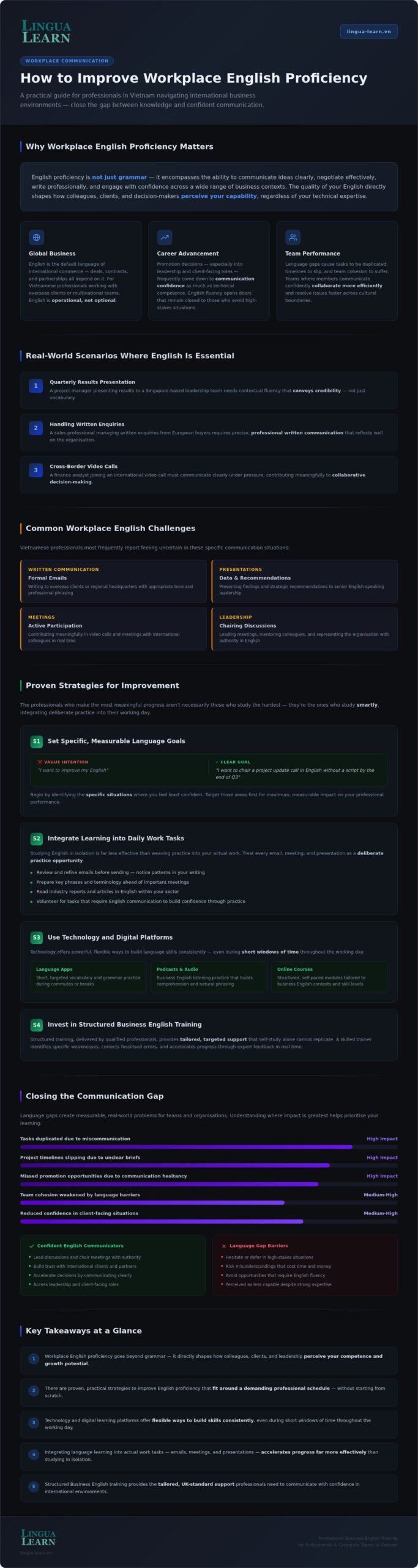
Workplace English proficiency isn’t simply about speaking grammatically correct sentences. It encompasses the ability to communicate ideas clearly, negotiate effectively, write professionally, and engage with confidence across a range of business contexts. For professionals in Vietnam navigating an increasingly international career landscape, this distinction matters enormously. The quality of your English communication directly shapes how colleagues, clients, and decision-makers perceive your capability, regardless of how strong your technical expertise may be.
English functions as the default language of international commerce. Across industries ranging from technology and finance to manufacturing and logistics, it’s the common ground on which deals are struck, contracts are negotiated, and partnerships are built. For Vietnamese professionals working with overseas clients, reporting to regional headquarters, or collaborating with multinational teams, English isn’t optional – it’s operational.
Consider what this looks like in practice. A project manager presenting quarterly results to a Singapore-based leadership team, a sales professional handling written enquiries from European buyers, or a finance analyst joining a cross-border video call – each of these situations demands not just vocabulary, but the kind of contextual fluency that conveys credibility. Businesses that communicate clearly across language boundaries consistently outperform those that don’t, because clarity reduces costly misunderstandings and accelerates decision-making.
The connection between language skills and career advancement is well-documented among HR professionals and hiring managers across the Asia-Pacific region. Promotion decisions, particularly into leadership and client-facing roles, frequently come down to communication confidence as much as technical competence. A professional who can articulate strategy, chair a meeting, or represent their organisation in English commands a different level of trust than one who hesitates or defers.
This is precisely why many ambitious professionals actively seek to improve workplace English proficiency as a deliberate career strategy, not simply as a personal development goal. The ability to lead discussions, mentor junior colleagues, and present to senior stakeholders in English opens doors that remain closed to those who avoid these situations out of uncertainty.
The barriers created by language gaps are real and measurable in their effect on team dynamics. When communication is unclear, tasks get duplicated, timelines slip, and team cohesion suffers. Conversely, teams where members communicate with confidence tend to collaborate more efficiently, resolve issues faster, and build stronger working relationships across cultural boundaries.
Structured support, such as the English language courses and corporate language training offered by Lingua Learn Vietnam, is designed specifically to address these professional communication needs at every level.
Knowing you need to improve is one thing. Having a clear, structured path forward is another entirely. The professionals who make the most meaningful progress with their English aren’t necessarily those who study the hardest – they’re the ones who study smartly, integrating deliberate practice into the rhythms of their working day rather than treating it as a separate obligation.
Vague intentions rarely produce results. “I want to improve my English” is a wish; “I want to chair a project update call in English without preparing a script by the end of Q3” is a goal. The difference matters enormously when you’re balancing professional development with a demanding workload.
Start by identifying the specific communication situations where you feel least confident. Common examples for Vietnamese professionals include:
Once you’ve identified your priority areas, use a simple self-assessment to establish a baseline. Record yourself speaking on a work-related topic for two minutes, then review it honestly. Note where you hesitate, which vocabulary you reach for repeatedly, and where your meaning might be unclear to a native speaker. Revisit this exercise monthly – the recordings themselves become a practical tracking tool that shows real progress over time.
Digital tools such as Grammarly (for written English), Speechling (for pronunciation), and the Cambridge Dictionary’s online resources can support independent development between structured sessions. That said, self-study works best when it complements, rather than replaces, guided learning from qualified instructors.
One of the most effective ways to improve workplace English proficiency is to stop treating it as a separate activity. Your daily tasks are already full of practice opportunities – they simply need to be approached with more intention.
Try these practical adjustments to your working routine:
Peer support is often underutilised. If your organisation has colleagues at different English proficiency levels, a structured language exchange – where one person practises English whilst helping another with Vietnamese – creates mutual accountability and a low-pressure environment for making mistakes. Some companies in Vietnam have formalised this through internal language circles or buddy systems, and the results are consistently positive for team cohesion as well as individual development.
Presentations, even short internal ones, are particularly valuable practice. The preparation process forces you to organise ideas clearly in English, and the delivery itself builds the kind of real-time fluency that no textbook exercise can replicate.
If you’d like expert guidance on which strategies will move the needle fastest for your specific role and goals, get in touch with the team at Lingua Learn Vietnam to discuss a learning approach tailored to your professional context.
The digital learning landscape has genuinely transformed what’s possible for busy professionals. Where once you needed to block out significant time for evening classes, today you can build meaningful English skills during a commute, between meetings, or over a lunch break. The key is choosing tools that align with your professional goals rather than simply downloading whatever app appears first in a search.
Not all language learning apps are built for professionals, and this distinction matters if your goal is to improve workplace English proficiency rather than simply expand general vocabulary. When evaluating any digital tool, consider these criteria:
Several widely used tools serve different needs well. Grammarly is particularly strong for written English, offering real-time suggestions on tone, clarity, and formality, which is directly useful when drafting client-facing communications. Speechling supports pronunciation with native speaker feedback. Cambridge English Online provides structured exercises grounded in internationally recognised standards. Each serves a specific function; combining two or three strategically tends to outperform relying on any single platform.
Apps and self-study tools have clear value, but they have an equally clear ceiling. Real fluency, especially the kind that holds up under the pressure of a live client call or a senior leadership presentation, requires interaction with qualified human instructors who can respond to your specific patterns and gaps.
This is where virtual language platforms offer a genuine advantage over generic app-based learning. Live sessions with experienced tutors allow for immediate, contextualised correction, something no algorithm currently replicates with the same precision. A tutor who understands your industry, your role, and the specific communication challenges you face can tailor every session to accelerate your progress in ways that pre-built course content simply cannot.
Lingua Learn Vietnam’s online English courses are delivered through a virtual classroom environment that combines the structure of formal training with the flexibility professionals in Vietnam need. Sessions are scheduled around working hours, content is adapted to your professional context, and instruction is delivered to UK-quality standards by qualified tutors. For organisations looking to upskill entire teams, the corporate language training programmes offer the same tailored approach at scale.
The most effective approach combines both: use digital tools to maintain daily practice and reinforce what you’ve learnt, whilst relying on structured virtual instruction to push your skills into genuinely professional territory.
The most sustainable way to improve workplace English proficiency isn’t to add more to your schedule. It’s to reframe what’s already there. Every email you draft, every meeting you attend, and every report you submit is a learning opportunity. The professionals who make the fastest progress are those who treat their working day as a language classroom, not a separate space from it.
Small, consistent habits compound into significant results over time. Rather than waiting for a dedicated study window, build English practice into tasks you’re already doing.
The cumulative effect of these habits is real. Professionals who consistently apply them report that English starts to feel less like a performance and more like a natural mode of communication at work.
Individual effort matters, but organisational support accelerates everything. HR teams and line managers are in a uniquely powerful position to create the conditions in which language development actually happens, rather than simply encouraging it in theory.
Practical steps companies can take include establishing internal language learning groups, where colleagues at similar proficiency levels meet weekly to practise English through real work scenarios. Some Vietnamese businesses have introduced structured buddy systems pairing employees who want to strengthen their English with colleagues who use it daily in client-facing roles. The results tend to benefit team cohesion as much as individual language skills.
HR departments can also formalise language development by incorporating it into professional development plans and allocating dedicated time during the working week for structured training. When language learning is treated as a business investment rather than a personal preference, participation rates and outcomes both improve significantly.
For organisations ready to build a structured, company-wide approach, Lingua Learn Vietnam’s corporate language training programmes are designed to deliver measurable results across entire teams, with content tailored to your industry and communication objectives.
Everything covered in this article points toward the same conclusion: sustainable progress requires more than good intentions and a language app. To genuinely improve workplace English proficiency at a professional level, you need structured support that understands your context, your goals, and the specific demands of your working environment. That’s precisely what Lingua Learn Vietnam is built to deliver.
Generic courses teach general English. Lingua Learn Vietnam’s approach is different. Whether you’re a finance professional preparing for cross-border reporting, a sales manager handling overseas client relationships, or an HR leader building English capability across your team, the training is shaped around your industry, your role, and the communication challenges you face daily.
For corporate clients, this means course content that draws on real workplace scenarios rather than textbook exercises. Vocabulary, writing frameworks, and speaking practice are all grounded in the kinds of tasks your team actually performs. The outcomes reflect this specificity: professionals don’t just improve their English in the abstract; they develop the confidence to chair meetings, draft client proposals, and present to international stakeholders with clarity and authority.
Organisations looking to build English capability at scale can explore Lingua Learn Vietnam’s corporate language training programmes, which are designed to deliver measurable results across entire teams, with content and scheduling adapted to your business requirements.
Live, tutor-led sessions are at the heart of the Lingua Learn Vietnam experience. This matters because real fluency develops through interaction, not passive study. Working directly with a qualified instructor means your specific patterns, gaps, and progress are addressed in real time, something no self-study platform can replicate.
Flexibility is built into the model from the start. Sessions are scheduled to fit around professional working hours, so language development doesn’t compete with your existing commitments. The online delivery format means you can learn from wherever you’re based in Vietnam, without the constraints of fixed classroom locations.
Learners consistently highlight two things: the practical relevance of the content, and the confidence they gain from working with instructors who hold UK-quality training standards. These aren’t abstract credentials; they translate directly into the calibre of feedback, the structure of each session, and the consistency of progress over time.
Individual professionals can explore the full range of options through Lingua Learn Vietnam’s English language courses, designed specifically for adult learners with professional goals.
If you’re ready to take a structured, expert-led approach to your English development, get in touch with the Lingua Learn Vietnam team today to discuss the right course for your goals and schedule.
The path to stronger workplace English isn’t about starting over. It’s about being deliberate. The strategies covered in this article, from integrating practice into your daily work tasks to choosing the right digital tools and investing in structured training, all point toward the same principle: consistent, purposeful effort compounds into genuine fluency over time.
What separates professionals who successfully improve workplace English proficiency from those who stay stuck is rarely talent. It’s having the right support in place. Flexible online learning, UK-quality training standards, and a professional development focus are what make structured guidance so much more effective than self-study alone.
Whether you’re looking to grow individually or build English capability across your entire team, Lingua Learn Vietnam has a tailored solution designed around your goals and schedule.
Your next career opportunity won’t wait. Start building the communication confidence to meet it head-on.
English proficiency directly affects how colleagues, clients, and senior leadership perceive your professional capability. In Vietnam’s international business environment, it’s the primary language used for cross-border negotiations, regional reporting, and multinational collaboration. Professionals who communicate clearly in English are more likely to be considered for leadership roles, client-facing positions, and opportunities that require representing their organisation externally.
Beyond individual advancement, strong English skills reduce costly miscommunications within teams. When instructions, project briefs, and expectations are expressed clearly, deadlines are met more reliably and working relationships across cultural boundaries become considerably stronger.
The most effective way to improve workplace English proficiency is to practise within your actual job tasks rather than treating language learning as a separate activity. Draft emails in English even when they don’t require it, volunteer to present internal updates, and prepare key vocabulary before attending English-language meetings. These habits build the kind of contextual fluency that holds up under real professional pressure.
Pairing daily work-based practice with structured guidance from a qualified instructor accelerates progress significantly. Self-study builds familiarity; tutor-led training builds confidence in applying what you’ve learnt to live, high-stakes situations.
The most useful resources depend on which skills need the most attention. Grammarly supports professional written communication by flagging tone, clarity, and formality in real time. Speechling helps with pronunciation through native speaker feedback. Cambridge English Online offers structured exercises built around internationally recognised standards. Used together, these tools address reading, writing, listening, and speaking in a balanced way.
That said, digital tools have a ceiling. For professionals who need to chair meetings, present to international stakeholders, or handle complex negotiations in English, structured Business English training with a qualified tutor delivers the kind of personalised, contextualised feedback that no app currently replicates.
Companies achieve the best outcomes when they treat language development as a business investment rather than an individual preference. Practical steps include incorporating English proficiency goals into professional development plans, allocating dedicated time during working hours for structured training, and establishing internal language groups where colleagues practise through real work scenarios. Buddy systems pairing employees at different proficiency levels are also consistently effective.
Organisations that formalise this support through corporate language training programmes see measurably higher participation rates and faster skill development than those that rely solely on employees pursuing learning in their own time. Structured, company-wide programmes also tend to strengthen team cohesion alongside individual communication skills.
Technology makes consistent practice genuinely accessible for busy professionals. Short daily sessions using well-chosen digital tools, whether during a commute, a lunch break, or between meetings, compound into meaningful progress over weeks and months. The key is selecting platforms built for professional contexts rather than general conversation, since business communication demands a distinct register, vocabulary, and set of conventions.
The most effective approach combines technology with human instruction. Digital tools reinforce vocabulary and written accuracy between sessions; live tutor-led learning pushes skills into professional territory by addressing your specific patterns, gaps, and communication goals in real time. Neither approach alone delivers the same results as both working together.
Lingua Learn Vietnam delivers tailored online English courses and corporate language training designed specifically for professionals and organisations in Vietnam. Rather than offering generic course content, the training is shaped around your industry, your role, and the communication situations you encounter daily, whether that’s client correspondence, cross-border presentations, or leadership meetings with regional headquarters.
All instruction is delivered to UK-quality training standards by qualified tutors, with flexible scheduling built around professional working hours. Individual learners can explore the adult English language courses, whilst HR teams and business leaders looking to build capability across entire teams can discuss a customised corporate programme. Contact Lingua Learn Vietnam to find the right solution for your goals.

Article by
Rob Holloway
Rob Holloway is the CEO of Lingua Learn Elevate Ltd (UK), the company operating Lingua Learn Vietnam. He works with businesses and organisations across Asia to provide high-quality online language training, corporate communication programmes and internationally recognised language certification preparation.
Working with organisations across industries including engineering, finance, technology, manufacturing and professional services, Rob helps identify language training needs and connect clients with tailored learning solutions delivered by Lingua Learn’s experienced academic team.
His professional focus includes corporate language training, business communication, cross-cultural communication, international education partnerships and helping organisations build the language skills needed to succeed in global business environments.
Through Lingua Learn Vietnam, Rob is committed to providing UK-managed online language training delivered by qualified instructors, helping professionals and organisations communicate with confidence in today’s international workplace.
 English (UK)
  Vietnamese