
Overcoming foreign language anxiety at work is one of the biggest challenges faced by professionals working in international environments. Imagine standing in a boardroom where your technical expertise is unquestioned, yet as the spotlight turns to you, your mind suddenly goes blank. This “freeze” response is a common hurdle for many talented professionals, but overcoming fear of speaking a foreign language at work is entirely possible with the right tactical approach. It is incredibly frustrating to feel like an imposter when your vocabulary doesn’t quite match your professional seniority, leading you to stay silent during crucial discussions or avoid high-stakes presentations altogether.
We recognise that missing out on career-advancing opportunities because of a language barrier is a source of genuine professional pain. This guide promises to equip you with practical, psychological, and structured methods to regain your authority in any meeting. You will discover how to contribute naturally to brainstorming sessions and present to global stakeholders without the shadow of panic. We will explore tactical micro-habits and the benefits of a CEFR-aligned learning pathway to ensure you can communicate with quiet confidence in every professional setting, turning your second language into a powerful asset rather than a barrier.
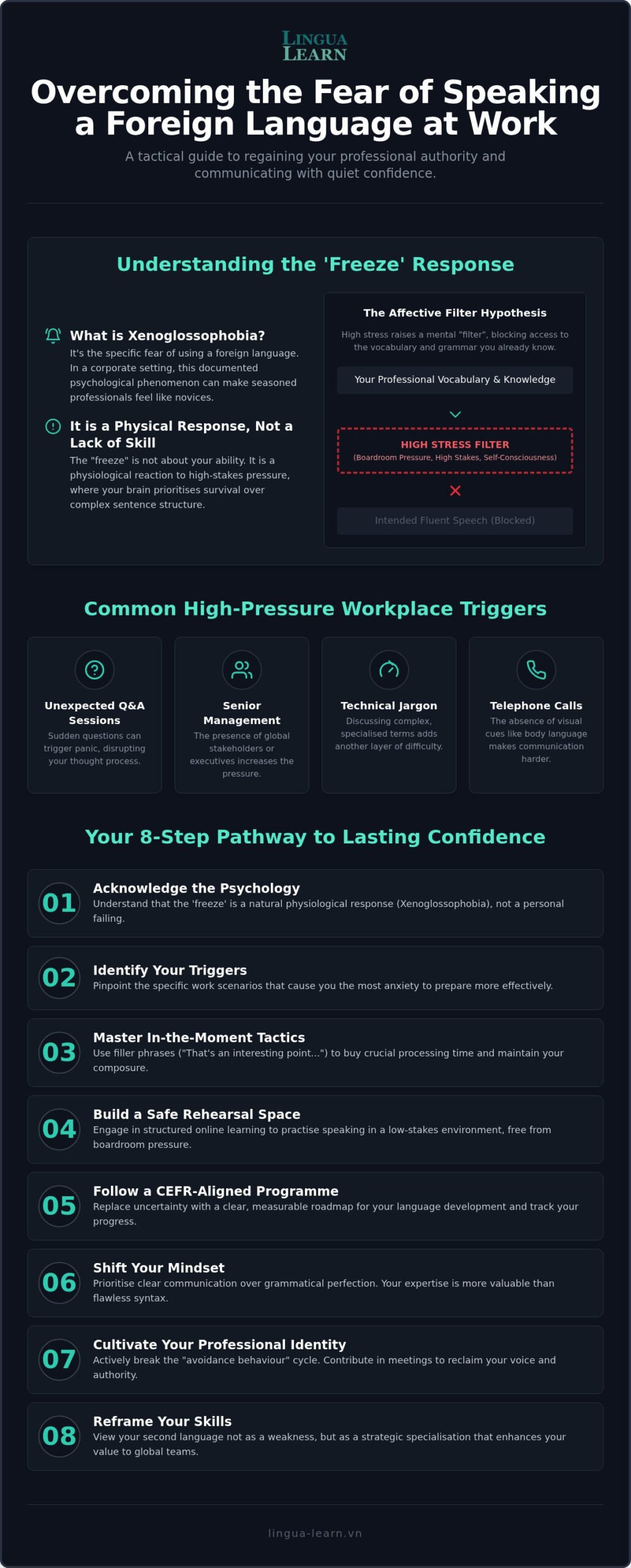
Xenoglossophobia might sound like an intimidating term, but for many international professionals, it’s a daily reality. It refers specifically to the fear of using a foreign language. In the modern corporate environment, it’s the silent barrier that prevents talented individuals from reaching their full potential. You aren’t simply “nervous”; you’re experiencing a documented psychological phenomenon that can make even the most seasoned executive feel like a novice. Successfully overcoming fear of speaking a foreign language at work starts with recognising that this isn’t a lack of ability; it’s a physiological response.
This “freeze” is often explained by the Affective Filter hypothesis. When you experience high levels of stress or self-consciousness, your brain’s “filter” goes up, effectively blocking the path between what you know and what you can say. Your technical vocabulary and grammar are still there, but your brain prioritises survival over sentence structure. This is why your mind goes blank during a high-stakes presentation even though you could speak fluently with a friend the night before.
It’s vital to distinguish between “classroom fear” and “boardroom fear” to validate your experience. In a learning environment, the stakes are low. A mistake might result in a minor correction from a teacher. In a professional setting, the stakes involve promotions, reputation, and multi-million pound deals. The pressure to maintain your professional authority whilst navigating a second language is immense, and it’s natural for your anxiety to scale alongside your career responsibilities.
There is a unique frustration in feeling less intelligent than you actually are. When you cannot express complex ideas with the nuance they deserve, it’s easy to feel like an imposter. This often leads to “avoidance behaviour,” where you might skip networking events or stay silent during brainstorming sessions to avoid the risk of a mistake. At Lingua Learn Vietnam, we see how this cycle limits growth. Developing language skills for leadership roles requires breaking this cycle of avoidance and reclaiming your professional identity.
Anxiety is rarely constant; it’s usually triggered by specific scenarios. Recognising these moments allows you to prepare more effectively. Common workplace triggers include:
Perfectionism is often the enemy of professional fluency. If you’re waiting until your sentence is grammatically perfect before speaking, the conversation will move past you. Recognise the physical signs of your anxiety, such as a racing heart or shallow breathing. These are signals that your affective filter is rising, and identifying them is the first step toward overcoming fear of speaking a foreign language at work through targeted relaxation and communication strategies.
While practicing in private can build a foundation, the real challenge lies in the “rebound” of a live boardroom discussion. Overcoming fear of speaking a foreign language at work requires a toolkit of immediate, tactical responses that you can deploy when the pressure rises. Instead of focusing on the potential for failure, you can use structured techniques to maintain control over the conversation and your own physiological response.
One of the most effective tools is the “Three-Second Rule.” When a colleague asks a complex question, don’t feel pressured to respond instantly. Use a deliberate, professional filler phrase to buy your brain the necessary processing time. This prevents the awkward silence that often triggers a panic response and allows you to organise your thoughts before speaking. Similarly, using active listening allows you to mirror the vocabulary used by others in the room, naturally aligning your speech with the group’s professional tone.
Shift your mindset to prioritise “Communication over Correctness.” In a high-stakes meeting, your stakeholders aren’t grading your syntax; they’re looking for your expertise and data. If you can convey a clear, actionable message, a minor grammatical slip becomes irrelevant. Before the meeting begins, use visualisation techniques to walk through the sequence of your points. Imagining the room and the flow of the discussion helps de-escalate the “fight or flight” response by making the environment feel familiar.
Signposting is a structural tool that uses specific phrases to guide listeners through your logic, ensuring workplace clarity even when you feel uncertain. These phrases create a professional rhythm that masks hesitation and gives you a sense of momentum. Useful signposting phrases include:
Mistakes are inevitable, but they don’t have to undermine your professional standing. If you stumble, avoid the trap of over-apologising, which can unintentionally signal a lack of confidence in your technical abilities. A simple “Let me rephrase that for clarity” is much more authoritative than “Sorry, my English is poor.”
If you don’t understand a colleague’s point, use sophisticated clarification techniques rather than simply saying you don’t know. Asking “Could you please elaborate on that point?” or “If I understand correctly, you mean…?” demonstrates engagement and high-level comprehension. If you find these live scenarios particularly daunting, speaking with a specialist consultant can help you design a tailored practice plan to build your resilience in real-time communication.
Whilst self-study apps and talking to yourself in the mirror can help with vocabulary, they often fail to prepare you for the dynamic “push and pull” of a corporate conversation. Overcoming fear of speaking a foreign language at work requires a social feedback loop that only live interaction can provide. This is where the virtual classroom becomes an essential asset. It acts as a low-stakes “rehearsal space” where professionals can test their communication strategies without the risk of damaging a client relationship or missing a promotion.
Qualified tutors play a pivotal role in this environment. Unlike a critical manager or an impatient stakeholder, a dedicated instructor provides constructive, non-judgemental feedback. They help you identify specific linguistic gaps whilst simultaneously building your confidence. At Lingua Learn Vietnam, our native-speaking instructors ensure you’re exposed to authentic workplace language, helping you transition from “textbook” proficiency to professional fluency.
Modern learning technology allows us to mirror the physical office environment with precision. Utilising UK-managed technology, we use tools such as virtual breakout rooms and interactive whiteboards to simulate real-world office collaboration. Online corporate language training in Vietnam is designed to put you in these exact situations, allowing you to practice “boardroom fear” in a controlled setting.
One overlooked benefit of digital learning is the ability to record and review your sessions. Watching yourself back allows you to analyse your “professional persona” and identify non-verbal cues or repetitive filler words. When you combine this with corporate soft skills training, you’re not just learning a language; you’re mastering the business etiquette and presentation styles required for global leadership.
Static, pre-recorded video courses often leave learners feeling isolated. In contrast, live tutor-led sessions provide the real-time interaction necessary to desensitise the brain to the “shock” of speaking another language. This immediate interaction forces you to think on your feet, which is the exact skill needed for overcoming fear of speaking a foreign language at work.
Peer group training further enhances this experience. Seeing that other high-level professionals share your struggles helps normalise the anxiety. It transforms the learning journey from a solitary battle into a shared professional development goal, fostering a sense of community that is vital for long-term progress.
Anxiety thrives in the absence of structure. When you’re unsure of your current level or the specific steps required to improve, the prospect of communication can feel insurmountable. Lingua Learn Vietnam utilises a specific 8-step Learning Pathway to Success to replace this ambiguity with a methodical roadmap. This structured process is a vital tool for overcoming fear of speaking a foreign language at work. It shifts your focus from the abstract goal of “fluency” to achievable, incremental milestones that build your professional resilience.
By following a UK-managed framework, you’re never left guessing about your progress. Each step is designed to remove the “fear of the unknown” that often triggers the freeze response in meetings. Instead of worrying about every potential mistake, you can rely on a proven system that prioritises your specific professional needs and career trajectory.
The journey starts with a rigorous Needs Analysis and Pre-Assessment. Identifying your exact position on the CEFR scale, from A1 through to C2, allows us to set realistic expectations that respect your current abilities. You’ll never be thrown into the deep end without the necessary linguistic support. We then develop a Student Action Plan, which serves as a personalised strategy for your specific workplace tasks. This ensures your training remains relevant to your actual job role, whether you’re leading a team or managing global accounts. For those seeking external validation, achieving an English certification provides objective proof of your proficiency. This tangible evidence is often the most effective way to dismantle the “imposter syndrome” that many professionals feel when speaking a second language.
Tracking your progress is not just about logistics; it’s about building psychological momentum. Our pathway includes detailed progress reports and attendance tracking through a secure LMS, ensuring transparency for both you and your organisation. Seeing your growth reflected in “measurable business performance” reports provides a sense of accomplishment that fuels further effort. You’ll understand exactly how your communication skills are evolving in relation to your professional goals. This data-driven approach is essential for overcoming fear of speaking a foreign language at work because it replaces self-doubt with hard evidence of your improvement. Regular, structured feedback at the conclusion of each course prevents the frustration of plateauing and keeps your career momentum steady.
Whilst many view a second language as a hurdle to clear, the most successful global leaders reframe it as a strategic specialisation. Overcoming fear of speaking a foreign language at work requires you to stop seeing your linguistic gaps as a professional weakness. Instead, consider the unique “bicultural advantage” you bring to the table. Being able to navigate multiple linguistic and cultural landscapes makes you a more versatile asset amongst global stakeholders, providing a level of empathy and perspective that monolingual colleagues may lack.
A significant part of this identity shift involves cross-cultural communication training. This isn’t just about grammar; it’s about understanding the “why” behind different communication styles. When you understand the cultural nuances of a negotiation or a presentation, your anxiety often decreases because you’re no longer guessing about the social rules of the room. Celebrating small wins is equally vital. Whether it’s the first time you made a colleague laugh with a joke in English or successfully navigated a technical Q&A session, these moments are proof that you’re elevating your career through your dedication to growth.
Confidence is built through consistency rather than intensity. You can desensitise your brain to the “shock” of using another language by integrating it into your daily office routine through micro-habits. These small actions help normalise the language, making it feel like a natural tool rather than an external threat. Consider the following tips:
If you’re ready to commit to a more structured approach, exploring adult language learning programs online can provide the professional guidance needed to accelerate this process. These programmes are specifically designed for busy professionals who need high-impact results that translate directly to the office floor.
The journey from boardroom anxiety to professional fluency is a logical progression. By understanding the psychological triggers of xenoglossophobia and utilising tactical signposting and rehearsal spaces, overcoming fear of speaking a foreign language at work becomes a manageable project rather than an insurmountable wall. You have the technical expertise; now it’s time to ensure your language skills reflect your professional seniority.
Take the first step toward reclaiming your authority by booking a pre-assessment with Lingua Learn Vietnam. This allows us to map your current abilities to our 8-step pathway, ensuring your training is as efficient as it is effective. Join our network of international learners and transform your second language into your greatest professional asset.
Mastering workplace communication in a second language is a journey of tactical adjustments and psychological shifts. By understanding the physiological “freeze” response and deploying professional fillers, you can maintain control in high-pressure boardrooms. However, long-term success relies on a structured environment where you can practice without risk. You have the technical expertise; now you simply need the linguistic tools to match your seniority.
Overcoming fear of speaking a foreign language at work is a strategic project that requires the right mentorship and a safe rehearsal space. Lingua Learn Vietnam supports this transition with UK-managed technology standards and a CEFR-aligned curriculum. Our proven 8-step Learning Pathway to Success ensures that every lesson translates directly into workplace performance, providing the measurable progress needed to dismantle self-doubt and reclaim your authority amongst global stakeholders.
Your expertise deserves to be heard with the same confidence in every language you speak. We look forward to helping you unlock your full international potential and elevating your professional identity.
This occurs because your brain’s “Affective Filter” rises when you feel stressed, blocking the retrieval of known vocabulary. Whilst your comprehension remains intact, the high-stakes environment of a boardroom triggers a physiological survival response. This prioritises quick reactions over complex sentence construction. Recognising this as a biological reaction rather than a lack of intelligence is a vital step in overcoming fear of speaking a foreign language at work.
The timeline varies depending on your frequency of exposure and the structure of your training. Many professionals report a significant increase in confidence within three to six months of consistent, tutor-led practice. By following a methodical roadmap like our 8-step Learning Pathway to Success, you can accelerate this process. This approach replaces vague goals with measurable milestones, providing the psychological momentum needed for overcoming fear of speaking a foreign language at work.
Yes, provided the course includes live interaction with a qualified instructor rather than just static exercises. Virtual classrooms act as a safe rehearsal space, allowing you to simulate high-pressure scenarios like presentations or negotiations. This desensitises your brain to the “shock” of speaking in a second language. At Lingua Learn Vietnam, we use native-speaking tutors to ensure your training reflects authentic workplace communication and business etiquette.
The most professional approach is to self-correct quickly without over-apologising. Saying “Let me rephrase that for clarity” allows you to maintain your authority whilst ensuring your message is understood. Remember that your colleagues value your technical expertise and the clarity of your data far more than your perfect use of prepositions. Focusing on the outcome of the communication helps lower the internal pressure to be linguistically flawless.
Selective transparency can often build rapport and reduce your internal stress. Briefly mentioning that you’re working on your language skills during a casual moment can make your team more supportive. However, avoid constant apologies during formal presentations. Projecting quiet confidence in your technical abilities whilst acknowledging your ongoing language development shows a growth mindset that many global organisations value in their leadership teams.
The CEFR standard provides an objective framework that removes the “fear of the unknown” regarding your abilities. Knowing exactly where you stand on the A1 to C2 scale sets realistic expectations for your interactions. This structured approach prevents you from feeling like an imposter by providing measurable proof of your proficiency. It allows you to track your growth with precision, turning a daunting challenge into a series of achievable professional milestones.
Utilising sophisticated signposting phrases can help you maintain a professional rhythm even when you’re searching for words. Try using “Whilst that is a valid point, we should also consider…” or “Could you please elaborate on that specific detail?” to buy yourself thinking time. Phrases like “To put it another way…” or “Expanding on what was mentioned earlier…” allow you to rephrase your points without losing the interest of your audience or your own momentum.

Article by
Rob Holloway
Rob Holloway is the CEO of Lingua Learn Elevate Ltd (UK), the company operating Lingua Learn Vietnam. He works with businesses and organisations across Asia to provide high-quality online language training, corporate communication programmes and internationally recognised language certification preparation.
Working with organisations across industries including engineering, finance, technology, manufacturing and professional services, Rob helps identify language training needs and connect clients with tailored learning solutions delivered by Lingua Learn’s experienced academic team.
His professional focus includes corporate language training, business communication, cross-cultural communication, international education partnerships and helping organisations build the language skills needed to succeed in global business environments.
Through Lingua Learn Vietnam, Rob is committed to providing UK-managed online language training delivered by qualified instructors, helping professionals and organisations communicate with confidence in today’s international workplace.
 Vietnamese
  English (UK)