
With China’s foreign trade reaching 20.68 trillion yuan in the first five months of 2026, mastering business Mandarin for trade has become a vital asset for global professionals. You likely recognise that a single mistranslated term in a supply chain agreement can lead to significant financial setbacks. It’s equally common to feel a sense of unease when high-stakes negotiations move from the boardroom to the dinner table, where the subtle rules of ‘Guanxi’ often dictate the final outcome.
We’ll show you how to master these nuances to eliminate uncertainty and build the trust-based partnerships your organisation deserves. This guide provides a clear pathway to gaining confidence in B2B environments, ensuring you use trade-specific terminology with precision. By integrating the specialised training we champion at Lingua Learn Vietnam, you’ll move beyond basic phrases to achieve a level of linguistic intelligence that transforms your international trade prospects.
Business Mandarin for trade is a highly specialised subset of the language. It moves beyond everyday conversation to focus on the technical lexicons of international commerce, global logistics, and contract law. In 2026, this skill is no longer merely an advantage; it’s a necessity for those leading global supply chains. With China’s foreign trade reaching 20.68 trillion yuan in the first five months of 2026, representing a 15.3% year-on-year increase, the language has cemented its position as the primary medium for cross-border transactions.
The global rise of Mandarin reflects its shift from a cultural interest to a critical economic tool. For professionals in Vietnam, where trade with China grew significantly in early 2026, being able to speak directly to suppliers provides a massive competitive advantage. Relying on basic translation apps or external interpreters often misses the strategic nuances of a deal, whereas “cultural fluency” allows you to read between the lines during high-stakes negotiations.
Mastering business Mandarin for trade allows you to bypass expensive third-party intermediaries who often dilute the message. When you communicate directly with a factory manager or a logistics provider, you reduce the risk of technical errors in manufacturing specifications. This directness naturally improves profit margins and shortens lead times. Trust remains the foundation of global trade, and nothing builds it faster than a partner who respects the local language enough to learn it. In a digital-first world, your ability to jump on a quick call and resolve a shipping delay in Mandarin is what sets you apart from the competition.
E-commerce platforms like Alibaba and JD.com continue to dominate the trade sector, but navigating these digital marketplaces effectively requires more than just a search bar. Digital contracts, real-time logistics tracking, and customs documentation demand a high level of written literacy. Misinterpreting a single clause in a digital trade agreement can lead to costly delays or legal disputes.
This is why professional language coaching, such as the Chinese language courses offered by Lingua Learn Vietnam, focuses on practical, corporate-level skills. For adults in the corporate sector, the shift towards online Mandarin proficiency means being able to manage an entire supply chain from a laptop, whilst maintaining the personal touch that traditional trade requires. Direct communication ensures your requirements are met exactly as specified, protecting your business interests in an increasingly fast-paced market.
Mastering business Mandarin for trade requires a shift in focus from general conversational skills to technical precision. Whilst social Mandarin helps build rapport over dinner, formal trade discourse is what secures a contract. The stakes are particularly high when it comes to tones. A slight mispronunciation can transform “buy” into “sell” or turn a “quote” into an “error”. This level of precision is why the U.S. Department of State’s Critical Language Scholarship classifies Mandarin as a critical language for economic prosperity and international stability.
During trade fairs or supplier site visits, your ability to discuss production capacity and quality control standards directly in Mandarin signals a high level of professionalism. It shows you aren’t just a buyer; you’re a partner invested in the process. Understanding the specific etiquette of a factory floor visit, compared to a formal boardroom presentation, ensures your behaviour aligns with local expectations at every stage of the supply chain.
Effective supply chain management hinges on clarity. You need to master phrases for customs clearance (hǎiguān qīngguān), warehouse management (cāngkù guǎnlǐ), and specific delivery schedules. Understanding how to discuss ‘Incoterms’ like FOB (Free on Board) or CIF (Cost, Insurance, and Freight) in Mandarin ensures there is no ambiguity regarding where risk transfers from the supplier to the buyer. Trade Mandarin is the bridge between production and profit. Clear communication here prevents the costly delays that often arise from misinterpreted shipping instructions or port documentation requirements.
Financial fluency is equally vital for any trade professional. You must be comfortable discussing letters of credit (xìnyòngzhèng), telegraphic transfers (diànhuì), and specific payment terms to protect your organisation’s cash flow. Navigating complex contract clauses or dispute resolution phrases allows you to manage risks without relying solely on external legal teams who may not understand the operational details of your trade.
Developing professional Mandarin speaking skills empowers you to take control in the boardroom, ensuring your interests are represented accurately during the final stages of a deal. If you’re ready to refine your technical vocabulary, you might consider how a structured course could tailor your learning to your specific industry needs. This targeted approach ensures you spend your time mastering the words that actually impact your bottom line rather than generic phrases that don’t apply to the trade sector.
Many professionals begin their journey with mobile apps, but for business Mandarin for trade, passive learning often falls short. Self-study is useful for memorising basic characters, yet it rarely prepares you for a complex negotiation or a technical discussion regarding shipping delays. Trade requires immediate, accurate feedback on tones and technical terminology. Without a live instructor to correct errors in real time, small misunderstandings can quickly become ingrained habits that are difficult to unlearn later.
At Lingua Learn Vietnam, we bridge this gap through our 8-Step Learning Pathway. This structured methodology moves beyond the “trial and error” of self-study, providing a clear route from your current level to professional proficiency. We align our curriculum with the Common European Framework of Reference for Languages (CEFR), which serves as the international benchmark for language ability. This alignment ensures that your progress is measurable, providing a transparent standard that both you and your organisation can trust.
Live interaction with qualified native-speaking instructors is the cornerstone of this pathway. These experts don’t just teach grammar; they provide the cultural context behind trade terms that an algorithm cannot replicate. Whether you’re discussing “Incoterms” or navigating a sensitive supply chain issue, having a mentor to guide your pronunciation and delivery is what builds true boardroom confidence.
Our training is supported by a UK-managed Learning Management System (LMS), designed to provide maximum transparency for corporate clients. Real-time analytics and detailed attendance reports allow organisations to track their return on investment with precision. For busy trade executives who are often on the move, the ability to access recorded sessions ensures that no lesson is ever truly missed. This digital environment also prioritises security and data privacy, adhering to high standards that protect sensitive corporate information whilst you learn.
Every trade sector has its own unique linguistic demands, which is why we don’t believe in a one-size-fits-all approach. We start with a thorough needs analysis to understand the specific challenges your team faces, whether that’s warehouse management or high-level financial reporting. This leads to a tailored student action plan that focuses on the vocabulary and scenarios most relevant to your daily operations. You can explore corporate language training options to see how these pathways are customised for trade teams looking to gain a competitive edge in the Asian market.
Whilst technical vocabulary is the foundation, the human element of business Mandarin for trade determines the longevity of your partnerships. Success in the Chinese market often hinges on ‘Guanxi’, a complex system of social networks and reciprocal obligations. It isn’t merely about who you know; it’s about the depth of trust you’ve cultivated over time. Mastering business Mandarin for trade involves more than just memorising characters; it’s about internalising the social codes that govern commerce. In 2026, as supply chains become more intricate, having strong Guanxi can mean the difference between a prioritised shipment and a cancelled order during peak seasons.
Negotiations also require a deep understanding of ‘Mianzi’, or ‘face’. During difficult price discussions, it’s vital to avoid cornering your partner or causing them public embarrassment. Using indirect language in Mandarin allows both parties to maintain their dignity whilst reaching a compromise. If you encounter supply chain delays, de-escalating the tension requires empathy. Phrases that acknowledge a shared challenge rather than assigning blame help preserve the relationship for future deals, ensuring that a temporary setback doesn’t lead to a permanent breach of trust.
Effective negotiators pay close attention to non-verbal cues and subtle linguistic markers. A long silence in a Mandarin-led meeting often signifies thoughtful consideration rather than a lack of interest. Rushing to fill that silence can be perceived as impatience. Small talk is equally essential; discussing family, travel, or regional specialities before diving into formal trade discussions shows that you value the person as much as the profit. Guanxi operates as a form of social capital that facilitates smoother transactions and provides a safety net during market volatility.
Social etiquette extends to business dinners, which are often the true venue for closing deals. Understanding the hierarchy of seating and the protocol for toasting demonstrates your respect for local traditions. Gift-giving remains a common practice, though it requires care to avoid taboo items like clocks or sharp objects. You must also recognise the decision-making structure within Chinese firms, which is typically more top-down than in Western organisations. Understanding these shifts is part of the broader language training for international business trends we see emerging this year.
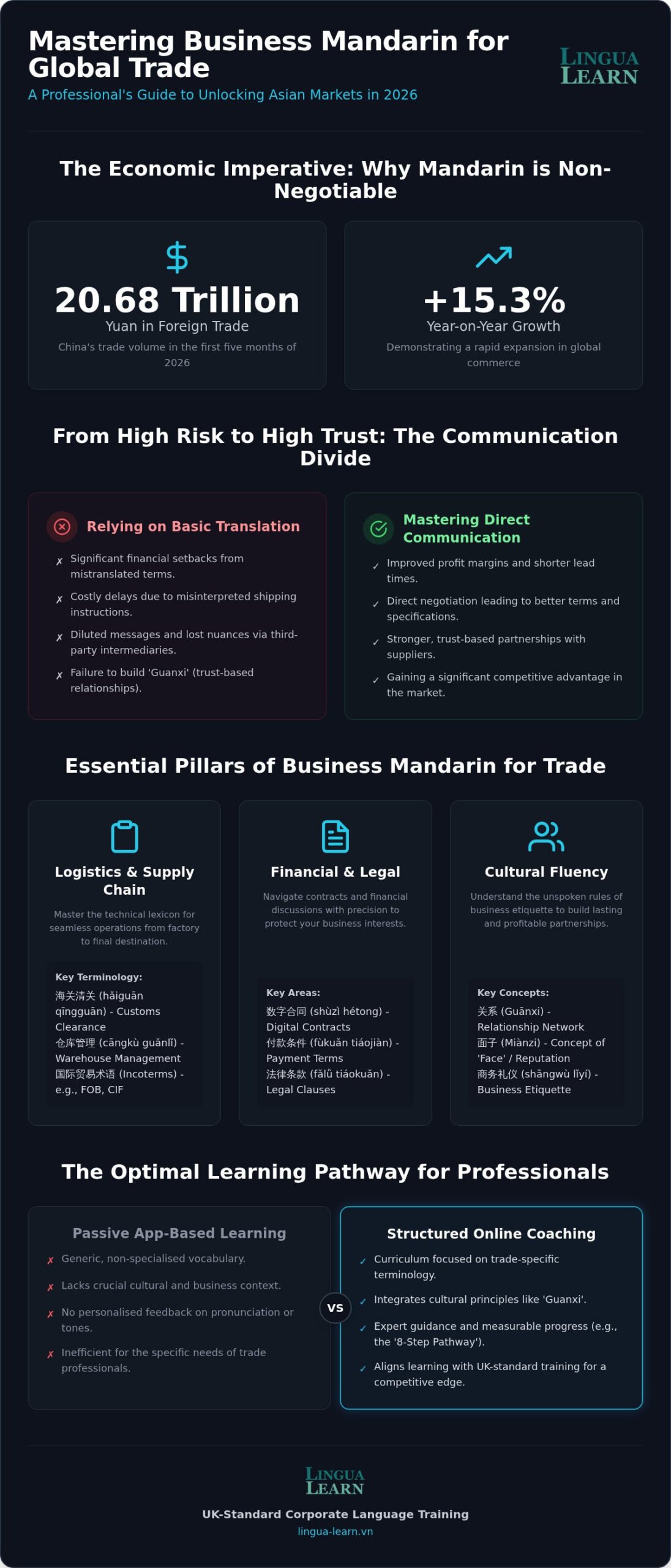
The link between Mandarin proficiency and trade success is undeniable. In a market where precision and trust are the primary currencies, mastering business Mandarin for trade is the most effective way to secure your organisation’s future. By communicating directly with your partners, you eliminate the delays and costs associated with third-party translation. You also demonstrate a level of commitment that resonates deeply with Chinese counterparts, turning transactional interactions into long-term strategic alliances.
Lingua Learn Vietnam provides a bridge between UK-standard academic quality and the practical realities of the Asian trade landscape. Our instructors act as both linguistic and cultural mentors, providing you with the insights needed to navigate complex social and professional environments. This mentorship is the final step in moving from theoretical learning to active trade implementation. It ensures that when you step into a negotiation or visit a production facility, you do so with the “linguistic intelligence” required to protect your profit margins and build lasting ‘Guanxi’.
We understand that corporate clients require measurable results. Our 8-Step Learning Pathway ensures that every hour spent in the virtual classroom contributes to your professional growth. Upon completion of your programme, a comprehensive Final Report and certification validate your team’s progress against international CEFR standards. This transparency allows you to track ROI with total confidence, whether you are training a single executive or an entire trade department. If you’re ready to see how our tailored curriculum can support your specific goals, you can enquire about our online Mandarin courses today to receive a personalised needs analysis.
Our commitment to student success is reflected in the flexibility and quality of our digital environment. Our virtual classrooms are designed for busy professionals, allowing you to join live sessions from any location with no software downloads required. This seamless experience ensures that your training never interferes with your operational duties. By choosing a partner that values efficiency as much as you do, you’re investing in a learning experience that delivers tangible business performance. We provide the tools, the technology, and the expertise to help you unlock your full potential in the global marketplace.
Mastering business Mandarin for trade is a transformative step that moves your organisation beyond simple transactions. You now understand how technical precision in logistics and the cultural nuances of Guanxi create a resilient foundation for international commerce. By choosing a structured path, you replace the uncertainty of mistranslations with the confidence of a seasoned negotiator.
Our approach at Lingua Learn Vietnam prioritises your professional success through a CEFR-aligned curriculum and our proven 8-Step Learning Pathway. You’ll benefit from the total transparency of a UK-managed LMS, ensuring every training hour translates into a measurable business advantage. You have the opportunity to lead your team with linguistic intelligence and cultural authority.
We are dedicated to helping you unlock your full potential and build the high-value partnerships that will define your success in the years ahead.
Yes, business Mandarin for trade is a highly specialised branch of the language that focuses on technical lexicons. Whilst general Mandarin covers daily conversations and social interactions, the trade variant prioritises terminology for logistics, international law, and finance. It also focuses on the specific cultural etiquette required for high-stakes negotiations and supplier relations. This targeted approach ensures that you spend your time mastering the exact vocabulary used in supply chain management.
Reaching negotiation-level proficiency in business Mandarin for trade typically requires consistent study over several months. Most trade professionals can achieve basic workplace fluency in approximately 120 to 150 hours of structured training. However, mastering the subtle linguistic markers needed for complex negotiations often takes longer. The timeframe depends on your starting level and the intensity of your chosen programme. A structured pathway ensures that every hour spent learning contributes directly to your commercial objectives.
You can certainly master these skills whilst managing a full-time corporate role. Online virtual classrooms are designed for maximum flexibility, allowing you to join live sessions from your home or office without the need for a commute. Lingua Learn Vietnam also provides recorded sessions through our UK-managed LMS, ensuring you never miss a lesson due to travel or late meetings. This digital-first approach allows trade executives to balance professional development with their daily operational responsibilities.
The ‘Learning Pathway’ is a structured 8-step methodology designed to move students from initial assessment to active trade implementation. It begins with a thorough needs analysis and ends with a Final Report and certification that validates your progress. This organised flow ensures that training remains focused on measurable business outcomes. It provides a clear, low-friction route for professionals to track their development and achieve a globally recognised standard of proficiency.
Whilst you can begin with Pinyin for spoken communication, understanding characters is vital for reviewing digital contracts and logistics documentation. Reading characters allows you to verify shipping labels, warehouse reports, and bank transfer details without relying on third-party translations. You don’t need to be a calligrapher, but a functional reading level protects your business interests. Most professional courses integrate character recognition into the curriculum to ensure you can navigate the digital trade landscape safely.
All instructors at Lingua Learn Vietnam are qualified native speakers with extensive experience in corporate language training. They act as both linguistic guides and cultural mentors, providing the real-world context needed for successful trade. Because they understand the nuances of the Chinese business environment, they can teach you the subtle non-verbal cues that are often missed in textbooks. This expertise ensures that your training is both academically rigorous and practically relevant to modern trade.
ROI is measured through tangible improvements in operational efficiency and the reduction of costly technical errors in contracts. Our UK-managed LMS provides real-time analytics and detailed attendance reports, giving organisations total transparency regarding their training investment. Beyond the data, you’ll notice stronger, trust-based relationships with partners and faster lead times due to direct communication. These factors combine to create a measurable competitive advantage that directly impacts your organisation’s bottom line.
A CEFR A2 or B1 level is generally the minimum requirement for conducting basic trade communication. At this stage, you can handle simple enquiries, understand shipping terms, and participate in social business dinners with confidence. Reaching this level allows you to manage routine supply chain tasks without the constant need for an interpreter. As you progress toward higher levels, you gain the ability to handle more complex legal clauses and sensitive price negotiations.

Article by
Rob Holloway
Rob Holloway is the CEO of Lingua Learn Elevate Ltd (UK), the company operating Lingua Learn Vietnam. He works with businesses and organisations across Asia to provide high-quality online language training, corporate communication programmes and internationally recognised language certification preparation.
Working with organisations across industries including engineering, finance, technology, manufacturing and professional services, Rob helps identify language training needs and connect clients with tailored learning solutions delivered by Lingua Learn’s experienced academic team.
His professional focus includes corporate language training, business communication, cross-cultural communication, international education partnerships and helping organisations build the language skills needed to succeed in global business environments.
Through Lingua Learn Vietnam, Rob is committed to providing UK-managed online language training delivered by qualified instructors, helping professionals and organisations communicate with confidence in today’s international workplace.
 Vietnamese
  English (UK)