
What if the “fluent” label on your top candidate’s CV is actually the biggest risk to your next international deal? It’s a common frustration for HR leaders who find that generic descriptions often fail to capture the specific language proficiency levels for corporate roles needed for high-stakes communication. You’ve likely experienced the disconnect between a polished interview and the reality of a staff member struggling to lead a technical briefing or close a cross-border sale.
We understand that measuring the ROI of training can feel like guesswork when you’re juggling different scales like ILR or TOEFL; it’s difficult to know which standard actually translates to workplace success. This guide provides a clear path forward by mastering the CEFR framework to align employee skills with specific business functions. You’ll learn how to set precise requirements for every role and implement reliable assessment methods that drive global performance. We’ll explore how to move beyond vague claims of “bilingualism” to create a structured environment where cross-cultural collaboration thrives and your organisation’s international potential is fully realised.
For decades, “fluency” was the ultimate benchmark for international business. It was also the most misunderstood term in recruitment. One person’s “fluent” is another person’s “conversational,” and this ambiguity creates constant friction in hiring. When a manager expects a new hire to lead a complex negotiation but finds they can only manage basic social greetings, the cost of that misunderstanding is high. Transitioning to standardised benchmarks allows companies to map specific language proficiency levels for corporate roles with surgical precision, ensuring that expectations always match reality.
Standardisation does more than just clarify definitions; it actively reduces bias in hiring and performance reviews. Without a framework, HR decisions often rely on a recruiter’s subjective “gut feeling” about a candidate’s accent or confidence. By using a universal rubric, a candidate in Ho Chi Minh City is measured by the same yardstick as one in London or Singapore. This level playing field is essential for Vietnamese firms aiming for global market share. To compete on an international stage, businesses must ensure their teams can communicate with the same professional rigour as their global counterparts.
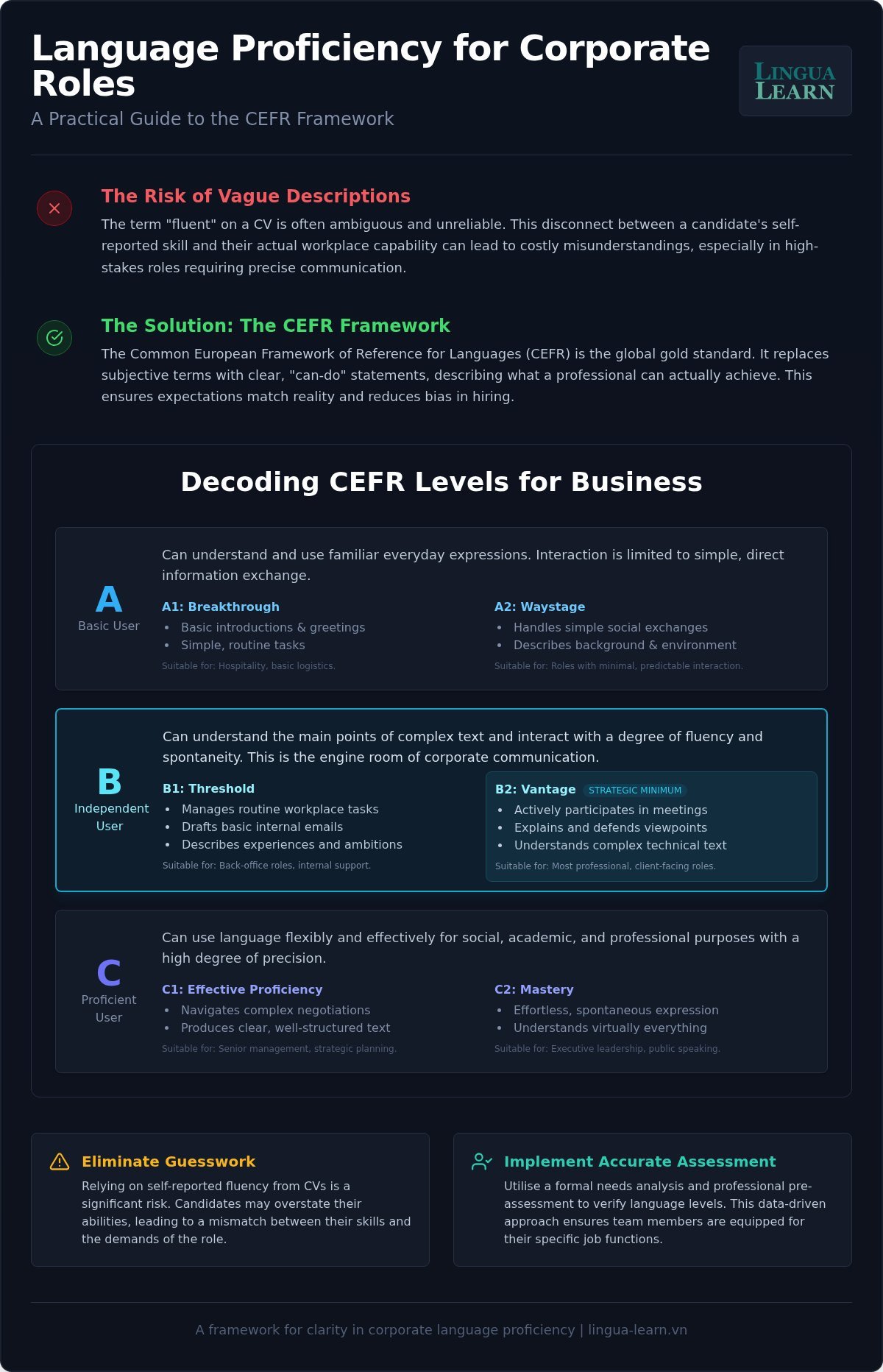
The Common European Framework of Reference for Languages (CEFR) is the global gold standard for describing language ability. It organises learners into six distinct levels, spanning from A1 (Beginner) to C2 (Mastery). The genius of the CEFR lies in its “can-do” statements. Rather than focusing on abstract grammar rules, it describes what a professional can actually achieve in a workplace setting. For example, a B2-level speaker can “interact with a degree of fluency that makes regular interaction with native speakers quite possible.” Global brands favour this approach because it focuses on functional competency rather than just academic knowledge.
Whilst other scales exist, they often serve narrow, non-corporate purposes. The Inter-agency Language Round-table (ILR) scale is common in US government circles, but it lacks the commercial flexibility of the CEFR. Similarly, academic scores like IELTS or TOEFL are excellent for university admissions, yet they don’t always reflect a person’s ability to handle a boardroom conflict or a technical briefing. Businesses prefer the CEFR for ongoing professional development because it provides a clear, incremental pathway for growth. At LINGUA LEARN VIỆT NAM, we utilise this framework to ensure that every training programme delivers a measurable increase in workplace performance.
Understanding the theoretical framework of the CEFR is a vital first step; however, for HR directors and department heads, the real value lies in practical application. In a corporate setting, the broad spectrum of language ability is divided into three main categories: Basic (A), Independent (B), and Proficient (C). Whilst an A1 or A2 level might suffice for a hospitality role involving simple social greetings or basic logistics, it rarely meets the language proficiency levels for corporate roles that require collaboration. For most modern businesses, the journey toward global competency truly begins at the B levels.
The transition from a basic user to an independent one is often the most significant hurdle for employees. It marks the point where a staff member moves from merely surviving in a foreign language to actually contributing to the organisation’s goals. Identifying the threshold for “Professional Working Proficiency” is critical. Most industry experts agree that B2 is the minimum requirement for any role involving regular international contact. At this level, an employee possesses the confidence to navigate complex situations without constant supervision or translation assistance.
B1-level staff can manage routine tasks and draft basic internal emails, making them suitable for back-office roles with limited external exposure. However, B2 is the real “engine room” of multinational collaboration. A B2-level professional can participate in meetings, explain technical viewpoints, and defend their opinions with clarity. They don’t just understand the words being said; they grasp the context and intent behind them. If you are unsure where your team currently stands, you can request a professional assessment to map their current skills against these benchmarks.
When we move into the C levels, language becomes a tool for influence rather than just information exchange. C1-level users handle subtle nuances and complex professional writing with ease, making them ideal for middle management and client-facing roles. C2 represents mastery, where an individual can negotiate high-stakes deals or deliver native-level public speaking under pressure. For a deeper look at how these top-tier abilities impact the C-suite, explore our guide on Language Skills for Leadership Roles. These levels are essential for anyone tasked with shaping company culture or leading cross-border mergers where every word carries significant weight.
Setting the right bar for language ability is a delicate balancing act for any HR department. If you demand a C2 “Mastery” level for a junior data entry role, you’ll likely struggle to fill the position or end up overpaying for overqualified talent. Conversely, assuming a B1 level is sufficient for a regional sales lead often results in lost revenue due to mismanaged expectations and lost nuances. Effective leaders view language proficiency levels for corporate roles as a functional requirement rather than a generic badge of honour, tailoring expectations to the specific demands of the seat.
The distinction between front-line and back-office roles often comes down to the “cost of error” and the luxury of time. In back-office functions, an employee usually has the opportunity to use translation tools or consult a colleague before hititng send. Front-line staff, however, must respond in real-time. A B2 speaker might understand a technical manual perfectly, but they may lack the linguistic agility required for a high-pressure trade negotiation. We’ve seen cases where a C1-level negotiator secured a significantly better margin simply by catching a subtle hesitation in the counter-party’s phrasing, a detail a B2 speaker would have likely missed.
For these departments, we typically recommend a B2 to C1 range. Success here depends on the ability to persuade, handle objections, and tell a compelling brand story. It isn’t just about being understood; it’s about being influential. For companies expanding within Asia, professional Mandarin training at these levels is often the deciding factor in whether a regional trade partnership succeeds or stalls.
In technical spheres, B1 to B2 is often the functional “sweet spot.” Developers and support staff primarily need to read documentation, report bugs, and collaborate on specific sprints. Whilst they don’t necessarily need the rhetorical flair of a CEO, they do require a firm grasp of industry-specific vocabulary. When technical jargon becomes a barrier, specialised corporate language training can bridge the gap without requiring the employee to reach full native-level mastery.
Leadership roles demand C1 to C2 proficiency. Executives aren’t just communicating facts; they’re projecting strategic vision and resolving complex internal conflicts. This requires high emotional intelligence and the ability to navigate linguistic nuance. Whether it’s drafting a sensitive policy or delivering a keynote, the precision of a C-level user ensures that the organisation’s message remains consistent and authoritative across all borders.
Relying on a candidate’s self-assessment of their “fluency” is a gamble that few organisations can afford to take. It’s a common trend for applicants to overestimate their abilities on a resume, often confusing social confidence with professional competence. To establish accurate language proficiency levels for corporate roles, businesses must move beyond the CV and implement a structured verification process. This begins with a comprehensive Needs Analysis, which identifies the specific communicative demands of a position before any training or hiring takes place.
Pre-assessments mapped strictly to CEFR standards remove subjectivity from the equation. These tests provide a scientific baseline, ensuring that every learner starts their journey at the correct level. By using a secure, UK-hosted Learning Management System (LMS), HR teams can track progress in real-time, moving away from anecdotal evidence toward data-driven talent management. This technology ensures that the training isn’t just a “box-ticking” exercise but a measurable increase in human capital that directly impacts the bottom line.
At Lingua Learn Vietnam, we follow a proprietary 8-step Learning Pathway to Success to ensure every corporate programme delivers results. Steps one and two are the most critical: identifying specific business goals and performing rigorous CEFR-aligned pre-assessments. This structured approach allows us to customise course content to your industry’s unique vocabulary and cultural nuances. We recognise that true proficiency includes the corporate skills of cross-cultural communication, such as understanding local etiquette and non-verbal cues. Once the training is complete, final reports provide HR with the accountability needed to verify that the target proficiency has been reached.
Demonstrating the return on investment for language training has traditionally been difficult. We solve this through our dedicated HR Dashboard, which provides transparent data on attendance, engagement, and progress milestones. You can see exactly which team members are excelling and where additional support might be needed. Final-course exams serve as a formal certification of skill mastery, giving employees a sense of achievement and the business a verified asset. To ensure these skills translate to the office, every learner receives a Student Action Plan. This document outlines how to apply their new linguistic abilities to their specific daily tasks immediately, bridging the gap between classroom theory and boardroom practice.
Implementing a robust strategy for language proficiency levels for corporate roles requires more than just a theoretical framework; it requires a partner who understands the high standards of global business. Lingua Learn Vietnam provides this bridge by combining UK-managed quality with a deep understanding of the Asian corporate landscape. We don’t just offer lessons; we provide a structured ecosystem designed to elevate your team’s performance from the first session. This ensures that your investment in human capital translates into tangible results on the international stage.
Our virtual classrooms are built for the modern professional. They offer the flexibility needed for busy schedules whilst maintaining the rigour of a traditional classroom. With a suite of over 20 languages available, we help organisations navigate diverse markets with confidence. Whether your team requires intensive Business English Training to align with global headquarters or Tiếng Quan Thoại courses to unlock regional trade opportunities, our programmes are tailored to your specific industry goals. We recognise that a one-size-fits-all approach doesn’t work for complex sectors like finance or technology. Instead, we build curricula that mirror your daily operations.
We believe that the quality of instruction determines the speed of progress. That’s why our tutors are not only native speakers but also certified professionals with genuine corporate expertise. They understand the nuances of a boardroom just as well as the rules of grammar. Our proprietary Learning Management System (LMS) further enhances this experience. Every session is recorded, allowing for continuous review and reinforcement, whilst our commitment to GDPR-compliant data security ensures your corporate information remains protected to UK standards. This focus on transparency extends to our data-driven reporting. HR managers can access real-time engagement metrics, ensuring that every training investment is backed by clear evidence of growth.
The first step toward a more capable team is understanding where you currently stand. We help you map your staff’s existing abilities through a comprehensive Needs Analysis and CEFR-aligned pre-assessments. This data allows us to develop a bespoke curriculum that addresses the specific communication gaps within your organisation. From technical reporting to executive leadership, we ensure that every training hour contributes to a measurable business outcome. We take the guesswork out of professional development, providing a clear pathway for every employee to reach their full potential.
Elevate your team’s global communication today. Enquire about our corporate training courses and discover how our structured Learning Pathway can drive your company’s international success.
Mastering the nuances of international communication is no longer a luxury; it’s a strategic necessity for any business with global ambitions. Transitioning from subjective descriptions of fluency to the precision of the CEFR framework allows you to build a team that is truly fit for purpose. By standardising the language proficiency levels for corporate roles across your organisation, you transform communication from a potential bottleneck into a measurable competitive advantage.
We’re here to help you navigate this transition with confidence. Our 8-step Learning Pathway to Success and UK-managed LMS ensure that every training programme is transparent, accountable, and aligned with your specific industry needs. With a CEFR-aligned curriculum, your employees gain the exact skills required to lead, negotiate, and collaborate on a world stage.
Your journey toward a more connected and capable workforce starts with a single step. Let’s work together to realise your team’s full international potential.
B2 is generally considered the minimum level for independent professional interaction in most global organisations. Whilst B1 might suffice for simple administrative tasks, a B2 level ensures an employee can participate in meetings and explain complex ideas without constant support. Defining these language proficiency levels for corporate roles helps HR avoid hiring mismatches that lead to operational delays and communication breakdowns.
Moving from B1 to B2 typically requires between 150 and 200 hours of guided learning. This timeline varies based on the learner’s starting point and the specific language being studied. At Lingua Learn Vietnam, our structured 8-step Learning Pathway helps accelerate this process by focusing on functional workplace tasks rather than abstract theory, ensuring that study time translates directly into improved office performance.
The CEFR is a descriptive framework rather than a single test, making it more flexible for mapping job requirements than academic scores like IELTS. Whilst IELTS is excellent for university admissions, CEFR “can-do” statements provide clearer benchmarks for what an employee can achieve in a boardroom. Many global brands prefer CEFR because it focuses on professional competency and practical communication.
It is quite common for professionals to have asymmetrical skills, often excelling in spoken interaction whilst struggling with formal email etiquette. In a corporate environment, this gap can lead to misunderstandings in legal or technical documentation. A balanced proficiency is usually necessary for leadership roles where both verbal persuasion and written precision are required to maintain the organisation’s professional image.
We recommend re-assessing staff every 12 to 24 months or immediately following a significant training block. Language skills can plateau or even decline if they aren’t used regularly in a professional context. Regular assessments through an HR Dashboard provide the transparency needed to track long-term skill retention and ensure your team remains ready for international assignments.
These terms originate from the ILR scale, where “Professional Working Proficiency” roughly aligns with CEFR B2 or C1 and “Full Professional Proficiency” matches C1 or C2. Professional level means you can handle most office tasks independently. Full proficiency implies a mastery where you can navigate complex social and professional nuances with the same ease as a native speaker, including high-stakes negotiations.
The most reliable way to verify claims is through a formal, CEFR-aligned pre-assessment conducted by an expert third party. Self-reported fluency is notoriously subjective and often inaccurate during the recruitment process. Implementing a structured Needs Analysis before hiring allows HR managers to test a candidate’s actual ability to perform job-specific tasks in the target language before an offer is made.
Yes, we provide formal certificates of completion for all our corporate students upon passing their final-course exams. These certifications are mapped directly to CEFR standards, providing a recognised benchmark of their progress. This documentation helps HR departments validate their training spend and provides employees with a credible, portable record of their professional development and linguistic growth.

Article by
Rob Holloway
Rob Holloway is the CEO of Lingua Learn Elevate Ltd (UK), the company operating Lingua Learn Vietnam. He works with businesses and organisations across Asia to provide high-quality online language training, corporate communication programmes and internationally recognised language certification preparation.
Working with organisations across industries including engineering, finance, technology, manufacturing and professional services, Rob helps identify language training needs and connect clients with tailored learning solutions delivered by Lingua Learn’s experienced academic team.
His professional focus includes corporate language training, business communication, cross-cultural communication, international education partnerships and helping organisations build the language skills needed to succeed in global business environments.
Through Lingua Learn Vietnam, Rob is committed to providing UK-managed online language training delivered by qualified instructors, helping professionals and organisations communicate with confidence in today’s international workplace.
 Vietnamese
  English (UK)