
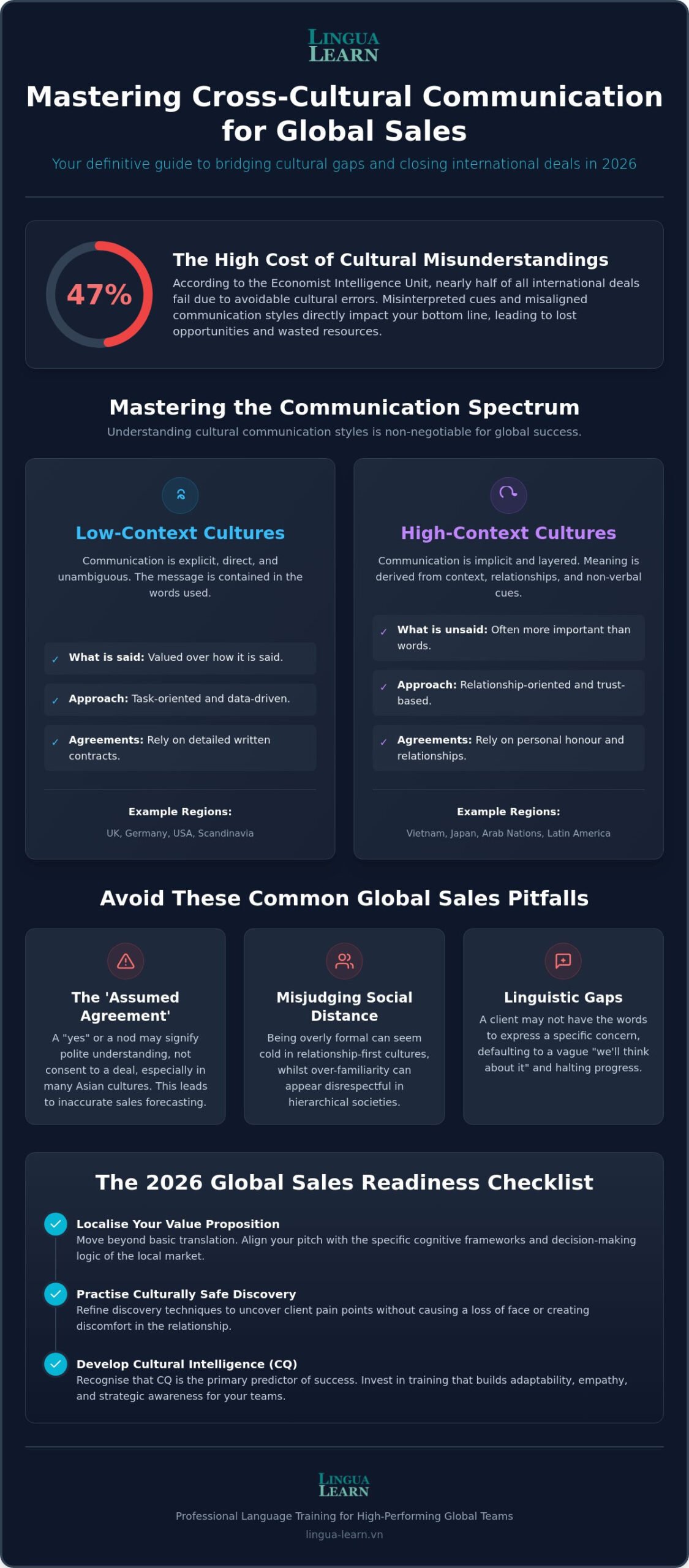
Did you know that 47% of international deals fail because of avoidable cultural misunderstandings? This striking statistic from the Economist Intelligence Unit highlights a reality many leaders face: technical expertise is no longer enough when your market is truly global. Mastering cross-cultural communication for sales teams has become the defining factor between a signed contract and a missed opportunity. It’s frustrating to watch a high-stakes deal collapse simply because a team member misinterpreted a subtle social cue or used an inappropriate greeting during a remote video call.
You likely recognise that standard sales scripts don’t translate across borders, yet maintaining consistency across diverse regions remains a significant challenge. We’ll help you bridge this gap by exploring the linguistic and cultural nuances required to build a high-performing global sales force. At Lingua Learn Vietnam, we see how professional language training transforms these barriers into competitive advantages. This guide provides a comprehensive checklist for 2026, covering everything from high-context cognitive adaptability to hyper-localised value propositions. You’ll gain the practical tools needed to navigate remote communication barriers and interpret client cues with quiet confidence.
In a globalised economy, technical proficiency is just the baseline. True success lies in the ability to adapt. Within the broader field of study, sales professionals must look beyond simple translation. It’s about cognitive alignment. If your value proposition doesn’t mirror the client’s local logic, it won’t resonate. Effective cross-cultural communication for sales teams ensures that every pitch is tailored to the audience’s specific expectations and decision-making frameworks.
By 2026, cross-border trade is projected to reach record heights, with global e-commerce sales expected to exceed $8.1 trillion. Standardised “one size fits all” sales playbooks are failing because they ignore regional nuances. High-performing teams now prioritise these skills to navigate decentralised, multi-cultural environments effectively. When a sales model is too rigid, it creates friction that can stall even the most promising partnerships.
Research shows that 47% of international deals fail due to cultural misunderstandings. Often, it’s the things left unsaid that do the most damage. Missed non-verbal cues or a failure to read the room often result in “ghosting,” where a lead simply stops responding because of a perceived lack of respect or understanding. This silence is expensive, leading to bloated pipelines and wasted resources.
Cultural Intelligence (CQ) is the primary predictor of international sales success in 2026.
Cultural alignment acts as a trust accelerator. When a prospect feels understood, the sales cycle shortens significantly. This isn’t just about closing the first deal; it’s about long-term account health. Higher retention rates are directly linked to how well a team manages ongoing relationships across borders. Investing in corporate soft skills training allows teams to hit these metrics by turning cultural awareness into a measurable business asset.
One of the most dangerous traps is the “Assumed Agreement.” In many Asian cultures, a nod or a “yes” might signify understanding rather than consent. Western sales reps often mistake this for a closing signal, leading to inaccurate forecasting. Lingua Learn Vietnam frequently helps clients navigate these subtle differences to ensure their pipelines remain realistic and their expectations are aligned with local reality.
There’s also the risk of misjudging social distance. Over-formalisation can feel cold in relationship-first cultures, whilst over-familiarity can seem disrespectful in hierarchical societies. Finally, linguistic gaps often mask genuine objections. If a client can’t find the words to express a concern, they might simply say “we’ll think about it.” This leaves the sales rep without a clear path forward, making it vital to develop the skills to probe deeper without causing offence.
Understanding the spectrum of high and low-context cultures is fundamental to effective cross-cultural communication for sales teams. In low-context cultures, such as the UK, Germany, and the USA, communication is explicit and transparent. Value is placed on directness, and the written contract serves as the definitive source of truth. Your prospects in these regions expect clear data, concise bullet points, and a straightforward path to the close. Relying on a one-size-fits-all pitch deck is a liability in 2026; if your materials are too vague for a German buyer or too blunt for a Vietnamese partner, you risk losing credibility instantly.
Conversely, high-context cultures like Vietnam, Japan, and many Arab nations prioritise the relationship over the transaction. Here, the message is often found between the lines. Non-verbal cues, social hierarchy, and long-term trust-building are the true drivers of a deal. For these clients, a sales presentation is less about the slides and more about the character of the person presenting them. Maintaining this level of nuance during virtual sales calls is a unique challenge. Utilising a sophisticated platform like the Lingua Learn Online Classroom allows teams to capture the subtle facial expressions and tonal shifts that are often lost on standard, low-quality video software.
Navigating indirect cultures requires a sharp ear for “soft nos.” A prospect might say “that could be difficult” or “we will think about it” whilst actually meaning “no.” Forcing a direct answer can cause a “loss of face,” effectively ending the relationship. In contrast, being assertive in direct cultures is seen as a sign of confidence, provided it doesn’t cross into aggression. Silence also plays a vital role. In some cultures, a long pause after a proposal is a sign of respect and deep consideration. If you rush to fill that silence, you may appear impatient or desperate, weakening your negotiating position.
Identifying the real decision-maker is often a complex task in collective cultures where consensus is required. You might spend weeks pitching to a senior manager, only to find the final approval rests with a group of elders or a board you’ve never met. Adjusting your tone is essential; you must know when to use high-level professional terminology to show expertise and when to use simplified, clear language to ensure understanding across a multi-lingual team. Dedicated online language training provides the linguistic tools to navigate these hierarchies with precision, ensuring your team speaks with the appropriate level of formality. Developing Cultural intelligence allows your reps to move from being mere vendors to becoming trusted advisors. If you are looking to refine your team’s approach to global markets, you can reach out to our team for a tailored consultation.
Effective cross-cultural communication for sales teams requires a tailored approach at every touchpoint of the buyer’s journey. By 2026, social selling has become a dominant force, with social media platforms seeing nearly double the response rate of traditional email. However, your choice of platform must reflect local habits. Whilst a prospect in London might prefer a formal LinkedIn message, a decision-maker in Brazil or the Middle East may find a professional WhatsApp introduction more appropriate. Customising your outreach demonstrates an immediate respect for local business norms.
During discovery calls, the goal is to uncover pain points without causing “loss of face.” In high-context cultures, blunt questions about budget or previous failures can feel confrontational. Instead, use indirect phrasing. Ask how the organisation typically allocates resources or what their vision for a successful partnership looks like. This allows the client to provide information comfortably whilst maintaining their professional dignity.
When you reach the presentation stage, balance is essential. Western buyers often demand data-heavy proof points and immediate ROI. Conversely, clients in Southeast Asia or the Arab world frequently prioritise storytelling and social proof. They want to know the “who” behind the “what.” Your pitch should weave together hard statistics with narratives of how you’ve supported similar organisations through their growth journey.
Closing the deal is the most sensitive phase. Aggressive “hard close” tactics common in the US can backfire in relationship-centric markets. In these regions, closing should feel like the natural conclusion of a blossoming partnership rather than a high-pressure event. If you push too hard at the final hurdle, you risk damaging the long-term relationship you’ve worked so hard to build.
Small talk is never truly “small” in international trade. It’s the foundation of trust. In the UK, safe topics often include travel or the weather, whilst in the Middle East, enquiring about a client’s health and general wellbeing is expected. Hospitality norms also vary; accepting a coffee or a meal is often a mandatory part of the negotiation process. For those selling technical solutions, ensuring your team has the right vocabulary is vital. Our guide on business English for IT professionals provides excellent insights into maintaining workplace proficiency whilst navigating these complex social waters.
Misunderstandings are inevitable, but they don’t have to be deal-breakers. Use de-escalation techniques by reframing objections as “cultural clarifications.” If a client seems hesitant, don’t treat it as a rejection. Instead, ask for their perspective on how the proposal aligns with their local market priorities. In some high-context negotiations, using a “Third Party” or mediator can help resolve deadlocks without either side losing face, keeping the momentum of the deal alive.
Moving from theory to execution requires a structured audit of your current capabilities. Cross-cultural communication for sales teams is not a static skill; it’s a measurable competency that requires regular assessment. By 2026, the most successful organisations will be those that treat cultural readiness with the same rigour as financial forecasting. If your team is operating in international markets without a formalised framework, you’re likely leaving revenue on the table through avoidable friction.
Start with linguistic proficiency. It’s no longer enough for a rep to be “conversational.” Every team member should meet a minimum CEFR level (typically B2 or C1) tailored to their specific market. This ensures they can handle complex negotiations without losing the nuance of the deal. Beyond language, a formal Cultural Intelligence (CQ) assessment identifies if your staff can actually apply their knowledge in high-pressure scenarios. Training shouldn’t be a one-off event but a continuous part of your professional development strategy.
Your technology must also support these efforts. Modern CRM systems should be configured to track more than just contact details. They should record cultural preferences, local time-zone etiquette, and specific communication styles preferred by the client. For instance, our HR Dashboard at Lingua Learn Vietnam allows managers to track team progress and ensure that every representative is meeting the necessary standards for their assigned region. Furthermore, ensure your sales materials are professionally localised. Relying on basic AI translation tools often leads to embarrassing phrasing that can undermine your authority instantly.
Before any global interaction, your team must perform a “pre-flight” check. This involves verifying local holidays and working hours, such as recognising the Friday schedules common in the Middle East. Review the “Power Distance” index of the client’s country. If you’re pitching to a high-power distance culture, you may need to adjust your presentation to be more formal and hierarchical. Finally, confirm technical compatibility. Don’t assume your preferred virtual meeting tool is the standard in every region; some markets have specific preferences or restrictions that could derail a call before it begins.
The learning process continues after the contract is signed or the lead is lost. Analyse every interaction to understand why a deal succeeded or failed from a communication perspective. Was there a specific moment where rapport was built or broken? Update your internal “Cultural Playbook” with these fresh insights to benefit the wider team. If gaps are identified, schedule follow-up professional development language courses to address them. To start building a more competent global sales force today, you can enquire about our corporate training programmes.
Closing the gap between linguistic ability and cultural competence requires more than just a textbook. It demands a structured, UK-standard framework designed for the complexities of modern commerce. At Lingua Learn Vietnam, we provide this through our proprietary 8-step Learning Pathway to Success. This methodology ensures that cross-cultural communication for sales teams becomes an integrated part of your business strategy rather than a secondary thought. By aligning CEFR standards with practical cultural training, we help your team move beyond basic fluency to achieve genuine cognitive adaptability.
Our approach centres on tailored curricula. We don’t believe in generic language training; instead, we build every course around your specific industry and sales targets. Whether your team is selling software in Seoul or construction equipment in Cairo, our native-speaking, certified tutors simulate real-world sales scenarios. This practical immersion allows your reps to practice handling objections and building rapport in a safe environment before they ever step into a high-stakes meeting. It’s about giving them the confidence to navigate the subtle nuances of international trade.
For management, transparency is paramount. Our Corporate HR Dashboard provides real-time data on team progress and attendance, allowing you to monitor ROI with precision. You can see exactly how your investment is translating into improved competencies across your global force. This data-driven approach ensures that your training budget is utilised effectively and that every team member is on track to meet their professional development goals.
The journey begins with Step 1, a comprehensive Needs Analysis, followed by a Step 2 Pre-Assessment. These stages act as a cultural and linguistic audit of your sales team, identifying exactly where the gaps lie. This ensures that no time is wasted on concepts they’ve already mastered. To ensure immediate impact, Step 7 of our pathway introduces the Student Action Plan. This tool requires sales reps to apply their new knowledge to active leads immediately, turning classroom theory into real-world conversion. All learning takes place on our secure, UK-managed LMS, providing a reliable and professional environment for your staff.
Global expansion requires a partner who can scale with you. With training available in over 20 languages, we support your team as they enter new markets and engage with diverse cultures. Mastering cross-cultural communication for sales teams is the most effective way to future-proof your international revenue streams. We invite sales managers and HR directors to book a consultation for a customised team training programme. Our experts will help you design a pathway that aligns with your 2026 growth objectives and empowers your team to close deals with quiet confidence.
Ready to transform your global sales performance? Enquire about sales team training with Lingua Learn Vietnam today and start your journey towards international excellence.
The global marketplace of 2026 demands more than just standard sales scripts. It requires a sophisticated blend of linguistic precision and cultural empathy. By mastering cross-cultural communication for sales teams, you move beyond the surface of language to align your value propositions with the unique cognitive frameworks of your international clients. Whether you are navigating high-context negotiations in Vietnam or direct, data-driven pitches in Germany, your ability to adapt determines your conversion rates.
Investing in your team’s cultural competence is the most direct path to shortening sales cycles and building lasting global partnerships. At Lingua Learn Vietnam, we provide the tools to make this transformation measurable. Our training is delivered via a secure, UK-managed Learning Management System and includes CEFR-aligned certification for all participants. It’s why we are trusted by global brands to build high-performing multilingual teams that close deals with confidence.
Take the first step towards a more resilient international pipeline today. Enquire about bespoke sales team training with Lingua Learn Vietnam and give your representatives the competitive edge they need to succeed in any market.
Initial improvements in rapport and team confidence are often visible within four to six weeks of consistent training. However, measurable shifts in international conversion rates usually emerge after three to six months as reps apply their Student Action Plan to active leads. This timeframe allows for the refinement of high-context communication skills through real-world trial and error in their specific markets.
No, relying solely on English is increasingly insufficient, as 76% of consumers prefer purchasing products with information in their native language. Whilst English remains a vital bridge, mastering cross-cultural communication for sales teams involves learning key phrases and local etiquette to build deeper trust. Showing respect for a client’s native tongue often differentiates a trusted partner from a generic vendor.
The most effective method is tracking “cultural conversion” metrics, such as shortened sales cycles and higher retention rates in international accounts. By using the Lingua Learn HR Dashboard, managers can correlate training progress with specific performance data. Comparing the cost of training against the revenue generated from previously “ghosted” international leads provides a clear financial picture of the investment’s value.
Yes, online training is highly effective, especially when using a secure, UK-managed LMS that supports real-time interaction. Virtual classrooms allow certified tutors to simulate high-stakes sales scenarios across different time zones, making the learning environment identical to the remote sales calls your team already performs. This digital shift ensures that the training is both flexible and directly applicable to the modern workplace.
The most frequent errors involve causing a “loss of face” through blunt directness or misinterpreting a “polite yes” as a closing signal. Many teams fail to recognise hierarchical structures or the importance of relationship-first approaches in markets like Vietnam or Japan. These misunderstandings are a primary focus of cross-cultural communication for sales teams, helping reps read non-verbal cues and indirect signals accurately.
You need a hybrid approach if your team is already fluent but still losing deals to avoidable misunderstandings or “cultural ghosting.” Language lessons focus on grammar and vocabulary, whilst cross-cultural training addresses cognitive frameworks and social cues. If your reps understand the words but misread the client’s intent or hierarchy, they require a curriculum that integrates both linguistic proficiency and cultural intelligence.
CEFR levels provide a standardised benchmark to ensure every representative has the linguistic tools required for their specific market. For professional sales performance, a minimum of B2 (Upper Intermediate) is usually necessary to handle complex objections and technical discussions. This certification ensures that your team doesn’t just “get by” but can lead negotiations with the authority expected by high-level international decision-makers.
Yes, it helps by teaching teams to respect local working hours and the “digital etiquette” specific to each region. For example, understanding that a Friday afternoon meeting in the Middle East is culturally inappropriate prevents your team from appearing disrespectful. Training also covers how to maintain rapport during virtual calls, ensuring that time zone differences don’t become a barrier to building a trust-based relationship.

Article by
Rob Holloway
Rob Holloway is the CEO of Lingua Learn Elevate Ltd (UK), the company operating Lingua Learn Vietnam. He works with businesses and organisations across Asia to provide high-quality online language training, corporate communication programmes and internationally recognised language certification preparation. Working with organisations across industries including engineering, finance, technology, manufacturing and professional services, Rob helps identify language training needs and connect clients with tailored learning solutions delivered by Lingua Learn’s experienced academic team. His professional focus includes corporate language training, business communication, cross-cultural communication, international education partnerships and helping organisations build the language skills needed to succeed in global business environments. Through Lingua Learn Vietnam, Rob is committed to providing UK-managed online language training delivered by qualified instructors, helping professionals and organisations communicate with confidence in today’s international workplace.
 Vietnamese
  English (UK)