Did you know that 73% of consumers will switch to a competitor after multiple bad experiences? In a global market, those “bad experiences” often stem from simple linguistic friction rather than a lack of intention. It’s frustrating to watch your customer satisfaction scores dip because of avoidable language barriers or an inconsistent tone of voice. If you’re looking to implement business English for customer service teams, you likely want a staff that handles complex complaints with poise and empathy, yet without clear data on progress, it’s difficult to justify the investment.
Choosing the right training is no longer a luxury; it’s a strategic necessity for 2026. This guide will show you how to select a bespoke training programme that transforms your staff into a high-performing global asset. We’ll explore how to identify partners who provide transparent HR dashboards and CEFR-aligned results, ensuring your team speaks with a standardised, professional brand voice that resonates with every customer.
Corporate English language solutions are bespoke, integrated training systems that go beyond simple vocabulary lists; they are strategic tools designed to align a workforce with a company’s specific operational goals. When you invest in business English for customer service teams, you are building a bridge between your brand’s values and your global clientele. At Lingua Learn Vietnam, we recognise that language is more than just a medium for information. It’s a vehicle for trust. If an agent lacks the linguistic confidence to navigate a complex enquiry, the customer immediately senses that hesitation, which can lead to a sharp decline in Customer Satisfaction (CSAT) scores.
Many organisations initially try to solve communication gaps with “off-the-shelf” digital courses. These generic programmes often fail because they don’t account for your unique brand tone of voice. A textbook might teach an agent how to say “hello,” but it won’t teach them how to embody your company’s specific culture of care or professional authority. To understand the foundation of these requirements, it’s useful to explore What is Business English? and how it prioritises clarity and efficiency in a professional context. Ultimately, professional English acts as the calm within the storm for modern service teams, equipping agents with the linguistic precision required to de-escalate tension whilst maintaining brand integrity.
Your team needs to sound like your brand, not a generic recording. Customised training focuses on “softening phrases” and polite structures that allow agents to maintain professional authority without sounding cold or dismissive. For instance, shifting from a blunt “We can’t do that” to a more empathetic “I understand your perspective, and here is what we can offer instead” requires a nuanced grasp of the language. This level of training significantly reduces the cognitive load on agents during stressful calls. When the right words come naturally, the agent can focus entirely on the customer’s emotional state rather than struggling with grammar.
The financial impact of mismanaged complaints is staggering. Research indicates that 73% of consumers will switch to a competitor after multiple bad experiences, and over half will leave after just one. These aren’t just lost sales; they represent a total loss of customer lifetime value. Language barriers also contribute to high employee turnover. When staff feel ill-equipped to handle their daily tasks, frustration mounts and they are far more likely to leave. This communication gap isn’t limited to the front lines either. As detailed in our guide on Business English for IT professionals, linguistic friction can hinder technical support and internal collaboration just as severely as it affects customer-facing roles.
Selecting a partner to upskill your workforce requires a methodical approach that looks beyond basic tutoring. Since English has become the global language of business, the market is saturated with various apps and platforms. However, most of these solutions lack the academic rigour necessary for corporate environments. When evaluating business English for customer service teams, you must prioritise providers who offer live, interactive classrooms. Pre-recorded video modules might be convenient, but they cannot simulate the real-time pressure or the spontaneous conversational needs of a busy call centre. A high-quality provider acts as a dedicated mentor, ensuring that every lesson is grounded in practical application rather than abstract theory.
Security and standardisation are equally vital. In 2026, corporate clients require more than just a video link; they need a partner that adheres to international quality standards. Choosing a UK-managed provider ensures that your training is overseen with a focus on excellence and reliability. This professional oversight guarantees that the curriculum is not just generic business phrases, but is instead customised to your industry’s specific challenges, whether that involves technical support, luxury retail, or global logistics.
Objective progress tracking is impossible without a standardised benchmark. The Common European Framework of Reference for Languages (CEFR) is the global gold standard for this purpose. By utilising CEFR levels from A1 (Beginner) to C2 (Mastery), HR managers can see exactly where an employee started and how far they have progressed. This transparency is essential for justifying training budgets and identifying high-potential talent within the organisation. Providing employees with recognised English language certifications upon completion also serves as a powerful motivational tool, validating their hard work and commitment to personal growth.
A proprietary Learning Management System (LMS) offers a far more secure and efficient experience than generic meeting tools. These platforms are designed specifically for education, featuring integrated tools for assessments, attendance tracking, and resource sharing. For corporate clients, GDPR compliance and secure data hosting are non-negotiable requirements. Browser-based platforms are particularly effective because they require no software installation, allowing your team to join sessions from any device without compromising internal IT security protocols. If you are concerned about data integrity, consider discussing your specific security requirements with our team to see how a structured LMS can protect your corporate information whilst delivering world-class training.
Fluency alone does not guarantee a high-performing support desk. A truly effective curriculum for business English for customer service teams must target the “big three” pillars of service excellence: active listening, empathy, and de-escalation. Whilst general English courses focus on grammar and syntax, a corporate solution focuses on the strategic use of language to manage customer emotions and solve problems efficiently. At Lingua Learn Vietnam, we’ve observed that the most successful agents aren’t necessarily those with the largest vocabulary, but those who know how to deploy “Power Words” to establish immediate trust.
Establishing authority requires a shift away from “Weak Words.” Phrases such as “I think” or “I’ll try” often create doubt in the customer’s mind. Instead, agents are trained to use definitive language like “I will ensure” or “I recommend.” This subtle shift in word choice projects confidence and reliability. Leading with what you can do, rather than what you cannot, fundamentally shifts the customer’s perception of the service quality. By focusing on solutions first, agents can maintain a positive dialogue even when delivering difficult news.
Handling “high-heat” interactions requires immense professional poise and a specific linguistic toolkit. One of the most critical skills is understanding the difference between an apology and empathy. A generic apology can sometimes sound scripted or even imply legal fault, whereas an empathetic statement like “I can see why this delay is causing you frustration” validates the customer’s feelings without making unnecessary admissions. This approach is particularly vital when dealing with a global audience where expectations of service vary. To see how these skills translate across different departments, you might explore our insights on cross-cultural communication for sales teams, as the principles of building trust remain remarkably similar.
In an age dominated by automated bots, the human touch is your greatest competitive advantage. Proactive relationship building involves personalising language so that customers feel heard and valued as individuals. This is achieved through:
By mastering these competencies, your team can move from merely “answering calls” to building long-term loyalty through every interaction.
For many HR managers, the most significant challenge isn’t finding a training provider; it’s proving that the investment actually works. Unlike generic platforms designed for individual hobbyists, professional business English for customer service teams must be built on a foundation of transparent data. You need to know that your budget is translating into tangible skills. At Lingua Learn Vietnam, we address this need through our proprietary Corporate HR Dashboard. This tool provides real-time oversight, allowing management to move beyond anecdotal feedback and focus on hard evidence of growth.
The process begins with rigorous pre-assessments to establish a baseline. By comparing these initial results with final exam scores, we create a measurable “learning delta” that clearly demonstrates the return on your investment. To ensure these gains aren’t just academic, every participant receives a Student Action Plan. These plans are designed for immediate workplace application, giving agents a clear roadmap for using their new linguistic skills in their very next customer interaction.
A high-quality programme doesn’t leave you guessing about engagement. HR teams should have access to comprehensive analytics that track:
Recorded sessions also serve as a valuable resource for internal quality audits. Managers can review how agents handle simulated scenarios, using these insights to refine performance reviews and plan future professional development phases.
The ultimate goal of improving business English for customer service teams is to move the needle on your most important business metrics. When agents speak with greater poise and empathy, there’s a direct correlation with improved Customer Satisfaction (CSAT) and Net Promoter Scores (NPS). Precise communication also has a significant impact on First Call Resolution (FCR) rates. When an agent can clarify a complex issue quickly and accurately, they reduce the need for follow-up calls; this lowers operational costs and enhances the customer experience. If you’re ready to see how data-driven training can elevate your team’s performance, enquire about a consultation and dashboard demo today.
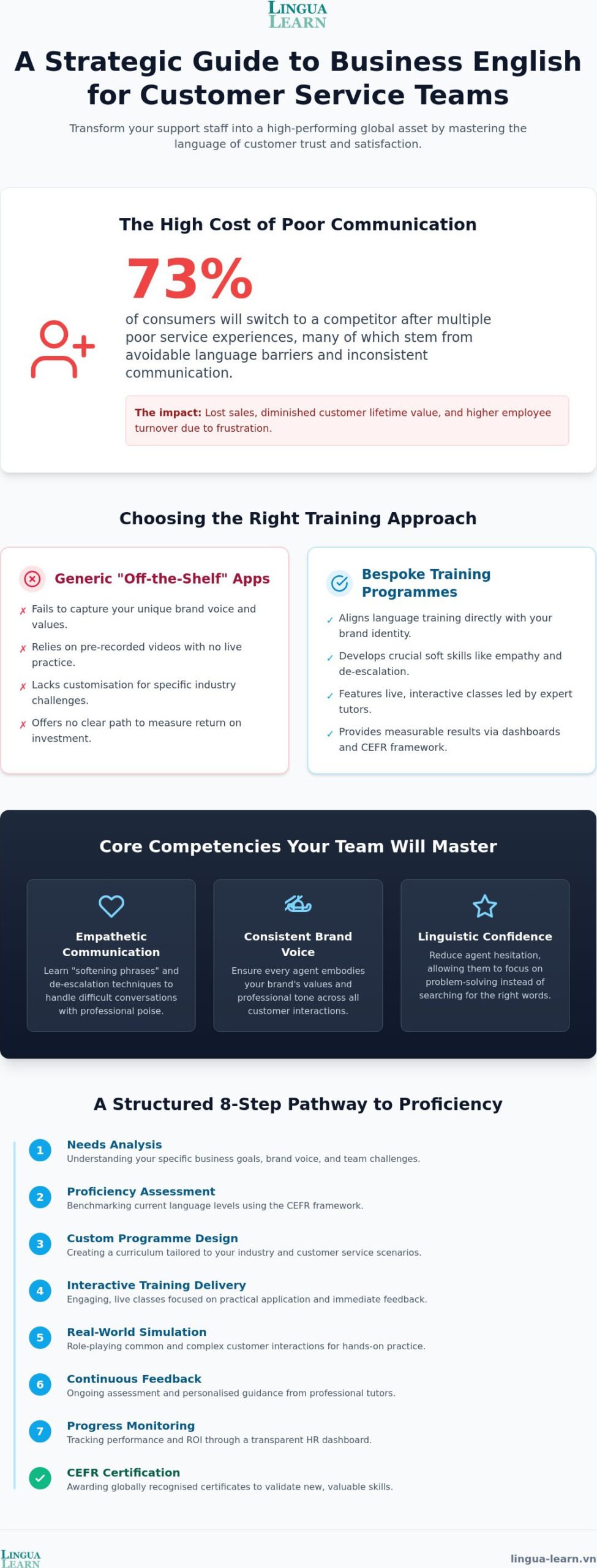
Implementing a successful programme for business English for customer service teams requires more than just a series of lessons; it demands a structured, methodical approach that aligns with your specific industry needs. At Lingua Learn Vietnam, we provide a Đào Tạo Ngôn Ngữ Doanh Nghiệp solution that is designed to be both low-friction and high-impact. Our process begins with a deep-dive Needs Analysis, where we examine the specific communicative challenges your team faces daily. Whether your agents are dealing with technical troubleshooting or luxury retail enquiries, the curriculum is built from the ground up to reflect those realities. This ensures that every hour spent in training translates directly into improved workplace performance.
All our live sessions are delivered by qualified, native-speaking instructors who act as dedicated mentors. They don’t just teach grammar; they model the professional behaviour and tone of voice that your brand requires. This human-centric approach, combined with UK-managed technology, ensures that your team receives a world-class education that is both engaging and academically rigorous.
Our “8-step Learning Pathway to Success” is a proven framework that ensures no detail is overlooked. This methodical journey includes:
This structured flow allows your team to learn exactly what they will use in their daily interactions, eliminating the fluff often found in generic courses.
Onboarding your team is remarkably simple. We provide one-click invitation links that allow agents to join their virtual classrooms directly through their web browser. There are no software downloads or complex IT installations required, which minimises the burden on your technical department. This seamless experience ensures that implementing business English for customer service teams is a smooth transition for both management and staff. If you’re ready to transform your team into a high-performing global asset, the first step is identifying their current proficiency levels. Our experts are ready to guide you through the initial assessment and design a pathway that fits your schedule and budget. To begin the transformation of your global service hub, enquire about customised business English for your team today.
Investing in your workforce is the most direct route to sustainable international growth. By choosing a bespoke approach over generic, off-the-shelf apps, you ensure your staff speaks with a unified brand voice that builds lasting customer trust. This guide has demonstrated how effective business English for customer service teams combines soft-skill mastery, such as empathy and de-escalation, with rigorous academic standards. Our UK-managed Learning Management System and CEFR-aligned reporting provide the transparency you need to track progress whilst watching your satisfaction scores climb. We’re proud to be trusted by global brands across Asia to deliver these transformative results.
Ready to empower your staff and standardise your service quality? Enquire about customised corporate English solutions for your team to begin your partnership with Lingua Learn Vietnam. We look forward to helping you turn your customer service department into a high-performing global asset.
A corporate solution is a bespoke, goal-oriented system designed to align with your specific brand values and operational needs. Whilst a generic course teaches general fluency and grammar, our corporate training focuses on your unique tone of voice and industry-specific vocabulary. We use a detailed Needs Analysis to ensure the curriculum reflects the real-world scenarios your agents face daily rather than abstract textbook examples.
We provide objective measurement through a real-time HR dashboard and the global CEFR framework. This technology allows management to track attendance, engagement, and assessment scores with total transparency. By comparing initial pre-assessments with final exam results, you can see a measurable “learning delta” that clearly demonstrates the return on your training investment.
Yes, our 8-step Learning Pathway includes a dedicated curriculum design phase for industry-specific requirements. Whether your team needs the precise, formal register required for international banking or the warm, proactive language of luxury hospitality, we tailor the role-play scenarios and vocabulary accordingly. This ensures the training is immediately applicable to your team’s specific professional context.
Live interactive online training is often more effective for modern teams because it integrates seamlessly with the digital tools they use daily. Our proprietary LMS facilitates real-time practice and recorded sessions, which are invaluable for internal quality audits. This format provides the same level of engagement as a physical classroom whilst offering greater flexibility and lower logistical overheads.
Moving up a full CEFR level typically requires between 100 and 200 hours of guided instruction, depending on the learner’s starting point and the intensity of the course. However, when implementing business English for customer service teams, we often observe significant gains in specific soft skills, such as de-escalation and empathy, much earlier in the programme through targeted, high-impact modules.
Our virtual classrooms are browser-based, so your team won’t need to download any software or manage complex installations. Agents simply require a stable internet connection, a headset with a microphone, and a webcam to participate. This low-friction approach ensures that your staff can join their sessions from existing workstations without compromising your internal IT security protocols.
Soft skills are the foundational pillars of our service-oriented curriculum. We move beyond basic grammar to teach agents how to deploy “Power Words” that build trust and empathetic phrasing that validates customer concerns without admitting fault. These techniques are essential for managing high-heat interactions and ensuring your team maintains professional poise during stressful customer enquiries.
Every instructor at Lingua Learn Vietnam is a highly qualified, native-speaking professional with extensive experience in corporate training environments. They are specifically vetted for their ability to teach business English for customer service teams, acting as knowledgeable mentors who can model the professional behaviour and linguistic precision your global clientele expects.

Article by
Rob Holloway
Rob Holloway is the CEO of Lingua Learn Elevate Ltd (UK), the company operating Lingua Learn Vietnam. He works with businesses and organisations across Asia to provide high-quality online language training, corporate communication programmes and internationally recognised language certification preparation. Working with organisations across industries including engineering, finance, technology, manufacturing and professional services, Rob helps identify language training needs and connect clients with tailored learning solutions delivered by Lingua Learn’s experienced academic team. His professional focus includes corporate language training, business communication, cross-cultural communication, international education partnerships and helping organisations build the language skills needed to succeed in global business environments. Through Lingua Learn Vietnam, Rob is committed to providing UK-managed online language training delivered by qualified instructors, helping professionals and organisations communicate with confidence in today’s international workplace.
 Vietnamese
  English (UK)